A Hundred Billion Dollar Market! When Will the 'Golden Age' of Agentic AI Arrive?
 08/28 2026
 510
510
In the past few years, the rapid development of generative AI has shown enterprises the immense potential of large models in scenarios such as content generation, knowledge Q&A, and office collaboration. However, as applications deepen, enterprises' expectations for AI are changing. They are no longer satisfied with AI simply answering questions but hope it can understand goals, break down tasks, call upon tools, coordinate resources, and ultimately autonomously complete complex business processes. Thus, Agentic AI (agent-based artificial intelligence), capable of reasoning, planning, and acting, has become the new focal point of competition in the next phase of the AI industry.
Market growth expectations also confirm this trend. According to recently released data from MarketsandMarkets, the global Agentic AI market is expected to grow from USD 7.06 billion in 2025 to USD 93.2 billion by 2032, with a compound annual growth rate (CAGR) of 44.6% during the forecast period. Behind this rapid growth, more and more organizations are beginning to leverage AI agents to enhance operational efficiency, accelerate decision-making, and boost the productivity of knowledge workers.
Earlier this year, at the Cisco AI Summit, Cisco's CEO predicted, 'We believe 2026 will be a turning point for artificial intelligence, and we believe it will be the first year of Agentic AI applications.' This statement also represents the industry's high expectations for the speed of Agentic AI implementation. As 2026 is now more than halfway through, is Agentic AI, which has been highly anticipated, delivering on its promises? What key progress has been made this year in enterprise application scenarios and business model exploration? What challenges still need to be overcome? This article provides a comprehensive overview.
Key Progress: Application Scenarios and Business Models Gradually Mature
Traditional IoT systems primarily focus on event perception and reporting, while Agentic AI further achieves environmental understanding and autonomous action. For example, when a smart smoke detector detects smoke, a traditional IoT system sends an alert to the user, whereas an Agentic AI system can further assess the risk level, automatically unlock smart door locks, shut down HVAC systems, activate sprinkler systems, notify the fire department, and guide personnel to evacuate to a safe area—all without human intervention.
Application Scenario Implementation
Thanks to this advantage, in industries with higher demands for real-time decision-making and automated execution, such as manufacturing, energy, and supply chains, enterprises are beginning to enable AI agents to connect data, understand business goals, and autonomously complete analysis, judgment, and execution.
The maturity of industrial intelligent AI applications has significantly improved in the past two years. At the 2026 Hannover Messe, Tulip, a U.S.-based industrial technology company, collaborated with Cognite, a Norway-based industrial software company, and AWS, a hyperscale cloud service provider, to demonstrate multi-agent troubleshooting technology: The Cognite Atlas AI agent (supported by Cognite Data Fusion's industrial knowledge graph) passes rich contextual data to Tulip's frontline operation and maintenance agent. The Cognite agent uses industrial context to identify issues, while the Tulip agent translates them into actionable workflows for frontline workers in real-time.
Also at the event, SAP showcased how its AI agents help manufacturers and operators shorten time-to-value, stabilize operations, and enhance service levels. Among them, the production planning and operations agent enables planners to place production orders using natural language while automatically verifying material availability, capacity, and scheduling constraints. The agent provides suggestions, such as alternative components or rescheduling options, for planners to review and approve, reducing manual workload and aligning production plans with actual conditions.
At the 2026 Dortmund Maintenance Show, IFS Ultimo demonstrated an intelligent module capable of independently identifying safety-related content in technicians' daily reports and automatically generating a separate, compliant safety incident record without human intervention.
Beyond industry, progress in cold chain use cases is also noteworthy. We know that millions of doses of vaccines, pharmaceuticals, and fresh food circulate globally in supply chains every day. Traditional IoT systems can monitor temperature and send alerts when anomalies occur, but often, by the time issues are detected, products may already be at risk of loss. To address such challenges, some enterprises are leveraging Agentic AI to further analyze problem causes, automatically adjust transportation routes, optimize refrigeration systems, arrange equipment maintenance, and update delivery plans. By taking action before products spoil, they help logistics companies reduce waste, lower costs, and enhance the reliability of transporting temperature-sensitive products.
Business Model Exploration
As Agentic AI transitions from the experimental phase to large-scale application, the industry is also confronting another key question: How to establish sustainable business models?
In the past, many AI products adopted free trial or pay-per-call models, hoping to drive ecosystem development by expanding user scale. However, for enterprise customers, once AI agents enter production environments, they often involve more complex model calls, longer task chains, and higher inference costs. How to provide customers with predictable ROI has become a question AI suppliers must answer.
A report from IoT research firm IoT Analytics points out an observed trend: Over the past two years, industrial software suppliers have added dozens of driver assistance/aids to their solutions, often offered as free trials. However, suppliers are now ending the initial free trial phases of these solutions and actively implementing commercialization and monetization models for their generative AI and intelligent agent AI capabilities.
Siemens' exploration of the Eigen Engineering Agent business model provides a reference for the industry. The product adopts a subscription model, offering services through user licensing, helping enterprises plan AI investments with clear annual fees. According to Siemens' Digital Exchange platform information, the subscription price for Eigen Engineering Agent is €2,100 per user per year.
Overall, the key to future Agentic AI competition lies not only in model capabilities but also in a comprehensive competition of 'scenario understanding, industry knowledge accumulation, system integration capabilities, and business model design capabilities.'
Key Challenges: Cost and Technological Issues Persist
As Agentic AI moves from proof-of-concept to large-scale application, the industry is gradually realizing that this transformation is not without resistance. Compared to traditional AI applications, agents need to autonomously execute complex tasks. This means that while enterprises gain stronger intelligent capabilities, they must also face higher technological costs and more complex system challenges.
First, cost issues are becoming the primary challenge for large-scale Agentic AI implementation.
According to Gartner, a business and technology insight firm, while model prices continue to decline, providing cost space for more complex workflows, the overall cost of using AI is steadily rising. By 2028, AI inference costs per agent workflow will increase more than fivefold.
This assertion is based on Gartner's summary of three fundamental trends in the token economy: ① The cost-effectiveness of foundational models is rapidly improving. ② AI efficiency gains are driving enterprises to deploy more powerful and costly models to support higher-value, more complex AI applications. ③ More complex AI workflows consume far more tokens than simple chatbot interactions, driving up overall AI inference costs.
These trends mean that while the unit cost of tokens is indeed becoming more economical, its decline rate cannot keep pace with the growth in AI capabilities and the associated cost increases (as shown below).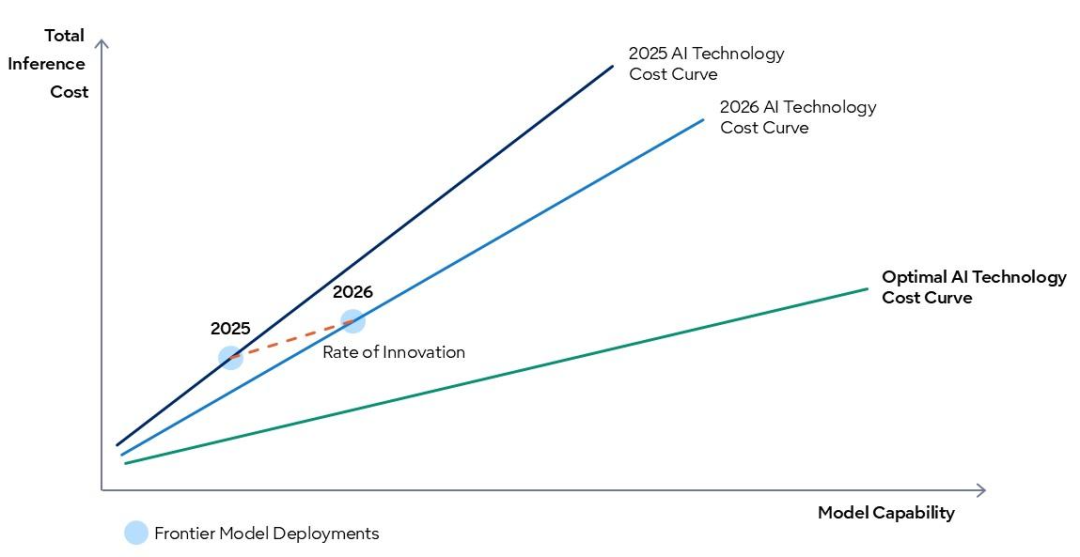
In other words, the speed of AI innovation is outpacing the decline of cost curves. To ensure that advanced AI technologies like inference agents generate a return on investment (ROI), enterprises either need to achieve exponentially higher returns compared to foundational models or must match complex tasks with more cost-effective and efficient AI capabilities through highly optimized inference tiering, model routing, and orchestration mechanisms. Both paths are entirely feasible but require significant optimization efforts for complex workflows.
Second, there is an inherent technological gap between GenAI and industrial IoT, which must be addressed for Agentic AI to enter the industrial sector.
The core logic of industrial IoT (IIoT) is built on determinism. Industrial equipment, production processes, and control systems typically follow strict physical laws and engineering logic. If you send a signal to a PLC (programmable logic controller) to open a valve, it will open the valve—every time. It follows strict logic: IF X > 100, THEN STOP. This predictability is the cornerstone of safety standards in manufacturing, energy, and logistics industries.
However, generative AI operates in a probabilistic real-world. Large language models (LLMs) do not truly 'know' facts but predict the next most likely token in a sequence based on statistical patterns. Even the most advanced models today (such as GPT-4, Gemini, Claude 3) operate more like creative improvisers than strictly logical controllers. They excel at information integration, content generation, and complex reasoning but are also prone to 'hallucination' issues—stating incorrect information with high confidence or constructing logical paths that do not actually exist.
Consider a scenario in a chemical production plant where Agentic AI is directly integrated into the control loop.
Input: AI analyzes equipment vibration sensor data, temperature records, and pressure monitoring data.
Hallucination: The AI mistakenly interprets a noisy sensor reading as a severe blockage problem. Instead of recommending staff inspection, it 'infers' a solution—increasing pipeline pressure to clear the blockage.
Action: Since the AI has 'write access' to the PLC, it directly executes this control instruction.
Outcome: The pipeline ruptures, causing equipment downtime, safety risks, and significant repair costs.
In the digital world, erroneous operations can often be undone with an 'undo' button; however, in the physical world, there is no simple 'Ctrl+Z' to restore a damaged motor, ruptured pipeline, or affected production line.
Nevertheless, this challenge is not insurmountable. Based on an analysis of over 200 B2B AI deployment projects, a clear trend is emerging: The most successful and safest AI projects adopt a common philosophy—enterprises do not treat AI agents as 'commanders' but as highly intelligent 'sensors.' This is known as the 'Read-Only Protocol.'
This architecture decouples AI's reasoning capabilities from actual execution capabilities: AI can access data, understand the environment, analyze problems, and make suggestions but does not directly control critical physical systems. In this way, enterprises can fully leverage generative AI's strengths in data understanding, anomaly analysis, and decision support while avoiding direct impact on industrial equipment operation by probabilistic models, thereby establishing a balance between intelligent innovation and industrial safety.
In Closing
From 'thinking' to 'acting,' Agentic AI is driving AI into a new phase of development. However, this transformation also reminds the industry that the endpoint of AI intelligence is not merely pursuing more powerful models but enabling intelligent capabilities to truly integrate into business processes and create measurable value in real-world environments.
In the future, the development of Agentic AI will be a comprehensive competition encompassing models, data, computing power, industry knowledge, and systems engineering capabilities. Especially in critical areas like industrial IoT, how to safely synergize AI with probabilistic reasoning capabilities and physical systems emphasizing determinism will be the key to determining the depth of industrial implementation. For enterprises, Agentic AI may not replace existing automation systems overnight, but it is becoming a new intelligent layer connecting data, devices, and decision-making. As technology continues to mature, those enterprises that can first find the balance between intelligence and reliability will be more likely to seize the initiative in the next wave of intelligent transformation.
References: Agentic AI Market Surges to $93.20 billion at a CAGR 44.6% by 2032 | Report by MarketsandMarkets™——yahoo finance
Gartner Predicts AI Inference Costs Per Agentic Workflow Will Increase More Than Fivefold Through 2028——Gartner
Mid-2026 industrial AI pulse check: Is this the year of agentic AI?——iot analytics
Agentic AI in the Physical World: The “Read-Only” Safety Protocol for Industrial IoT——iotforall
The Agentic IoT Opportunity: How Autonomous AI Agents Are Creating the Next Billion-Dollar Products——iotforall
'Physical AI' Sweeps Through Hannover Messe 2026——IoT Intelligence Institute
-
![]()
It's Hard to Build Cars, Even Harder to Build Humans, and XPENG is Doing Both
-
![]()
Valuation Soars by $57 Billion: Three Entrepreneurs Born in the 1980s Forge an AI Unicorn Now Suddenly on the Market
-
![]()
How Can We Achieve the Goal of 100,000 Hydrogen Vehicles by 2030?
-
![]()
July Online Market for Consumer-Grade Sports Cameras: Robust Double-Digit Growth in Sales Volume and Value, Mid-Range Products Fuel Market Expansion
-
![]()
A Hundred Billion Dollar Market! When Will the 'Golden Age' of Agentic AI Arrive?
-
![]()
Changzhou’s Wealthiest Woman Faces Unexpected Setback
-
![]()
FAW Seeks Efficiency Gains, Leapmotor Accelerates Expansion
-
![]()
Dual Leaders in Robot Vacuum Industry Look Overseas for Growth