Changzhou’s Wealthiest Woman Faces Unexpected Setback
 08/28 2026
 498
498
Author | Gao Linglang Editor | Ai Qingshan
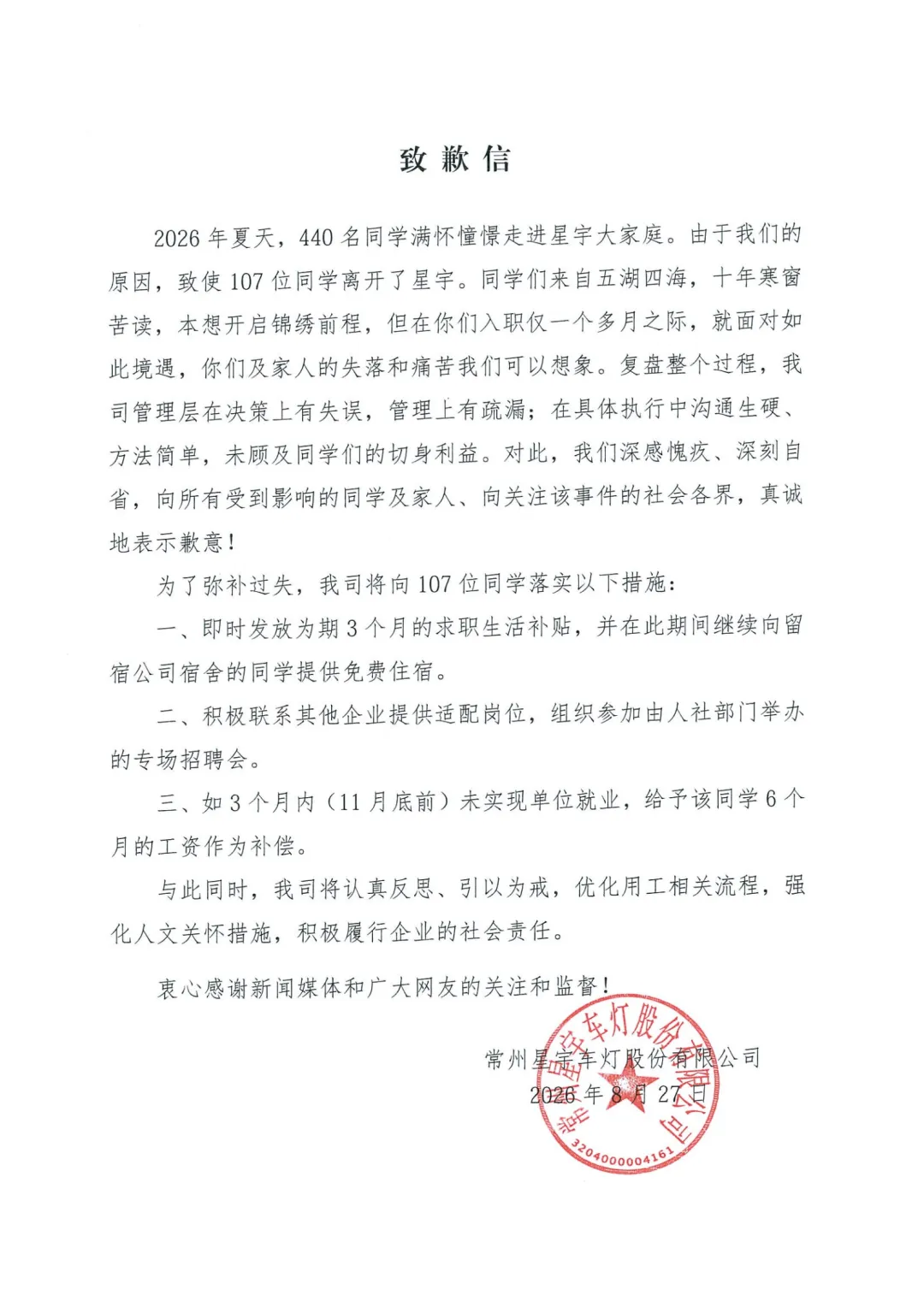
On the morning of August 27, Changzhou Xingyu Automotive Lighting Systems Co., Ltd. issued an apology letter, announcing that it would offer a three-month job-hunting subsidy, free accommodation during this period, and an additional six-month salary to 107 fresh graduates whose contracts had been terminated if they remained unemployed by the end of November.
The day before the apology, the company released its semi-annual report for 2026, revealing a mere 1.87% increase in revenue, while net profit attributable to the parent company saw a 5.26% year-on-year decline.
Coincidentally, this contract termination controversy arose at a critical moment, as Xingyu was making its second attempt at an IPO on the Hong Kong Stock Exchange (HKEX).

According to multiple media sources, during the 2025 autumn recruitment season, Xingyu primarily hired around 400 master’s graduates from non-double first-class universities. By July 2026, approximately 440 had officially joined the company.
Upon joining, these graduates were initially assigned a one-month production line internship, with the company stating at the time that they would be transferred to their respective positions upon completion.
However, less than a month into their employment, around August 8, Xingyu’s HR department began meeting with these new hires in batches, citing a challenging market environment and operational issues as reasons for the changes.
The options presented were stark: either sign to leave the company immediately and receive half a month’s salary as compensation, or stay and be reassigned to production line operator roles—also known online as "screwing"—with the original one-month internship extended to three months and salaries recalculated based on ordinary workers’ pay.
According to National Business Daily, some students reported that during HR discussions, there were hints that HR personnel across Changzhou were interconnected, and non-cooperation in signing could affect future background checks when changing jobs, which many students perceived as indirect pressure.
Ultimately, about 70% of the students chose to sign and leave. The original onboarding group of over 400 people was reduced to around 120 members.
On August 25, after the incident went viral online, the Changzhou Human Resources and Social Security Bureau issued a notice confirming that Xingyu had recruited 440 fresh graduates from the class of 2026, with 107 having their labor contracts terminated. The notice stated that the negotiation process was overly simplistic and blunt, with insufficient communication, and the company’s HR director had been suspended. It also clarified that an investigation found no irregularities in the company’s receipt of employment and talent subsidies.
As of the notice’s release, 22 of the 107 individuals had already secured new jobs, and 14 were attending interviews with other companies.
A lawyer interviewed by the media stated that forcing employees to choose between resignation and reassignment is essentially a disguised unilateral termination of the labor contract. The company’s reliance on a poor market environment as a reason does not meet the legal conditions for unilateral termination during the probationary period under the Labor Contract Law.
For these students, the greatest loss may not be the half-month salary but the forfeiture of their fresh graduate status, which essentially disqualifies them from civil service exams, institutional recruitment, and campus recruitment channels in the future—a status that cannot be regained once lost.

Xingyu is not short of cash, so why did it choose this particular time to lay off a large number of new employees? Clues can be found in the semi-annual report.
In the first half of this year, the company’s revenue was 6.884 billion yuan, up only 1.87% year-on-year, while net profit attributable to the parent company was 669 million yuan, down 5.26% year-on-year. The company attributed this to sluggish domestic sales of passenger vehicles downstream, lower-than-expected sales of some supporting models, and rising raw material prices.
Compared to the first quarter, when revenue and net profit growth rates were both double-digit (10.84% and 10.26%, respectively), the growth had already slowed significantly from the 28.28% and 32.68% increases seen in the same period last year. By the second quarter, the downward trend had worsened further.
Looking at a longer timeline, Xingyu’s employee structure has been evolving in recent years.
According to the company’s annual reports, the number of on-the-job employees decreased from 10,426 at the end of 2024 to 7,532 at the end of 2025, a reduction of nearly 2,900 people. During the same period, the number of production personnel increased from 3,650 in 2022 to 7,911 in 2024, more than doubling, while the number of technical personnel decreased from 2,649 to 1,734, a reduction of more than 30%.
Corresponding to these changes was a significant increase in the use of labor outsourcing, with outsourced working hours rising from 2.384 million in 2022 to 10.874 million in 2025, and total outsourcing compensation increasing from 65.727 million yuan to 302 million yuan.
These figures suggest that Xingyu has been replacing formal employees and technical positions with outsourced workers and ordinary operators in recent years to reduce labor costs.
Beyond the semi-annual report figures, the HKEX IPO timeline also collided with this controversy. Xingyu first submitted its listing application to the HKEX on January 26 this year, with the prospectus expiring on July 26. It resubmitted the application on July 29, just one week before the mass interviews with fresh graduates erupted.
On August 14, Xingyu received a notice from the China Securities Regulatory Commission regarding its overseas listing, approving the issuance of no more than 44.8 million H shares. A lawyer analyzed that this labor dispute, involving a significant number of people and high public attention, may trigger inquiries from the HKEX regarding labor compliance and lower the company’s ESG score. While it may not directly halt the listing process, it could slow down the review.
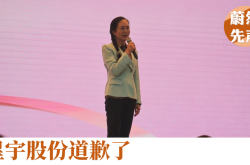
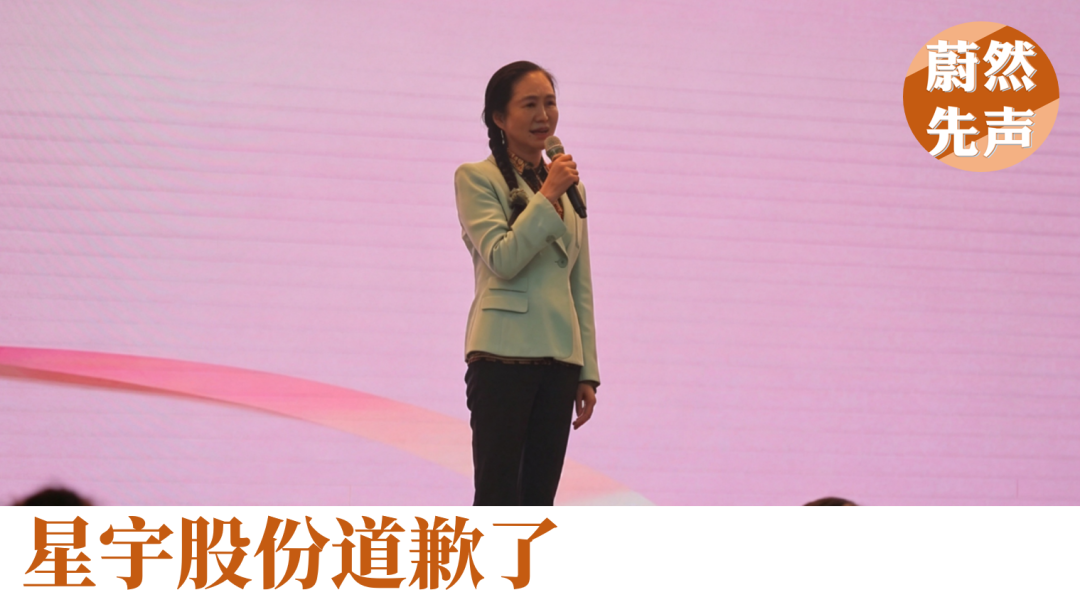
For the actual controller, Zhou Xiaoping, the impact of this controversy is also substantial. She left her position as a health school teacher in 1993 and, with 360,000 yuan raised with her father, started Xingyu Automotive Lighting Factory. She grew the company into the largest domestic automotive lighting manufacturer and the seventh-largest globally, with her personal wealth once reaching the top spot among Changzhou’s wealthiest women.
However, according to the 2026 New Fortune 500 Rich List, her net worth has shrunk from 31.68 billion yuan in 2022 to 19.14 billion yuan.
Whether this controversy will further affect the progress of the HKEX listing remains to be seen, depending on the follow-up verification results from the Changzhou labor inspection authorities.
Disclaimer: The content of this article is for reference only. The information or opinions expressed herein do not constitute any investment advice. Readers are advised to make investment decisions cautiously.
-
![]()
Changzhou’s Wealthiest Woman Faces Unexpected Setback
-
![]()
FAW Seeks Efficiency Gains, Leapmotor Accelerates Expansion
-
![]()
Dual Leaders in Robot Vacuum Industry Look Overseas for Growth
-
![]()
BYD: The Giant That Rose Again
-
![]()
Claude Finally Integrates a Built-in Browser! Doubao Work Beat It to the Punch—Can Qianwen Catch Up?
-
![]()
Cars Are Expanding: Will Class A Vehicles Be Phased Out as Class B Models Approach the 100,000 Yuan Threshold?
-
![]()
Xiaopeng Faces Two 'Tough Battles'
-
![]()
NVIDIA: Projected to Surge by Another 70% Next Year, the Computing Power 'Central Bank' Ramps Up Production!