FAW Seeks Efficiency Gains, Leapmotor Accelerates Expansion
 08/28 2026
 446
446

The Second Path to Scaling Up
Original content by Autopix (ID: autopix)
When FAW Group and Leapmotor inked their initial agreement in March of the previous year, they outlined three key collaboration areas: co-developing new energy passenger vehicles, joint component development, and exploring capital partnerships.
In the automotive sector, such broad strategic frameworks are commonplace. They can either signal the start of a lasting partnership or remain mere ceremonial gestures.
Seventeen months on, the duo has sealed three agreements. By the end of last year, FAW had acquired approximately 5% of Leapmotor's shares for RMB 3.744 billion, while its subsidiary, Qixin Power, entered into a powertrain collaboration with Leapmotor. This August, their cooperation widened to encompass ten domains, including complete vehicles, assisted driving systems, power batteries, intelligent chassis, embodied intelligence, and body process equipment.
Simultaneously, progress on two projects was unveiled. The first jointly developed model is poised for mass production, and Qixin Power's hybrid engine will power Leapmotor's global lineup.
FAW is integrating Leapmotor's technology into its Hongqi brand, while Leapmotor is incorporating FAW's engines into its global models, thereby establishing each other as pivotal partners.
01 Leapmotor's Second Path to Scaling Up
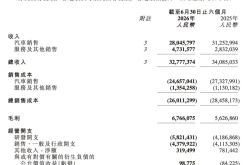
On August 24, Leapmotor reported its interim results. In the first half of 2026, it delivered 356,500 vehicles, marking a 60.8% year-on-year increase; revenue soared to RMB 38.11 billion, up 57.2% year-on-year; and net profit reached RMB 210 million. In July, Leapmotor's monthly deliveries surpassed 100,000 units for the first time.
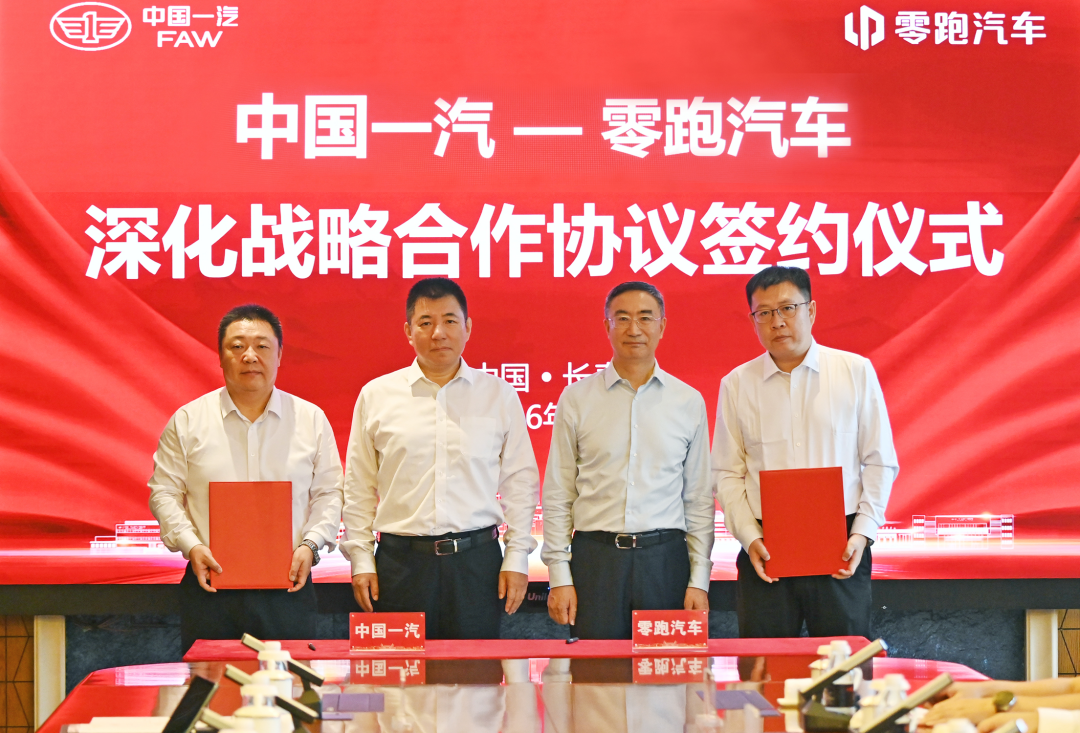
On the same day, Leapmotor and FAW signed a deepened strategic cooperation agreement in Changchun.
The two sides first signed a memorandum of understanding in March last year, agreeing to co-develop new energy passenger vehicles, collaborate on components, and explore capital cooperation. By the end of last year, FAW had subscribed to 74.83 million domestic shares of Leapmotor at RMB 50.03 per share, investing RMB 3.744 billion for an approximately 5% stake. FAW's subsidiary, Qixin Power, simultaneously signed a powertrain cooperation agreement with Leapmotor.
The agreement finalized in August this year marks the third signing between the two sides within 17 months. Notably, projects from the first two rounds have progressed to the delivery stage. Li Tengfei, Vice President of Leapmotor, previously mentioned that the first collaboration project involved Hongqi's overseas models. The latest disclosure confirms that this model is set for mass production.
Through this partnership, FAW gains access to a market-proven new energy platform, along with its derived electronic electrical architecture, battery, chassis, and component systems. Compared to initiating a new development project, collaborating with Leapmotor accelerates the time-to-market for a new energy vehicle model.
Leapmotor's benefits are multifaceted: RMB 3.744 billion in investment, Qixin Power engines, FAW's industrial resources, and a significant external customer.
Financially, Leapmotor is well-funded. By the end of June this year, it held RMB 38.59 billion in cash, time deposits, and financial assets. Its operating cash flow for the first half of the year was RMB 2.17 billion, remaining positive.
However, for a new energy vehicle company aggressively pursuing globalization, cash remains a crucial safety net for future strategies. In the first half of this year, Leapmotor's capital expenditures reached RMB 2.03 billion, with an additional RMB 7.76 billion in capital commitments, primarily for factory equipment and new model production lines.
According to the subscription plan, about half of FAW's investment will be allocated to R&D, with the remainder used to supplement operating funds, expand the sales and service network, and enhance brand building.
Leapmotor's need for sustained investment is intrinsically linked to its competitive strategy.
The company's self-developed and self-manufactured high-value core components account for roughly 65% of total vehicle costs, with a platform generalization rate exceeding 88%. It has established 18 core component factories. Battery packs, electric drives, domain controllers, electronic electrical architectures, and chassis control systems are reused across different models, spreading R&D expenses, molds, and production equipment costs over a larger volume of vehicles.
This vertical integration enables Leapmotor to control costs, allowing it to rely on a "cost-based pricing" strategy for long-term competition against much larger rivals. However, it also increases the company's fixed costs. Self-built production lines require stable orders, and the R&D team must continuously launch new platforms. Factory capacity utilization directly impacts per-unit profits.
In 2025, Leapmotor first experienced the benefits of scale. Annual sales doubled, revenue grew by 101.3%, while selling, general, and administrative expenses combined grew at a slower pace, reducing the expense ratio from 19.1% to 15.2%. Leapmotor thus crossed the annual breakeven point.
In the first half of this year, Leapmotor's product portfolio and scale continued to expand. The A-series entered lower price segments, the D-series expanded upward, and overseas networks further developed. The resulting performance was significant, with Leapmotor's sales growing by 60.8%.
However, sales growth also necessitated new R&D, manufacturing, and sales investments. Leapmotor's gross margin for the first half of the year was 11.7%. The company attributed the limited improvement in gross margin to raw material price increases and changes in the model mix.
As sales expanded, revenue and profit growth rates began to diverge. Relying solely on Leapmotor-branded sales means all fixed investments must be recovered through its own models.
External customers offer an alternative path for cost amortization.
FAW's procurement of Leapmotor's batteries, domain controllers, or chassis systems can enhance the utilization rate of component factories; joint models can amortize platform R&D and engineering validation investments; and as the same architecture is adopted by more products, Leapmotor's own models can also achieve lower costs.
Leapmotor has previously supplied components and technology to some external customers. FAW represents a higher volume and stricter requirements. Entering mass production projects of a large automotive group requires passing complete R&D processes, quality standards, durability verification, and continuous supply assessments.
After the successful mass production of the first model, Leapmotor will gain a case study of a major domestic automaker adopting its vehicle platform and core technologies.
Qixin Power's engines represent a reverse supply. Leapmotor has not built its own engine system and has long relied on externally sourced engines for its extended-range models, with suppliers including Dongan Power, Xiaokang Power, and Geely's Aurora Bay. Qixin Power's inclusion in Leapmotor's global models meets real demand and provides Leapmotor with additional supply options.
The engine market already offers multiple mature solutions, leaving Leapmotor with choices. The new energy platform and product efficiency that FAW needs are harder to rebuild in the short term. The bidirectional procurement in the agreement creates a closed-loop cooperation, but the scarcity of resources invested by both sides still differs.
02 Why the Growing Closeness with FAW?
FAW is Leapmotor's second major strategic shareholder among vehicle manufacturers.
In 2023, Stellantis invested approximately EUR 1.5 billion to acquire about 20% of Leapmotor's shares. The two sides subsequently established Leapmotor International, with Stellantis holding a 51% stake, responsible for sales and production of Leapmotor vehicles in global markets outside Greater China.
The revenue from this cooperation is already evident in Leapmotor's financial statements.
In the first half of this year, Leapmotor exported 96,300 vehicles, marking a 372.6% year-on-year increase, surpassing total exports for 2025 and accounting for 27% of total deliveries. European revenue rose from RMB 1.85 billion last year to RMB 8.88 billion; Leapmotor International established over 1,000 sales and service outlets across 45 overseas markets, including over 900 in Europe.
Overseas sales also generated carbon credit revenue. Leapmotor's service and other revenue increased from RMB 1.15 billion to RMB 2.51 billion in the first half of the year, up 118.3% year-on-year. The financial report attributed this growth mainly to carbon credit transactions driven by increased overseas sales.
Stellantis initially assisted Leapmotor in selling cars, providing channels and after-sales resources for Leapmotor's overseas sales. Now, cooperation has extended to components and platforms.
The two sides announced plans in May this year to produce the B10 at Stellantis' Zaragoza plant in Spain and evaluate a new Opel C-segment pure electric SUV. Information released by Opel indicates that the new model plans to adopt core components of Leapmotor's latest pure electric architecture and battery technology while retaining Opel's design, chassis, cabin, and seating systems.
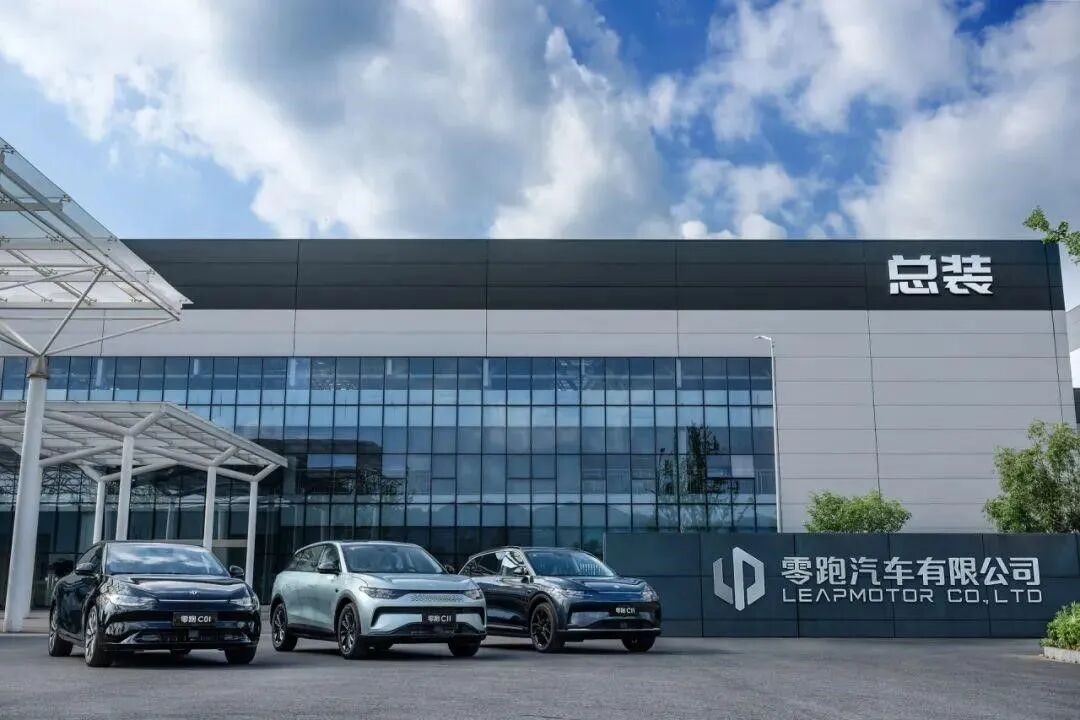
Leapmotor's relationship with Stellantis has evolved from channel borrowing to technology supply. The Opel project provides a vivid example: Leapmotor's architecture and batteries can supply new energy core components to international clients beyond its own branded products.
FAW and its influential brands represent a full-scale test of this cooperation model in the Chinese market. The mass production of the jointly developed Hongqi model indicates that Leapmotor's platform has completed adaptation to another set of product definitions, development processes, and quality systems; collaborations on batteries, assisted driving, and intelligent chassis extend single-model projects to repeatable component supply.
Supplying core components can directly generate revenue. In the current market environment, profits may not necessarily be lower than those from complete vehicles.
More critically, Leapmotor's strategy of high self-research and cost-based vehicle pricing relies heavily on scale. It determines how quickly Leapmotor can amortize costs and R&D expenses over time.
Previously, scale could only be achieved through increased vehicle sales. With the opening of component supply to external customers, future scale can be achieved through new avenues. As the same platform and core components enter other brands, the denominator for scale can expand from Leapmotor's sales volume to the total installed base of Leapmotor's technology.
Leapmotor's financial reports still disclose vehicle and component revenues together, with related revenue reaching RMB 35.6 billion in the first half of the year. The second path to scaling up has not yet formed a separate category, but clearer evidence comes from the product plans of Hongqi and Opel.
As the industry enters a knockout phase, scale becomes self-reinforcing. Procurement volume determines component costs, sales volume determines R&D amortization, and cash flow determines the next round of investment.
Zhu Jiangming, Leapmotor's founder, once said the company aims to be the "Uniqlo" of the automotive industry. Previously, this metaphor referred to a highly generalized platform, vertical integration, and increased sales volume. Now, it has taken on an additional layer of meaning.
Leapmotor crossed the breakeven line with its first path to scaling up. However, the second path represents its resilience in the next round of competition.
This article is original content by Autopix (autopix). Unauthorized reproduction is prohibited.
-
![]()
Changzhou’s Wealthiest Woman Faces Unexpected Setback
-
![]()
FAW Seeks Efficiency Gains, Leapmotor Accelerates Expansion
-
![]()
Dual Leaders in Robot Vacuum Industry Look Overseas for Growth
-
![]()
BYD: The Giant That Rose Again
-
![]()
Claude Finally Integrates a Built-in Browser! Doubao Work Beat It to the Punch—Can Qianwen Catch Up?
-
![]()
Cars Are Expanding: Will Class A Vehicles Be Phased Out as Class B Models Approach the 100,000 Yuan Threshold?
-
![]()
Xiaopeng Faces Two 'Tough Battles'
-
![]()
NVIDIA: Projected to Surge by Another 70% Next Year, the Computing Power 'Central Bank' Ramps Up Production!