From AR Bubble to AI Boom: Rokid Faces a Pivotal Battle
 06/29 2026
 571
571
Fourteen years ago, a live-streamed skydiving event at a conference introduced Google's AR glasses concept to the public for the first time, convincing Zhu Mingming, then deeply involved in cutting-edge technologies, that AR glasses would become the next best product form for human-computer interaction after PCs and smartphones.
Two years later, he left Alibaba to found Rokid, diving headfirst into the then-uncharted AR arena.
During the years when photonic waveguide technology was immature, terminal battery life was a constraint, and consumer scenarios were largely absent, AR quickly went from a capital darling to a neglected niche, with many startups quietly exiting.
Rokid pivoted through smart speakers, industrial AR, and cultural tourism solutions, patiently awaiting the industry's turning point. The advent of general-purpose large models and AI finally filled in the long-missing practical scenarios for AR glasses, with a surge in demand for interactions like translation, meeting transcription, and real-world recognition, reviving the long-dormant sector.
According to multiple media reports, Rokid is actively advancing its plans to list in Hong Kong, with an internal target window set for July this year. Prior to this, Rokid has completed several capital preparation steps, including corporate restructuring and bringing in multiple industry chain companies for equity participation, covering optics, chips, batteries, and communications.
Yet, behind the prosperity lies intensifying competition. On one hand, leading AR glasses manufacturers are still mired in heavy losses; on the other, domestic smartphone and internet giants are rapidly entering the fray with mature ecosystems, while overseas, Meta has long monopolized the global market share, sparking a fierce "Hundred-Glasses Battle."
Having endured a decade-long winter to secure its place, Rokid must now answer capital market queries about profitability while defending its survival against encroaching giants.
In 2012, Google co-founder Sergey Brin took the stage wearing Google Glass, as engineers skydived from a San Francisco building, with the entire scene live-streamed to the conference via Google Glass, sparking global interest in wearable smart devices for the first time.
Among the audience was Zhu Mingming, then head of Alibaba's M Studio, leading explorations in deep learning and visual technology. Years later, he repeatedly expressed his conviction that AR would become the next-generation interaction platform after smartphones, with AR glasses being the best product form for human-computer interaction after PCs and smartphones.
Two years later, Zhu left Alibaba to start Rokid, betting on AR.
The industry atmosphere at the time was optimistic. In April 2014, Google Glass opened to public purchase, and a few months later, Microsoft unveiled HoloLens, hailed as the next computing platform after PCs and smartphones, pushing optimism to its peak. Many believed smartphones would eventually be replaced by AR devices.
But the boom was short-lived.
In early 2015, Google officially announced the withdrawal of Google Glass from the market; in the following years, Microsoft's HoloLens story gradually became clear, targeting enterprise and professional scenarios; Magic Leap, a U.S. AR company once Crazy pursuit (feverishly hyped) in the primary market with a valuation soaring to billions of dollars, also failed to deliver on its promises in subsequent product launches, leading to a collapse of its valuation narrative.
The entire AR industry fell into a multi-year slump.
The reasons were not complex. On one hand, core technologies such as display modules, photonic waveguides, chip performance, and battery life remained immature. A pair of AR glasses with true display capabilities often meant a heavier body, higher costs, and a poorer wearing experience.
On the other hand, even if technical issues were resolved, the industry still lacked compelling consumer scenarios. For most users, AR glasses priced at thousands or even tens of thousands of yuan still could not replace smartphones.
They looked cool but remained non-essential, leading capital markets to remain cautious about AR companies. Over the past decade, a large number of AR startups have disappeared in the industry winter.
Rokid, however, became one of the few survivors.
From smart speakers to AR glasses, from consumer markets to industrial scenarios, from cultural tourism displays to enterprise solutions, the company continuously adjusted its direction to secure survival.
The turning point came after 2023.
With breakthroughs in large model technology, AI began to imbue glasses with new value.
While AR glasses previously solved the problem of what to see, AI glasses now solve the problem of understanding the world and providing direct responses. Capabilities like real-time translation, meeting transcription, visual recognition, and intelligent Q&A began to create genuine usage scenarios for glasses.
The AR glasses industry regained capital attention.
Meta led the market validation, with Ray-Ban Meta sales continuing to grow; Google returned to the smart glasses arena; Chinese tech companies like Alibaba, Baidu, and Xiaomi successively entered, betting on AI glasses.
After more than a decade of waiting, the industry cycle finally reached a turning point, and Rokid ushered in its moment of capitalization.
In March 2026, the company completed its joint-stock transformation, clearing institutional barriers for its subsequent capital market listing. In the following months, Rokid successively brought in six industry chain companies—Huace Film & TV, Conant Optics, Haopeng Technology, Awinic Electronics, Fibocom, and Jingzhida—achieving full coverage of core industry chain links including content, optics, batteries, chips, communications, and testing.
After more than a decade of waiting, the AR glasses industry finally stood at the IPO threshold.
The biggest issue for AR glasses over the past decade has been the lack of a clear reason for consumers to wear them daily.
For those ten years, the industry's mainstream answer was optical display, using waveguide or Birdbath solutions to overlay digital information onto the real-world field of view, creating a what-you-see-is-what-you-get future computing experience.
But this approach carried a heavy burden. To accommodate optical engines, display modules, and optical components, products struggled to achieve both thinness, long battery life, and high image quality. As a result, AR glasses failed to win over the general public—they were novel but not user-friendly; they attracted geeks but could not retain ordinary users.
The industry had been waiting for a killer scenario until the emergence of large models injected soul into AR glasses. Rokid also adjusted its product path amid the AI boom.
In November 2024, Rokid officially launched its consumer-grade AI+AR glasses, Rokid Glasses. Weighing just 49 grams, the device abandoned the heavy optical engines of traditional AR devices, retaining only a minimalist display module to precisely deliver lightweight, high-frequency information such as speech draft prompts, real-time translation subtitles, and navigation arrows, paired with a dedicated smart ring for convenient page-turning control.
Unlike the industry's extreme approach of completely screenless designs, this product represented a compromise of lightweight body + localized practical display, precisely balancing daily wearability with practical functionality.
What truly propelled the product into the mainstream was a public exposure.
On February 18, 2025, at the Economic High-Quality Development Conference in Yuhang District, Hangzhou, Rokid founder Zhu Mingming delivered a speech entirely without notes while wearing Rokid Glasses, with the entire script projected in real-time onto the lens screen, allowing page-turning via the ring. No paper scripts or Lowering one's head and delivering a speech ( Look down at the prompt words ) were needed, making the practical scenario instantly understandable to the general public and showcasing the real-world value of AI glasses.
The video of Zhu Mingming delivering a speech without notes while wearing Rokid Glasses briefly went viral, allowing Rokid to break out of industry circles for the first time and achieve a critical leap in public recognition.
The buzz quickly translated into tangible market orders, with demand far exceeding internal company projections. Rokid's initial internal forecast for annual shipments in early 2025 was just 100,000–150,000 units. However, official data showed that Rokid Glasses sales surpassed 300,000 units in 2025, triple the original target.
At CES 2026, Rokid further iterated its product logic, launching the new screenless AI glasses, Rokid Style. Weighing 38.5 grams, the product completely removed the display module, returning to a pure AI perception and voice interaction route, relying on a dual-chip architecture and a 12MP Sony sensor to emphasize all-day wearability and 4K recording, directly competing with Meta's Ray-Ban in overseas markets.
Within the industry context, this is not just a Rokid story.
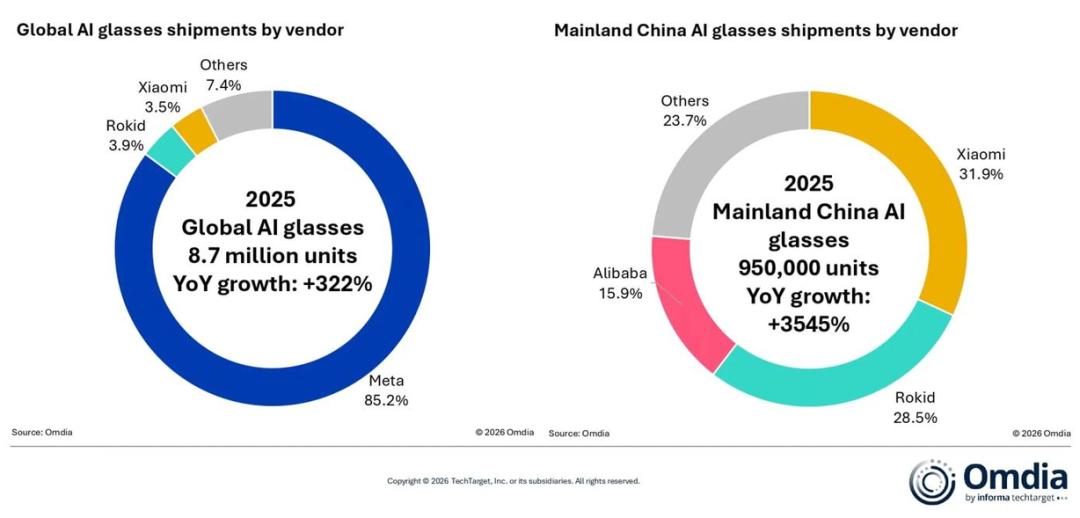
Omdia data shows that global AI glasses shipments surged 322% year-on-year in 2025, reaching 8.7 million units. More notably, the user base expanded to include broader professional groups such as businesspeople, civil servants, lawyers, and teachers.
The true watershed for AI glasses begins as such hardware products gradually reach the mainstream, marking the emergence of a genuine dividing line in the industry.
The story might seem to end on a happy note here. After a decade of freezing conditions, general-purpose AI large models have filled in the long-missing practical scenarios for AR glasses, with leading players like Rokid embarking on the path to capitalization, and the commercial narrative of the next-generation human-computer interaction gateway taking shape.
But the true knockout phase of the industry begins precisely at this moment when the industry cycle turns, as the "Hundred-Glasses Battle" engulfs both domestic and overseas markets.
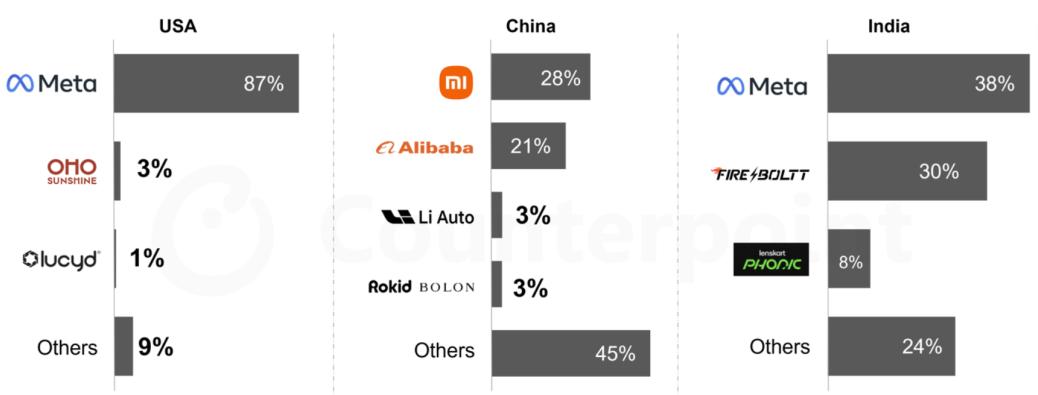
Leveraging its ecosystem approach, Xiaomi has already secured the top spot in domestic AI glasses shipments for 2025. According to the latest data from market research firm Counterpoint, Xiaomi ranked first with a 28% market share in domestic smart glasses shipments in Q1 2026.
Huawei officially launched its HarmonyOS AI glasses in April this year, leveraging HarmonyOS's cross-device collaboration capabilities to capture the business and mass consumer markets; Alibaba introduced its Qianwen AI glasses, deeply integrating with Alibaba's lifestyle service ecosystem; ByteDance has also planned to launch its Doubao AI glasses.
Xu Wu, a partner at ZhenFund, believes that the domestic smart glasses market has not yet moved beyond the "brand-driven" stage, with the primary audience being fans of the brands themselves. People are not buying AI glasses for their essential functions but out of trust in the brand or because they are already users of the brand's ecosystem.
This represents a natural weakness for startups like Rokid. Tech giants possess hundreds of millions of existing users, mature channels, and supply chain bargaining power, allowing them to quickly replicate similar products and erase technological first-mover advantages; meanwhile, Rokid has long focused on technology and product development, with its public brand recognition and ecological barriers still under construction, and its first-mover advantage shrinking.
Even more severe pressure comes from the fiercely competitive overseas market.
According to Omdia's 2025 Global AI Glasses Market Report, by shipment volume, Meta's Ray-Ban series smart glasses captured 85.2% of the global market share, with a single brand volume exceeding the combined sales of all Chinese smart glasses manufacturers going overseas.
At the same time, the wave of capitalization in the industry has also exposed the real profitability dilemma of the AI glasses sector.
The prospectus of XREAL, a leading AR glasses brand, shows that its revenue from 2023 to 2025 was 390 million yuan, 394 million yuan, and 516 million yuan, respectively, with gross margins improving from 18.8% to 35.2%, approaching Apple's hardware business gross margin level. However, it still reported a net loss of 456 million yuan in 2025, with cumulative losses over three years exceeding 2 billion yuan.
This means that at the current stage, even as product revenue scale and gross margins improve simultaneously, the industry as a whole remains in an investment cycle of exchanging losses for scale. Rokid has not disclosed any profit data, and its profitability remains an open question. We believe its profitability still depends on its ability to scale.
Zhu Mingming himself has set clear sales targets for Rokid: exceeding 1 million units in 2026, reaching 2–3 million units in 2027, and surpassing 10 million units in 2028.
In the consumer electronics industry, annual shipments of 2 million units are generally seen as the lifeline for establishing a foothold in the mass consumer market. This means Rokid needs to convert its current short-term buzz into sustained consumer demand within the next two years, relying on stable sales to amortize R&D and supply chain costs, completing the transformation from a niche to a mainstream product.
After twelve years of patient hibernation, Rokid has secured a ticket but now faces an even more intense arena. Going forward, Rokid must prove that a startup can become a company truly capable of weathering industry cycles amid encroachment from tech giants.
-
![]()
Depreciation Rate on Par with Mobile Phones: Just 40% Value Retention After Three Years—Why Do Battery Electric Vehicles Lose Their Worth?
-
![]()
Clearing Bugatti Stock Worth 7 Billion: Why is Porsche 'Cutting Ties'?
-
![]()
Don’t Dismiss Huawei’s Potential in Sedans Just Because the Shangjie Hasn’t Hit It Big Yet
-
![]()
Unsold Cars in China Find Success Overseas
-
![]()
Ghosn: Only I Can Save Nissan, Shareholders Beg Me to Return
-
![]()
Expanding Automobile Consumption: It's Time to Address the High Cost of Electric Vehicle Repairs
-
![]()
Luna Ultra Entangled in 'National Subsidy Fraud' Controversy, Insta360 Pushed to the Brink by DJI
-
![]()
People have long suffered from splash ads. Will the 'temporarily disappeared' traffic behemoth make a comeback?