Competitors Experience Surge in Overseas Orders: Gree Must Act
 07/03 2026
 440
440
"

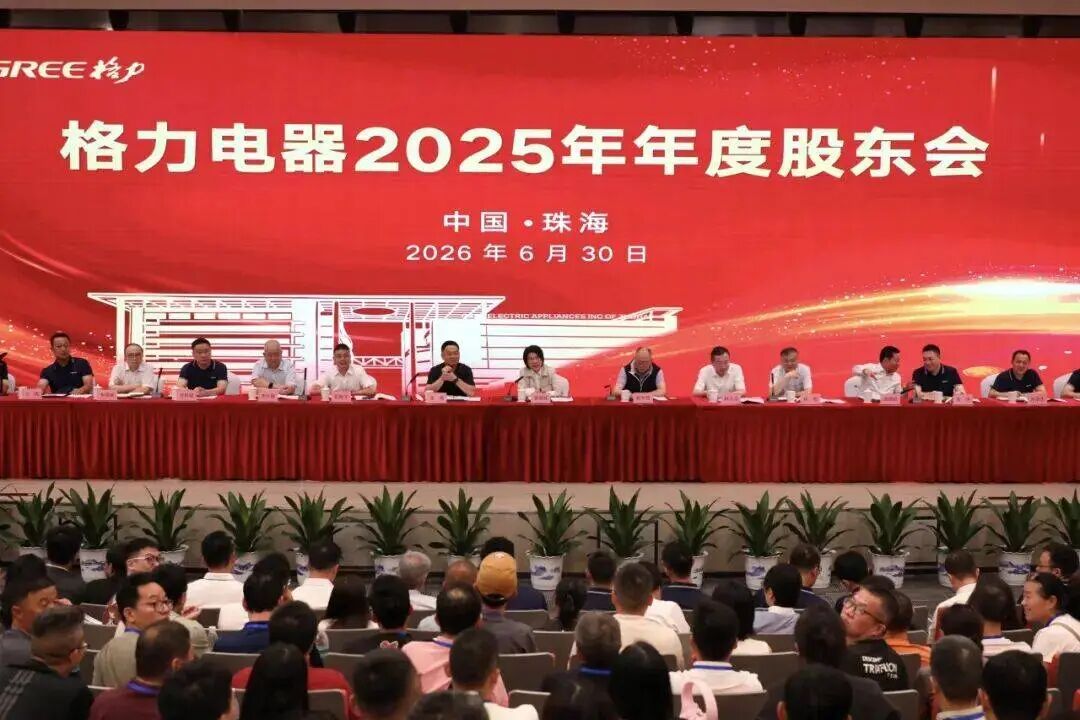
At Gree Electric's 2025 Annual Shareholder Meeting, Dong Mingzhu candidly admitted that Gree's export performance this year has fallen short, attributing this to the necessity for ongoing enhancements and transformations in Gree's export sales model as it progresses into a new phase.

In 2026, Europe experienced an exceptionally early and intense heatwave, with temperatures soaring to break multiple historical records and triggering an unprecedented surge in air conditioner sales across the continent.
Midea's portable split air conditioners flew off the shelves in Europe, while Gree's terminal sales surged by over 50%. In the first half of the year, TCL Air Conditioner's European orders for complete units increased by 68% year-on-year, and Hisense's overall sales in Western Europe grew by over 20% year-on-year.
The heatwave not only swept across Europe but also propelled Chinese home appliance exports to new heights. However, amidst this surge, Gree Electric's Chairwoman Dong Mingzhu offered a sobering assessment of the company's own performance.
At the recently concluded 2025 Annual Shareholder Meeting of Gree Electric, Dong Mingzhu bluntly stated, "Gree's export performance has not been satisfactory," a remark that appeared to be more than just a humble gesture.
In 2025, Gree's overseas revenue accounted for only 16.06% of its total revenue, making it the only one among the four major white goods leaders to experience a year-on-year decline in overseas business.
While data alone does not paint the full picture, Dong's admission carries significant weight.
1 Gree's Overseas Expansion: "Not Well Executed"
At Gree Electric's 2025 Annual Shareholder Meeting, Dong Mingzhu reiterated that Gree's export performance this year has been subpar, attributing it to the need for continuous improvement and transformation in Gree's export sales model as it enters a new phase.
Gree's history of overseas expansion is extensive.
As early as 2001, Gree established the first factory by a Chinese company in Latin America, in Brazil. Subsequently, it set up factories in Pakistan and Vietnam, but according to its official website, only two overseas production bases remain today—in Brazil and Pakistan.
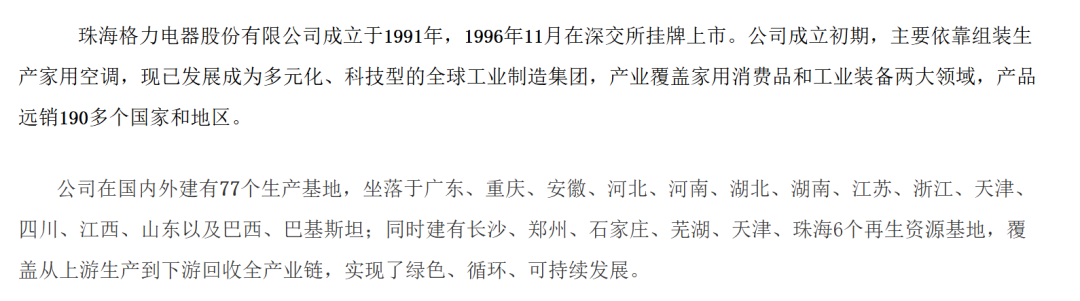
After establishing its overseas production bases, Gree embarked on an aggressive expansion across various continents to accelerate its internationalization.
In 2011, Gree USA was established in the City of Industry, California. In 2015, Gree proposed the brand proposition of "Let the world love Made-in-China," reflecting Dong Mingzhu's ambition for overseas markets.
After years of development, Gree's products are now sold in 190 countries and regions, a seemingly impressive achievement. However, the world does not yet fully embrace Gree.
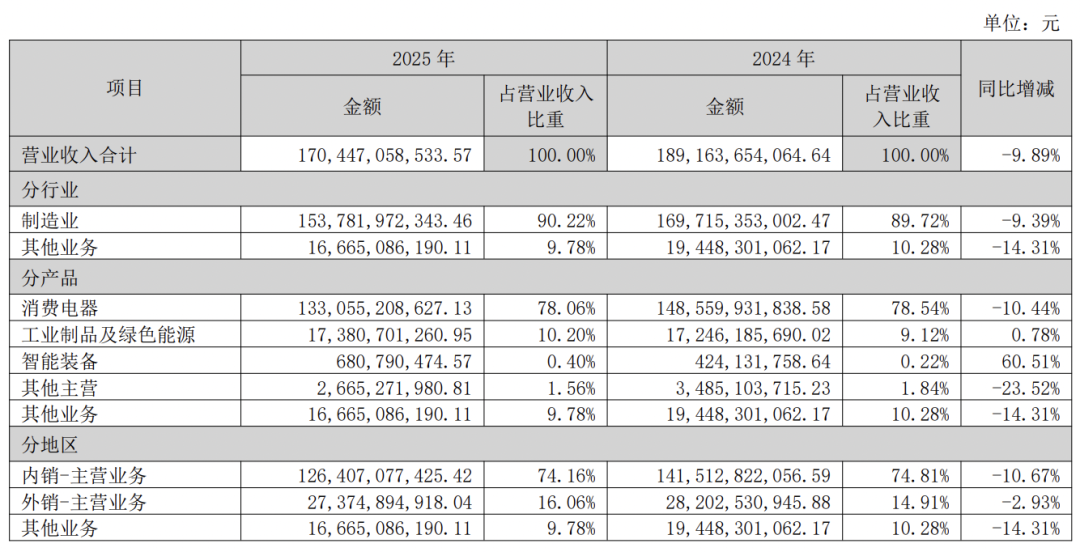
Let's examine the data. In 2025, Gree's annual overseas business revenue was RMB 27.375 billion, down 2.93% year-on-year, with overseas revenue accounting for only 16.06% of total revenue.
In comparison, Midea's overseas revenue was RMB 195.948 billion, up 15.92% year-on-year, with overseas income accounting for over 42% of total revenue. Haier's overall overseas revenue was RMB 154.545 billion, up 8.15% year-on-year, accounting for over 50% of total revenue. Hisense Home Appliances' overseas revenue was RMB 37.925 billion, with export growth of 6.4% year-on-year, raising its share of total revenue to 43.13%.
Whether in terms of total overseas revenue or its proportion, Gree lags significantly behind its competitors. This is partly due to Gree's focus on exporting under its own brand (accounting for about 70%).
Referring to Midea's disclosed data, in 2023, OEM (contract manufacturing) revenue accounted for as high as 61.59% of its overseas revenue. By the first half of 2025, OBM (own-brand manufacturing) revenue accounted for over 45% of its overseas revenue, suggesting that contract manufacturing still accounted for over 50%.
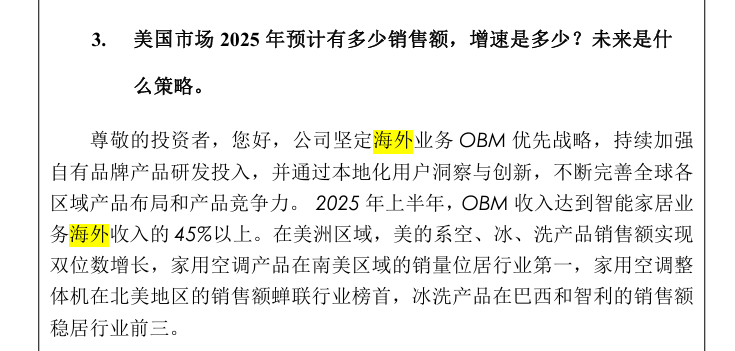
Considering the influence of Chinese home appliance brands in international markets, Gree's slightly weaker overseas performance is understandable. However, the issue is that competitors are accelerating their own-brand overseas expansion, suggesting that Gree's "lagging" may be more due to internal factors.
From Gree's overseas actions, it started early but has been conservative in style.
Take production base layout as an example: Gree still has only two overseas production bases, and it was not until 2025 that it proposed "planning pilot overseas regional sales companies and gradually improving the layout of overseas smart manufacturing bases."
In contrast, Midea already has over 400 subsidiaries, 41 R&D centers, and 43 major manufacturing bases worldwide. By 2024, it planned to increase the number of overseas sales companies to over 40.
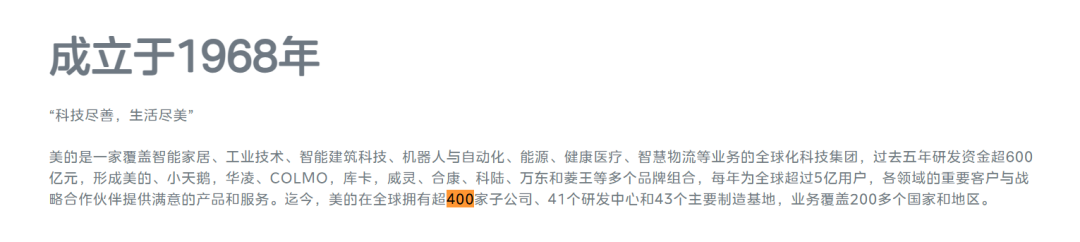
For home appliance brands, going overseas involves more than just shipping products; having responsive production bases and local marketing channels directly impacts development in overseas markets.
Gree's conservatism is also reflected in its product mix.
In recent years, Gree has been gradually increasing the export share of refrigerators, washing machines, and other appliances, but it has chosen a go-it-alone approach, making every step particularly challenging.
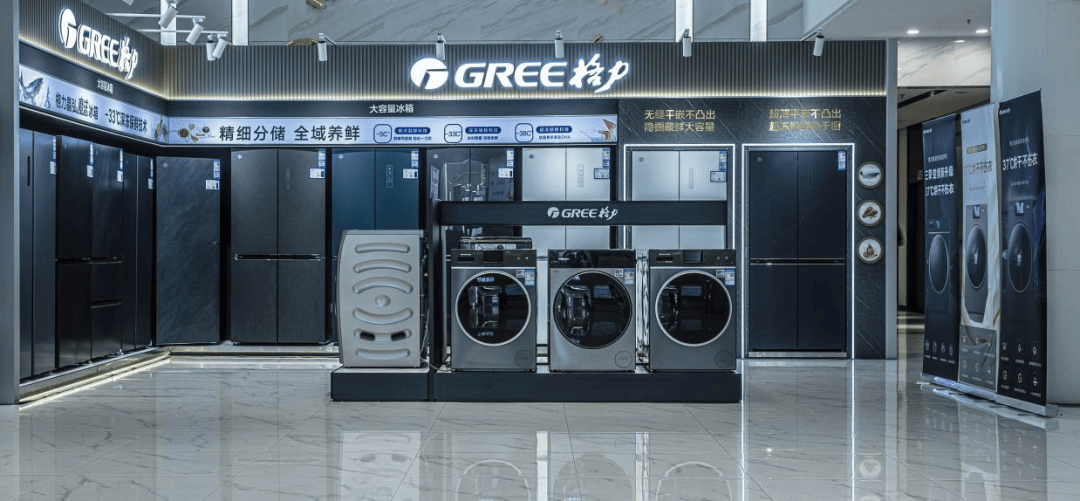
In contrast, Midea and Haier have taken a "shortcut" by acquiring well-known global home appliance brands to quickly penetrate overseas markets, such as Midea's acquisition of European kitchen appliance giant Arbonia Climate and Haier's acquisition of GE Appliances.
Rome wasn't built in a day, and the gap between Gree and its competitors in overseas markets did not form overnight. For Gree, "reflection" is indeed more urgent than "rhetoric" if it wants to continue deepening its overseas presence.
2 Dong Mingzhu Aims for a Turnaround
This wave of "European heat" has also put greater pressure on Gree.
Certainly, Midea, Haier, Hisense, and other home appliance giants have benefited from the high temperatures. However, more detailed sales data and local market influence require brands to conduct careful reviews.
But Dong Mingzhu's reflection at this time is a significant signal.
The key issue is not whether Gree performed well in exports this year but that it has been gradually left behind over the past few years.
For example, Haier's overseas revenue share first exceeded 50% in 2024. Midea's overseas revenue share has remained stable at around 40% in recent years, while Gree's overseas revenue share has consistently failed to break 20%.
Therefore, Dong Mingzhu stated bluntly at the shareholder meeting that "transformation of overseas sales channels is imminent." She also emphasized that Gree has significant room overseas and will undertake major reforms in its export model.
Over the past year, Gree has indeed seen more frequent personnel adjustments.
The most notable change was Dong Mingzhu stepping down as president after 24 years, with Zhang Wei, an internal promotion, taking over.
At the same time, Zhang Jundu, Shu Lizhi, and Zhong Chengbao were elected as non-independent directors of Gree Electric. Zhang Jundu is the executive director and general manager of Zhejiang Shengshi Xinxing Gree Trading Co., Ltd., representing the interests of Gree's dealers.
Shu Lizhi and Zhong Chengbao are new faces, previously serving as vice president, chief engineer, and assistant to the president of Gree Electric, respectively. Zhong Chengbao is the youngest "post-85" executive.
This round of personnel adjustments reflects two major directions in Gree's internal restructuring:
One is Dong Mingzhu stepping back to set the overall direction, giving the new generation of management greater room to operate.
The other is the "youngening" trend of the management team. Dong Mingzhu stated, "Why such frequent changes? It's to let [the team] find their own presence so that a young team can be cultivated."
From these management changes, it appears that Gree intends to reduce its reliance on Dong Mingzhu's personal IP for overall corporate development, hoping to bring new ideas and directions through internal restructuring.
For Gree's future overseas development, this presents a rare opportunity for breakthrough.
In the past, Gree's decision-making system revolved around Dong Mingzhu, and this "centralized" model was effective domestically. Dong's strong leadership efficiently integrated the vast dealer network and drove channel reforms to quickly adapt to market changes.
However, overseas, this model may become a constraint. After all, domestic and overseas markets differ in consumer habits, market rules, and channel ecosystems, requiring local market teams to flexibly adjust strategies and adapt to different market rhythms.
In short, appropriate "decentralization" can give overseas teams greater room for exploration and trial and error.
Already, some new changes are emerging.
Last August, the business of Gree's Thai agent was taken over by a Gree-affiliated company. In June, Gree Air Conditioner Singapore Pte. Ltd. officially opened in Singapore, marking Gree Electric's entry into the Singaporean market under its own brand.
This signals Gree's overseas channel reforms—through pilot overseas regional sales companies, it aims to gradually form international production bases integrating production, sales, and R&D.
This time, Dong Mingzhu's decision to slightly relinquish control is a crucial step in Gree's reforms.
3 Overseas Markets Become the "Second Front"
Of course, the reason for Dong Mingzhu's urgency is simple: the ceiling of the domestic market is within reach.
AVC data shows that in 2025, the domestic home appliance (excluding 3C) retail market size was RMB 893.1 billion, down 4.3% year-on-year. In the first quarter of 2026, the retail market size was RMB 172.6 billion, down 6.2% year-on-year, with domestic home appliances failing to reverse the downturn.
However, while the domestic market shrinks, overseas markets represent a vast blue ocean. According to Euromonitor data, in 2025, the global large home appliance market size reached USD 369.25 billion, with an expected average annual compound growth rate of 5.5% over the next decade.
Breaking it down by category, in 2025, China's air conditioner exports reached nearly USD 28 billion, accounting for about 40% of global air conditioner exports. Refrigerator export value was USD 10.259 billion, up 1.9% year-on-year. Washing machine exports were 36.16 million units, up 10% year-on-year.
Against this backdrop, overseas markets have become the "second front" that Chinese home appliance companies must compete for, with major players accelerating their overseas布局 (layout).
Midea is building or expanding production bases in Egypt, Brazil, and Thailand. Haier Smart Home acquired Carrier's commercial refrigeration business to further consolidate its global leadership in cold chain. TCL's overseas manufacturing network in Thailand, Vietnam, and India is becoming increasingly mature.
However, for Gree, the pressure may be even greater.
From 2024 to 2025, Gree experienced two consecutive years of revenue and profit declines. In 2025, Gree achieved revenue of RMB 170.447 billion, down 9.89% year-on-year. Net profit attributable to shareholders was RMB 29.003 billion, down 9.89% year-on-year, both nearing double-digit declines.
Under this performance pressure, in February, Gree's largest shareholder, Zhuhai Mingjun, reduced its stake by no more than 112 million shares, its first reduction since becoming Gree's largest shareholder, cashing out RMB 1.6 billion.
In fact, Gree has been seeking transformation for years, proposing as early as 2018 to become a diversified, technology-driven global industrial group.
One detail is that at Gree's shareholder meeting, Dong Mingzhu actively promoted the company's self-developed threshing machine. Earlier, Gree's CMO, Zhu Lei, also stated that Gree's self-developed coffee robots had secured many orders.
However, the market does not seem to believe Gree's "story." Whether in its core home appliance business or its technology sidelines, Gree has not produced sufficiently impressive results to restore investor confidence.
Therefore, overseas markets represent a battle it cannot afford to lose—with domestic growth capped, going overseas is no longer an optional "icing on the cake" but a mandatory "sink or swim" move.
But this battle will undoubtedly be a tough one. Today, the global home appliance industry has moved beyond the era of simply pursuing sales volume and scale. Global consumers no longer demand only "cheap and functional" products.
Samsung's story may be worth considering for Gree. In the
Certainly, the adage "it's never too late to mend" holds true. Dong Mingzhu's bravery in directly confronting issues is, in and of itself, a significant stride forward. Yet, the journey from recognizing problems to actually resolving them is fraught with numerous challenges.
The heatwaves that periodically sweep across Europe are poised to return. Whether Gree will emerge as the next standout player hinges not on Dong Mingzhu's verbal assurances but on the concrete actions taken by Gree.

-
![]()
Rokid's Ambition and Embarrassment: 300,000 Sales Can't Support Its Ecosystem Dream
-
Are Gaming Ventures No Longer in Vogue Among Tech Titans?
-
![]()
Kuaishou’s Keling AI, Valued at $18 Billion with a Five-Year IPO Pledge, Faces a Make-or-Break Challenge
-
![]()
Valued at $18 Billion with a Five-Year IPO Plan: Kuaishou’s Kling AI Takes a Bold Leap
-
![]()
NVIDIA Launches 'Computing Power Financing'
-
![]()
Following Up on the 'Safety Net' for Intelligent Driving: Is Huawei's Strategy Astute or Perilous?
-
![]()
ICML 2026 | One Model to Unify Humans, Objects, Sounds, and Actions: OmniShow Revolutionizes Multimodal Controllable Video Generation as a Systematic Engineering Feat!
-
![]()
Mid-Year Sales Analysis: Leapmotor Faces Challenges Alone, NIO Breaks Free from the 'NIO 30K' Stigma