The Illusion of Recovery in China's Commercial Rockets: Pre-Designed Endgame Capabilities
 06/29 2026
 386
386
【Preface】This article is part of the 'Illusions in China's Commercial Rocket Technology' series. As promised earlier, I will systematically debunk these illusions, covering aspects such as recovery methods, engines, and fairings.
Featured in this issue: Qianyi Aerospace, Yushi Space, Dahang Transition, CAS Space, and i-Space.
In June 2026, an interesting phenomenon emerged in China's commercial rocket sector: discussions on recovery methods are significantly outpacing the actual verification of orbital insertion and reuse.
Before achieving stable orbital insertion and forming a reliable reuse closed loop (closed loop), various recovery paths—including aerodynamic deceleration with horizontal recovery, tower capture, clustered recovery, and maritime recovery—have already entered the industry's expressive framework as near-'final solutions.'
The issue is not whether these technical routes hold potential but that they are being presented as final solutions before being adequately validated by flight data.
01 Horizontal Recovery: A Question Already Answered by the Space Shuttle
Public information from Qianyi Aerospace often carries strong communicative impact.
From its early proposal of 'falling leaf' aerodynamic deceleration to naming its rockets 'Cosmic Hunters,' the company has consistently showcased a distinct characteristic in the commercial space context: it emphasizes not just technical routes but also a narrative differing from mainstream approaches.
ADHL lies at the core of this narrative.
Outsiders summarize it as horizontal, sideways, drifting, or even 'lying down' recovery. The basic idea is that, unlike SpaceX's Falcon 9, which relies on engine retro-thrust for vertical deceleration and landing, ADHL attempts to use high-angle-of-attack aerodynamic deceleration during the first stage's return, delegating part of the deceleration task to the atmosphere, ultimately achieving horizontal landing or runway-like recovery.
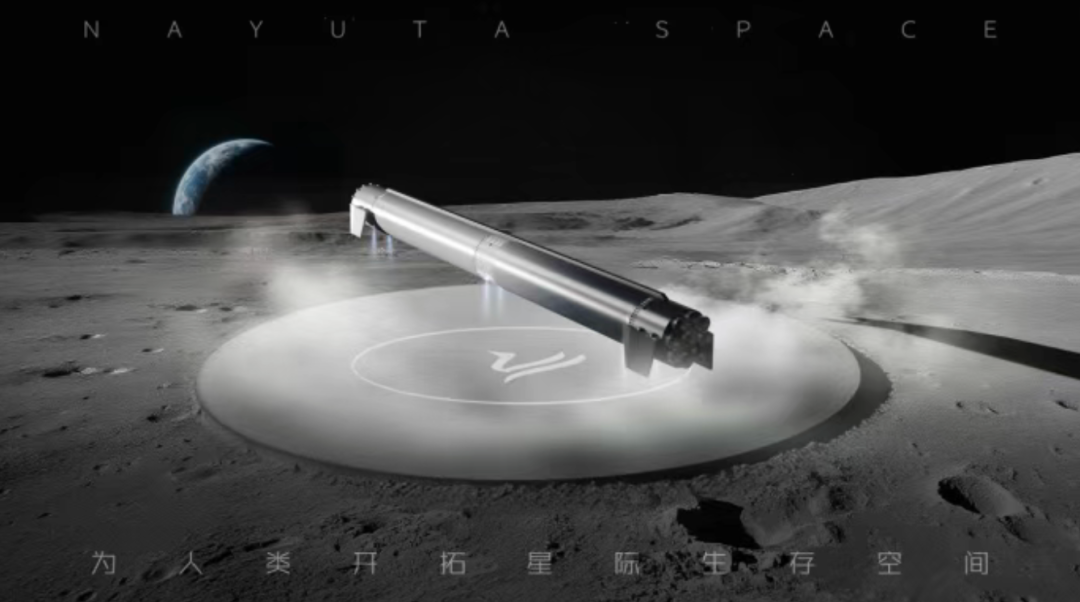
From a communicative perspective, this approach's appeal lies in suggesting a 'non-Falcon 9 path' and implying an alternative engineering imagination beyond existing technical paradigms.
But this is precisely where the problem begins.
ADHL is often described as a 'recovery path better suited to China's supply chain.' The underlying logic is that Chinese commercial rocket companies are still catching up in deep throttle variation, multiple ignitions, and highly reliable retro-thrust control for engines but possess a certain foundation in aerodynamic design, structural manufacturing, and complex system integration.
Thus, ADHL's core idea is to shift recovery challenges from engine performance limits to aerodynamic and structural systems. However, this shift does not reduce problems—it merely redistributes their structure.
Vertical recovery's challenges concentrate on engines and thrust control, but ADHL expands them into: high-angle-of-attack aerodynamic stability, attitude control under high dynamic pressure, thermal protection system coverage and maintenance costs, horizontal landing structure strength and reliability, and post-recovery structural inspection and reflight cycles.
Problems are not reduced but expanded from a single system to multiple systems. In other words, complexity is not bypassed but redistributed.
Moreover, ADHL is repeatedly emphasized as Qianyi Aerospace's exclusive rocket recovery technology. However, from basic spacecraft engineering logic, aerodynamic deceleration is not new. All re-entry vehicles, including capsules and spacecraft, undergo aerodynamic deceleration. Thus, ADHL's true distinction lies not in using aerodynamic deceleration but in making it the primary design path for a reusable first-stage recovery system.
Currently, no mature validation samples exist globally, which is one source of controversy.
Discussing horizontal recovery inevitably leads to the Space Shuttle system. It also used high-angle-of-attack re-entry, aerodynamic gliding, and horizontal landing, proving technical feasibility but leaving a more critical issue: economic viability was unproven.
The Space Shuttle's core cost issue was not 'whether it could recover' but the highly complex system maintenance that followed, including thermal protection inspections, structural fatigue testing, and long-cycle overhauls.
Thus, even if reusability was achieved, low-cost closure was not.
ADHL now faces the same class of issues, even earlier in its development.
Recent public information shows Qianyi Aerospace completed wind tunnel tests for the XuanNiao-R's ascent phase, covering speeds from Mach 0.3 to 4, to verify aerodynamic consistency with simulations.
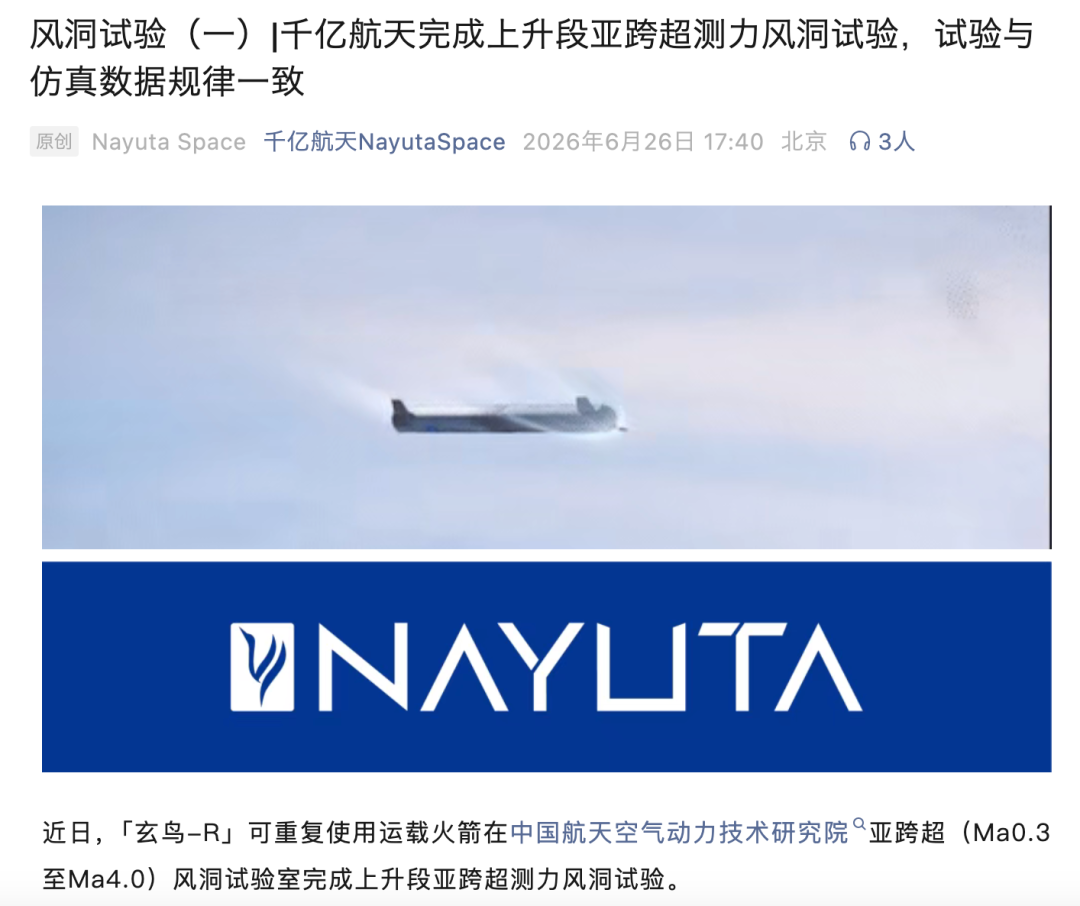
Wind tunnel tests are foundational in rocket development, but their scope is clear. They answer whether the aerodynamic shape is reasonable, simulation models reliable, and mechanical properties vary across speed ranges.
However, they cannot answer ADHL's truly critical questions, such as: Is attitude stable under high dynamic pressure? Is the return trajectory controllable and convergent? Does thermal protection enable reuse? Are post-recovery maintenance costs controllable?
Most critically, they cannot answer the ultimate conclusion: Does this recovery method truly reduce unit launch costs after multiple flights? Thus, wind tunnel tests only indicate aerodynamic design has entered verification but cannot prove a complete recovery closed loop (closed loop) exists.
So, the problem returns to its origin. Capital may continue betting on a trial-and-error approach, but from an engineering perspective, ADHL is neither simple nor necessarily cheaper. Its claimed 'adaptability to China's supply chain' remains unproven by flight data.
Until these questions are answered, it remains a proposal awaiting verification.
02 'Chopstick Capture': The Premature Finalization Trap
Tower capture, colloquially known as 'chopstick capture,' is becoming one of China's commercial rocket sector's most communicative technical symbols.
In current public information, both Yushi Space and Dahang Transition position 'tower capture recovery' as their core recovery path. Yushi Space emphasizes its stainless steel body + liquid oxygen-methane propulsion + chopstick capture arm as a 'benchmark against SpaceX Starship recovery,' while Dahang Transition directly defines Transition-1 as 'China's first tower-recovery rocket,' making capture recovery a key product selling point.
But tower capture's communicative advantage itself constitutes its first 'trap.'
Visually and conceptually intuitive, it eliminates repeated retro-thrust landings, instead using 'clamps' to recover rockets. This imagery reinforces the illusion that recovery is simplified.
In reality, tower capture is not a simplified solution but an ultra-high-precision terminal interception system.
It relies not on 'tower strength' but on whether the entire system has achieved sufficient certainty, including: minimal first-stage return trajectory errors, stable re-entry attitude control, reliable engine multiple ignitions, and engineered convergence of landing point distribution. Only after these conditions are met does tower capture become the 'final step,' not the design starting point.
In other words, tower capture does not capture the rocket body but an uncertainty system already converged by flight data.
SpaceX's ability to discuss Mechazilla in the Starship system stems not from tower capture being more advanced but from Falcon 9's extensive flights reducing first-stage recovery to an error-control problem. Under this premise, the tower is merely a high-precision interception device, not the system's core solution.
This also explains another easily overlooked issue: tower capture does not reduce difficulty—it shifts it to terminal extreme precision.
Compared to vertical recovery's reliance on engine retro-thrust and thrust modulation, tower capture compresses system fault tolerance into millimeter-level docking windows. Far from easier, it imposes stricter demands on preceding flight stability.
In some current Chinese commercial rocket proposals, tower capture is prematurely set as the design starting point. Stable orbital insertion verification is incomplete, yet capture system design proceeds. Reliable return trajectory data is absent, yet terminal docking precision is discussed. Error convergence capability is unverified, yet it is marketed as a core selling point.
Engineering order is thus inverted.
More critically, one might ask: Does a rocket truly need tower capture?
In Falcon 9's context, choosing vertical recovery or tower capture is an evolutionary outcome, not an initial design choice. Stable recovery capability precedes optimization of terminal capture methods. For systems yet to complete orbital insertion and reuse verification, tower capture resembles a 'premature declaration of final form,' remaining an engineering hypothesis.
With tower capture, the key is 'capture,' not 'tower.'
03 Clustered Recovery: Fewer Separations, More Coupled Problems
CAS Space's clustered recovery concept aims to reduce structural and mechanical complexity in traditional rockets through non-separation design.
However, from a broader systems perspective, this 'simplification' more accurately describes a shift—not a reduction—of complexity. Problems do not decrease but transfer from separation events to multi-body system control during return.
When multi-core structures return intact, the system faces not 'whether they can separate safely' but deeper control challenges: multi-body aerodynamic interference, center-of-gravity drift from propellant consumption differences, multi-engine thrust coordination errors, and structural flexibility-induced coupling responses under high dynamic loads.
These factors' criticality lies not in their existence but in their mutual coupling and potential amplification during return, increasing system uncertainty.
Historically, multi-engine parallel systems' challenges exemplify this. The early N1 rocket's issues stemmed not just from excessive engine count but from systemic coupling instability between high-frequency vibrations, thrust fluctuations, and control system responses, ultimately preventing stable mission completion.
Thus, engineering-wise, such schemes are more accurately described not as 'simpler recovery methods' but as introducing unvalidated multi-body coupling control problems after eliminating separation events.
This is precisely why they remain at the design stage.
04 Maritime Recovery: From Landing Point Variation to System Reconfiguration
Maritime recovery is often described as a natural extension of land-based recovery, merely shifting the landing site from land to an offshore platform. However, this understanding is fundamentally inaccurate.
Maritime recovery introduces an entirely new constraint system, transforming a relatively static ground recovery problem into a dynamically coupled ocean systems issue.
Take i-Space's maritime recovery plans for Hyperbola-3 as an example. The critical challenges lie not in whether the rocket can land on the platform but in ensuring the entire recovery chain functions: Is the offshore platform's dynamic positioning system stable enough? Do sea conditions permit recovery operations? Can the rocket withstand structural corrosion and salt spray environments post-splashdown? Are post-recovery inspection, disassembly, and remanufacturing systems fully closed loop (closed loop)?
These factors introduce a key change: land-based recovery is a static reference problem, while maritime recovery is a dynamic systems problem.
Maritime recovery must contend with a continuously shifting base. Platform positions drift microscopically, and sea conditions' six-degree-of-freedom motions directly translate to landing errors. High-precision capture must occur on a moving system, with each link (link) introducing new uncertainty variables.
Thus, maritime recovery's difficulty lies not in single-point capability but in whether the system can maintain closed loop (closed-loop) stability dynamically. It does not reduce problem complexity but expands engineering challenges from the launch site to the maritime environment and backend support systems.
This aspect is often downplayed in current industry communication.
From a strict engineering perspective, maritime recovery is not a simplified recovery path but an environmental-dimensional expansion of the recovery system.
The cost of system expansion never disappears—it merely manifests differently.
05 Is Recovery Method the 'Final Form' or Still Design?
Observing China's commercial rocket recovery methods through a longer-term engineering lens reveals a structural issue: recovery methods are entering the 'design pre-positioning stage' at unprecedented speed, while the flight data accumulation they rely on lags significantly.
However, rocket engineering's fundamental laws remain unchanged. Recovery methods are not design outcomes but statistical results of flight data convergence.
Thus, when multiple recovery paths are simultaneously framed as 'final capabilities' without sufficient flight validation, the more pertinent question is not which is more advanced but whether these schemes have reached comparable engineering stages.
On this front, the industry must still answer foundational questions: How many flights have occurred? How many returns? How many reflights? How long do refurbishments take? Have costs truly decreased?
Until these questions are answered, recovery method competition resembles narrative competition more than engineering competition.
This narrative drift was hinted at earlier in industry observations.
As Science and Technology Daily noted in a September 2018 commentary: Private commercial space must earn capital through steady technological innovation, ensuring 'firsts' hold genuine value. Overindulgence in sensationalism risks industrial short-termism and bubble formation.


This judgment remains relevant today, not just in the industry's infancy.
Commercial space can embrace imagination, but ultimately, only one standard matters: flight data itself.
Important Disclaimer: This article represents the author's personal views. For inaccuracies or disagreements, readers are welcome to contact the author via backend systems.
-
![]()
Depreciation Rate on Par with Mobile Phones: Just 40% Value Retention After Three Years—Why Do Battery Electric Vehicles Lose Their Worth?
-
![]()
Clearing Bugatti Stock Worth 7 Billion: Why is Porsche 'Cutting Ties'?
-
![]()
Don’t Dismiss Huawei’s Potential in Sedans Just Because the Shangjie Hasn’t Hit It Big Yet
-
![]()
Unsold Cars in China Find Success Overseas
-
![]()
Ghosn: Only I Can Save Nissan, Shareholders Beg Me to Return
-
![]()
Expanding Automobile Consumption: It's Time to Address the High Cost of Electric Vehicle Repairs
-
![]()
Luna Ultra Entangled in 'National Subsidy Fraud' Controversy, Insta360 Pushed to the Brink by DJI
-
![]()
People have long suffered from splash ads. Will the 'temporarily disappeared' traffic behemoth make a comeback?