Is AI-Powered Shopping Really Worth It or Not Necessary At All?
 08/04 2026
 521
521

Shopping Now Starts in the Chat Box
Written by / Li Wenjie
Edited by / Chen Dengxin
Typeset by / Annalee
When you type “I’m a new mom-to-be, what should I buy?” in the Qianwen App, the AI lists a maternity checklist within seconds. When you enter “phones under 4,000 yuan” in the Doubao chat box, the AI compares prices and calculates discounts for you. When you open Taobao, the AI shopping guide quickly appears... AI assistants have quietly become a standard feature on leading e-commerce platforms and local life service platforms. Shopping is shifting from the “search bar” to the “chat box.”
Since 2026, mainstream e-commerce platforms have collectively bet on AI-powered conversational shopping: Taobao has upgraded its full-chain AI shopping guide with Tongyi Qianwen, JD.com has empowered scenario-based consumption with its self-developed Jingyan large model, ByteDance's Doubao has launched a “Help You Choose” primary transaction entry, Alipay’s group buying has introduced AI auto-bargaining, and Pinduoduo has quietly launched a grayscale test of AI-powered smart search.
Despite the excitement, is the AI shopping assistant truly valuable or just a gimmick? A survey by the Shanghai Consumer Council based on 4,308 questionnaires revealed a sobering figure: 84.56% of consumers have tried AI shopping features, but only 16.06% believe AI can accurately match products. In other words, over 80% of users find AI recommendations unreliable.
It cannot be denied that some AI functions directly address core pain points like price comparison, product selection, and order combination, reshaping consumer decision-making efficiency. However, functions such as AI virtual outfit try-ons, smart recommendations, and random bargaining have become “gimmicky features” criticized by users due to technical shortcomings and mismatched scenarios.
All Players Enter the Race
Recently, Liu Yingdi, who just started working out, used an AI shopping assistant for the first time. She originally planned to search for fitness essentials on social media and then compare prices on e-commerce platforms. However, as she switched between multiple apps, she accidentally clicked into an AI shopping assistant chat box on one of the e-commerce platforms.
So, Liu Yingdi decided to ask the AI shopping guide on the e-commerce platform and other AI assistants like Doubao, “What do fitness beginners need to buy?” When one of the AI assistants quickly responded, “You don’t need to buy much for beginners; basic equipment is enough to start,” and listed specific categories with product links and prices, Liu was pleasantly surprised.
The conversation didn’t end there. After recommending relevant products, the AI assistant asked, “Do you plan to work out at home or at the gym? If at home, consider adding...” When Liu said she would go to the gym, the AI assistant suggested additional items like fitness gloves, quick-drying towels, and a gym bag. She noticed, “The AI’s top recommendations weren’t necessarily the cheapest or most famous brands. Clicking ‘More Products’ showed options at different price points and brands.”
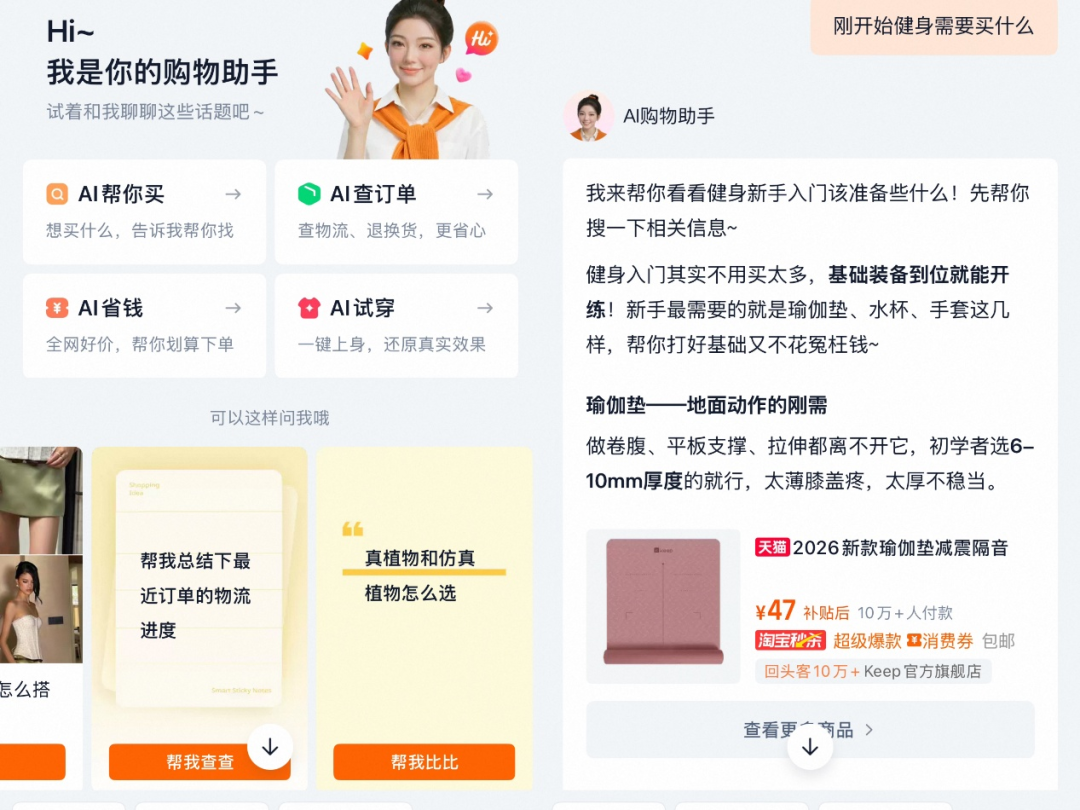
However, after several conversations, Liu’s favor (goodwill) toward the AI assistant diminished. “It kept asking questions to recommend more products.” Since all products were concentrated on the same platform, Liu still had to switch to other e-commerce platforms to compare prices.
Later, Liu also used other AI chat apps to input her shopping needs, thinking, “These AI apps should act as all-in-one shopping guides, neutrally filtering options and integrating discounts across platforms.” Instead, she found that the recommended products either came from a single platform or had mismatched prices and descriptions after redirecting.
Behind Liu Yingdi’s disappointment lies the common confusion of countless consumers during the first “618” shopping festival where AI-powered shopping chains entered the mainstream spotlight.
It cannot be denied that unlike the shallow applications of e-commerce AI in previous years, which were limited to smart customer service and passive product recommendations, the AI shopping capabilities of major platforms in 2026 have achieved a qualitative leap. Players are no longer blindly piling on features but are building conversational shopping systems tailored to their own ecosystems, user bases, and scenario advantages, forming an industry layout that is comprehensive, differentiated, and scenario-driven, completely reshaping traditional e-commerce service models.
Among them, the full integration of Qianwen and Taobao has allowed many users to truly experience “shopping through conversation” for the first time. Official information shows that Qianwen can accurately understand users’ shopping intentions in conversations based on Taobao’s 4 billion product library and over 20 years of accumulated real shopping scenario data.
Unlike Alibaba’s “embedded” approach, JD.com took a more aggressive product route. JD.com developed the intelligent shopping assistant “Jingyan” based on its self-developed Yanxi large model, which launched in 2023. By late December of the same year, JD.com also launched a standalone app, “JD AI Shopping,” powered by the same Yanxi model. This was an attempt to “start from scratch”—not satisfied with just adding an AI feature to the mall app, JD.com aimed to create an AI-native shopping entry. As of the first quarter of 2026, nearly 80 million users on the JD app have used “Jingyan” for assisted shopping. Jingyan’s strength lies in rational analysis: supporting price trend displays, AI review analysis, and multi-product comparisons.
Additionally, the Doubao app launched the “Help You Choose” AI shopping feature during the 2026 618 festival, fully integrated with Douyin e-commerce. Its standout feature is content-driven—after recommending products, it attaches video explanations from professional influencers, allowing users to “watch reviews before placing orders.” In May 2026, Alipay’s “AI Pay” introduced the “AI Low-Price Snatch” feature—users submit their shopping needs to the AI assistant, and Alipay’s “AI Pay” generates a one-time commission setting. After user identity verification and authorization, the AI monitors prices and places orders as required. As of May 21, 2026, Alipay’s “AI Pay” completed over 120 million payments in the latest week.

It’s worth mentioning that Pinduoduo, which has kept a low profile on AI topics, quietly launched the “AI Search” shopping feature on May 27, 2026. Unlike traditional keyword searches, users can describe their needs in natural language, and the system automatically understands and filters requirements such as specifications, price, and tags.
Reviewing the strategies of various platforms and user stories, a clear picture emerges: Taobao is building a full-chain shopping guide closed loop (closed loop), JD.com is experimenting with an independent AI-native entry, Douyin is leveraging its content strengths for immersive recommendations, Alipay is seeking breakthroughs in vertical scenarios, and Pinduoduo is quietly transforming its infrastructure with AI. The routes differ, and progress varies, but the direction is consistent—shopping is shifting from search bars and recommendation pages to chat boxes.
However, as “Liu Yingdis” have experienced, AI solves some problems while creating new ones.
AI Virtual Try-Ons, Smart Price Comparisons... Polarized Experiences
“I seriously tried the AI shopping assistant for a day. I really just wanted to ask about buying commuter shoes, but instead of just dropping links, it first helped me figure out what type suits me before giving options. When I was ready to order, it reminded me that the shoes run small and suggested sizing up. When I checked the reviews, it was true...”
“Randomly clicking into a store pops up an AI shopping guide window. I spent the whole night clicking these windows... felt like I kept telling salespeople, ‘Thanks, I’ll browse myself.’”
“AI virtual try-ons are the greatest invention ever. Now I don’t have to imagine outfits in my head when buying clothes.”
“Is the AI virtual try-on feature okay? I thought it would accurately show how clothes fit, but instead, it edited my body shape to look nothing like me. I want to see if the clothes suit me, not make me suit the clothes!”
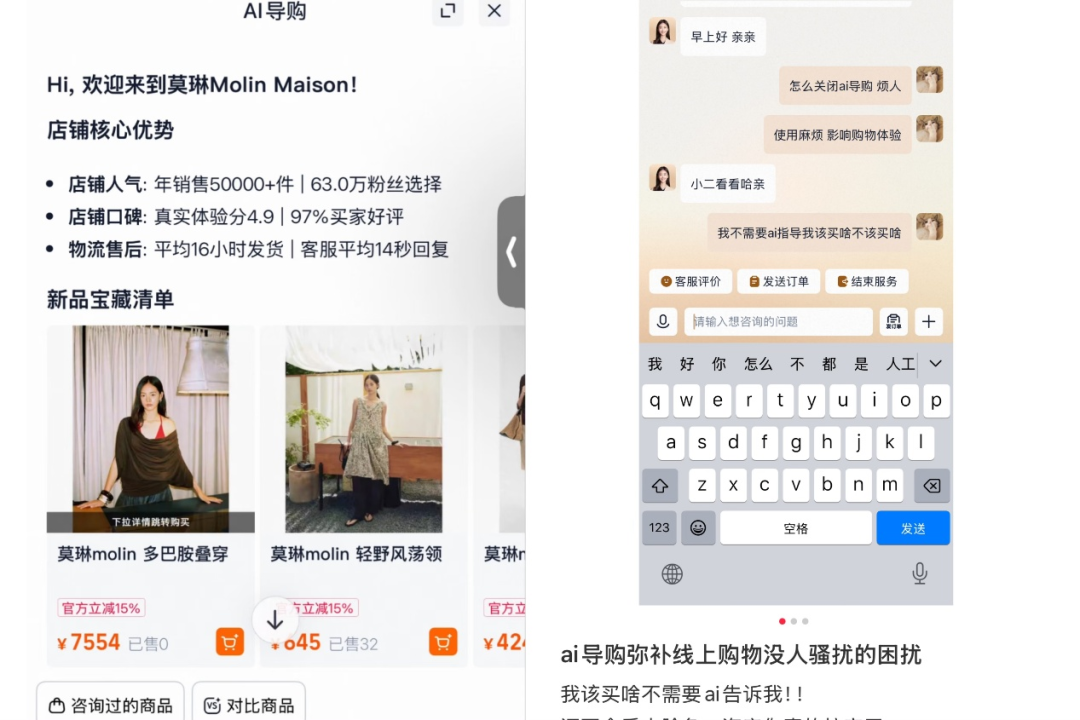
Image source: Xiaohongshu
Judging from social media reviews of AI features, many AI shopping guide experiences are clearly polarized.
Zinc Scale noticed that for categories like electronics, appliances, and home furnishings, where product value is determined by fixed parameters, performance metrics, and after-sales rules—without subjective aesthetic differences—AI’s information integration, comparison, and computation abilities are maximized, fully replacing users’ repetitive mechanical operations and thus receiving more praise.
Take the real-life shopping scenario of a frequent electronics buyer: Under traditional search, users spending hours browsing countless product links, manually organizing parameters, comparing prices, calculating discounts, and assessing after-sales risks when selecting mid-to-high-end ultrabooks or appliances. The entire process is time-consuming, labor-intensive, and prone to errors. AI, however, can complete full-platform screening, parameter comparisons, pros and cons evaluations, and optimal discount matching in a short time.
Additionally, AI often shines in scenario-based recommendations for complex needs. This is perhaps the most fundamental difference between AI shopping and traditional search.
Specifically, traditional search relies on “keyword matching,” but many shopping needs cannot be precisely described with keywords—“buy a gift for my nephew,” “the same leather jacket as Jensen Huang,” “celebrity-recommended bladeless fans.” Such abstract, vague, and context-dependent needs often stump traditional search. AI, however, can “convert human language into filtering conditions and even understand abstract requirements like ‘bright colors.’”
For example, when users don’t know exactly what they want to buy: What gear is needed for camping? What products are required for scientific weight loss? Where to start for skin whitening? AI can not only explain category knowledge but also recommend corresponding product combinations. This “from zero to one” demand discovery ability is AI’s incremental value over traditional search. Although current AI has limitations in depth and accuracy, this direction has been validated as a genuine user need.
However, overall, while AI shopping assistants hold great promise, many specific functions are “nice in theory but tiresome in practice.” They occupy prime real estate on product homepages, carrying platforms’ grand narratives about AI’s future, yet in users’ actual experiences, they become “one-and-done” gimmicks.
For example, AI virtual try-ons are one of the most heavily promoted features by major platforms. Yet many users say, “AI virtual try-ons still can’t fully replace real try-on experiences.”
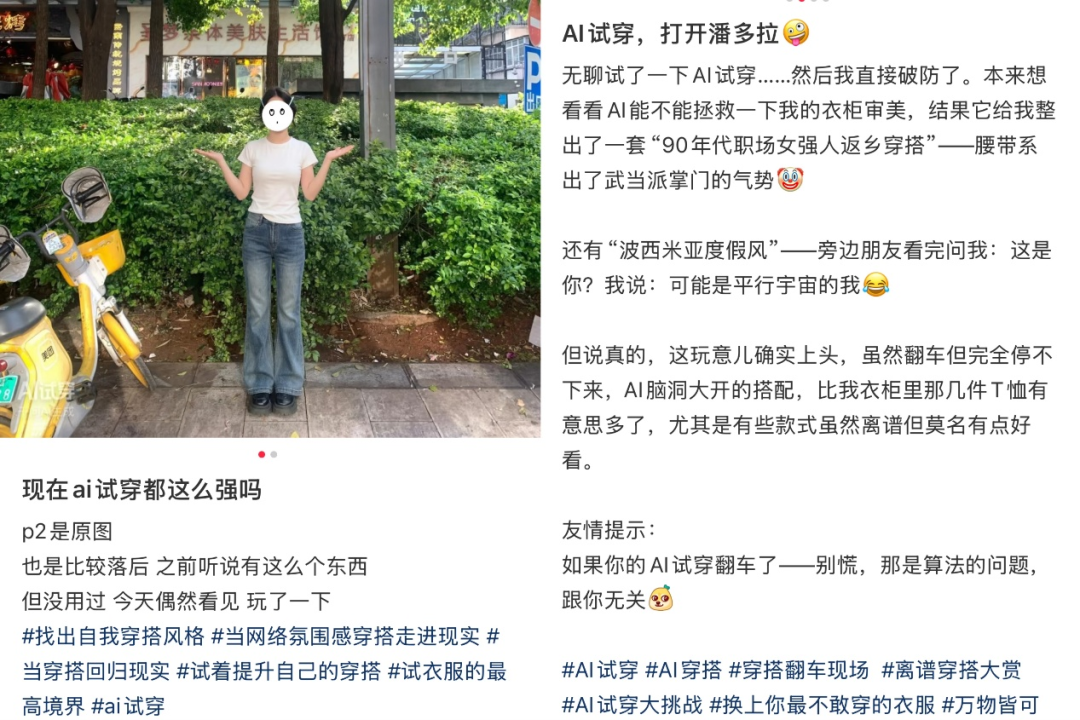
Image source: Xiaohongshu
The issue isn’t just technical precision. Even with accurate user body data and clothing fit data, factors like fabric drape, color rendering under different lighting, and wearing comfort—which determine whether to buy—cannot currently be replicated by AI virtual try-ons. As Titan Media analyzed: AI shopping won’t evenly take over all consumption scenarios. It will first handle decisions users don’t want to spend time on, but for purchases involving aesthetics, emotions, and self-expression, users still want to retain the selection process. Clothing consumption falls into the latter category. When buying clothes isn’t just about “covering the body” but also about self-expression and aesthetic taste, AI try-ons’ “standard answers” lose persuasiveness.
Cross-platform price comparison is consumers’ most basic and strongest expectation for AI shopping—users hope AI can act like a search engine to find the cheapest deal across the web. But testing reveals that platform barriers are an insurmountable flaw.
The logic is simple: E-commerce platforms spend huge sums training AI not to help users order from competitors. AI shopping assistants are first and foremost the platform’s AI, then the user’s AI. When conflicts arise between the two, “platform loyalty” will always take priority over “user interest” as a matter of commercial rationality. Unless a neutral third-party AI price comparison tool emerges and major platforms agree to open price comparison interfaces—which is nearly impossible under current competitive dynamics.
Of course, for most ordinary users, the other side of the experience is “trust issues.” According to the Shanghai Consumer Council’s *AI Era Consumer Cognition and Purchasing Decision Survey*, 64.22% of consumers worry about AI shopping’s privacy and security, while 62.53% question AI’s decision-making accuracy.
Feedback on social media shows users complaining that AI shopping guides always “push products with higher advertising fees,” questioning why AI recommendations are highly concentrated among merchants paying higher weights. Users think AI recommends “the most suitable products,” but in reality, it’s “what the platform most wants you to buy,” even block (blocking) high-selling, 99%+ positive-rated affordable bestsellers.
In fact, this is merely the “paid search ranking” problem from the traditional search era resurfacing in a more concealed way in the AI era. Except this time, users struggle to even see “advertisement” and “organic result” labels. AI recommendations are packaged as “smart suggestions,” but users can’t tell whether these are truly the “best solutions” or simply the “highest bidders.”
Returning to that sobering consumer council figure—84.56% of consumers have tried AI shopping, but only 16.06% believe AI can accurately match products. This number says it all: AI shopping is far from mature, and most users’ experiences remain at the “tried it, didn’t work well” stage.
But interestingly, over 85% of consumers express anticipation for AI one-stop shopping modes, with 38.65% saying they strongly look forward to one-click Agent shopping. Consumers don’t reject AI—they reject the current AI. They want an intelligent assistant that truly understands their needs, honestly recommends products, and saves them time and money, not an “AI salesperson” in disguise.
Shopping is quietly shifting from search bars and recommendation pages to chat boxes. This trend is irreversible. But who truly wins users’ trust depends on whether AI can find the balance between “platform interests” and “user interests.”
-
![]()
Two Key Moves in a Month! This Optical Giant is Quietly Shifting Tracks
-
![]()
Strong Alliance Unveiled! CooperVision and Eb Medical Forge Strategic Partnership
-
![]()
Is AI-Powered Shopping Really Worth It or Not Necessary At All?
-
![]()
Doushengsheng: Is It Really 'Stealing the Base'?
-
![]()
Dealer Service Operation Capability | After-sales Customer Retention: Three Key Strategies for Attracting Customers with Competitive Pricing
-
![]()
Revealed: CXMT’s New Wafer Fab Set to Establish Presence Here
-
![]()
Is Ant Afu Facing Its First Leadership Shuffle? Official Statement Dismisses Claims as Baseless
-
![]()
Pixel 11 Specs and Price Leaked Early: Price Hike of $100, Yet Memory Trimmed to 12GB