Tesla's Struggles in India: A Mere 'Over 100' Units Sold in Two Months
 12/04 2025
 550
550




Source: Zhiche Technology
India has long been a key market that Musk has set his sights on conquering. However, Tesla's entry into the Indian market has been far from smooth, instead encountering an unexpected "market cold shower."
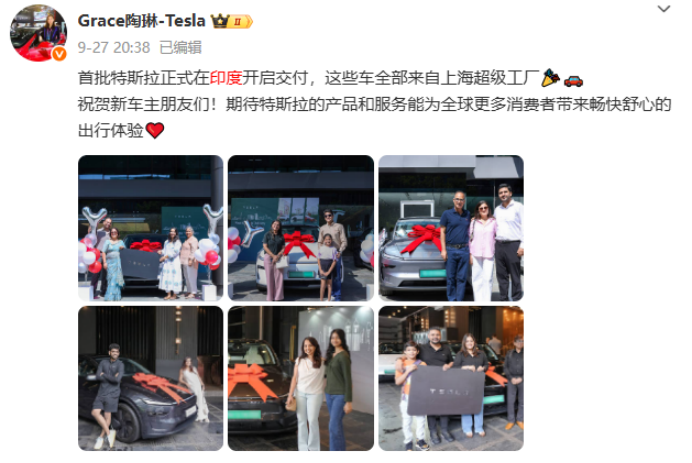
In July 2025, Tesla inaugurated its first experience center in Mumbai, marking its official entry into the world's third-largest automotive market. However, recent data reveals that Tesla had only delivered "over 100" vehicles in India by the end of November. This figure pales in comparison to the 4,000 units sold by German luxury electric vehicle brands during the same period and appears especially lackluster against the backdrop of rapid growth by local and Chinese brands.

A Chilly Debut
Tesla's inaugural Indian store is situated within a commercial complex spanning approximately 4,000 square feet in Mumbai. The China-produced Model Y is Tesla's sole offering in the Indian market, entrusted with the task of securing Tesla's "first victory" in India.
However, the exorbitant price tag has set the stage for subsequent sales challenges. Tesla opted to pay high import tariffs as a "trial" rather than committing to building a factory, resulting in an inability to reduce costs and a consumer wait-and-see attitude.
In the Indian market, the starting price of the Model Y rear-wheel-drive version is as high as 5.989 million rupees (approximately $71,000 or 500,000 yuan), making it one of the most expensive regions for this model in major global markets. In contrast, the model costs $44,900 in the U.S., $36,700 in China, and $53,700 in Germany.
What does such a steep price imply in the Indian market? Horizontally, this amount could purchase three mid-range fuel-powered SUVs in India. Vertically, it far exceeds the affordability of the mainstream consumer group, directly targeting the luxury car segment, which accounts for only about 1% of the local market. This positions Tesla in direct competition with traditional luxury brands like BMW and Mercedes-Benz, which have deep roots in India, while failing to reach the much larger pool of ordinary affluent and middle-class consumers.
Although Tesla received over 600 orders from July to mid-September this year, only slightly more than 100 orders had been converted into actual deliveries by the end of November, indicating an extremely low order-to-delivery conversion rate.
The rocky start has also been marred by internal turbulence. Just before the opening of the first Indian store, Tesla's head of Indian operations resigned. This executive played a pivotal role in Tesla's early Indian strategy, and after their departure, the Indian business will be temporarily overseen by the Chinese team, adding more uncertainty to Tesla's localized operations in India.

Root Causes of the Dilemma
The sluggish sales can be directly attributed to the high vehicle prices, primarily driven by India's 70%-100% import tariffs on fully assembled vehicles.
Although the Indian government introduced a new policy in March, promising to reduce import tariffs to 15% for electric vehicle companies that commit to local manufacturing, Tesla has not participated in this plan and instead chosen to import fully assembled vehicles with high tariffs. This has resulted in the Model Y being priced nearly 30% higher in India than in the U.S. market.
Besides price, the lack of charging infrastructure severely restricts purchase intentions. India currently has about 25,000 charging stations nationwide, with a vehicle-to-charger ratio as high as 235:1, concentrated mainly in major cities and along highways. Tesla has only deployed two Supercharger stations in India (located in Mumbai and New Delhi), making it difficult to support users' long-distance travel needs. It can be said that India inherently lacks a robust charging network.

Source: Zhihu @91che
Additionally, Tesla's product positioning significantly mismatches the mainstream market demand in India. Although the Indian electric vehicle market is growing rapidly, the overall penetration rate of electric passenger vehicles is only about 2.5%, with over 85% of sales coming from affordable electric two-wheelers and three-wheelers.
In the four-wheeler electric vehicle segment, mainstream demand is concentrated on models priced below 2 million rupees (approximately $24,000). The Tesla Model Y's price is three times this threshold, confining itself to the luxury car segment, which accounts for only 1% of total vehicle sales.
More critically, even within the luxury electric vehicle segment that Tesla targets, it has failed to gain an early foothold. This year, German luxury brands such as Mercedes-Benz, BMW, and Audi have sold approximately 4,000 electric vehicles in India, 40 times more than Tesla. These brands have an advantage due to their earlier market entry or partial tax benefits.
While Tesla struggles in the narrow high-end market, Indian domestic giants are expanding rapidly with a deep understanding of the market. Brands like Tata and Mahindra rely on extensive dealership networks and more affordable prices (such as the Tata Nexon EV at around 120,000 yuan) to firmly occupy the mainstream market.
Notably, the rapid growth in Indian electric vehicle sales this year has been largely driven by Chinese brands, which have captured nearly one-third of the market share.

What Lies Ahead
To truly unlock the Indian market, Tesla urgently needs to reduce prices through localized production. India's new electric vehicle policy clearly requires automakers to invest at least 41.5 billion rupees (approximately $480 million) in factory construction and gradually increase localization rates to qualify for the 15% low tariff.
However, negotiations between Tesla and the Indian government on this issue have been fraught with twists and turns, with disagreements over investment scale and localization progress. Tesla currently seems more inclined to test the market with imported vehicles rather than making immediate major investments.

Source: Chaping XPIN
Even if prices can be lowered in the future, Tesla still needs to make substantial investments in building a dedicated charging and service network. Currently, its planned new charging stations are still concentrated in major cities, and covering India's vast geographical expanse requires enormous and long-term investment. Sources told the BBC that Tesla has already begun strengthening the construction of India's electric vehicle ecosystem to revive sales momentum.
Meanwhile, Indian consumers are becoming increasingly rational, focusing more on vehicle practicality, after-sales convenience, and total cost of ownership rather than mere brand prestige. Tesla needs a more localized market strategy to address this challenge.
Previously, Tesla's Indian team calculated for potential users, emphasizing that fuel and maintenance cost savings could recover the approximately 2 million rupee price difference within 4 to 5 years. However, in a market with generally limited car-buying budgets and lagging charging infrastructure, persuading consumers to bear high upfront costs and usage uncertainties remains a daunting task.
Tesla originally planned to exhaust its annual import quota of 2,500 vehicles for the Indian market this year. However, due to lower-than-expected sales, Tesla has adjusted its plan and now expects to deliver 300 to 500 Model Y units to the Indian market this year. Nevertheless, without price reductions and large-scale charging network deployment, Tesla faces significant challenges in turning the situation around in India.
Cars may only be the surface of Tesla's entry into India, as its long-term strategy may focus more on India's vast energy industry. Compared to the North American and Chinese markets, India represents one of the few large-scale experimental fields for Tesla to build its energy industry from scratch globally.
Despite the setback at the start, Tesla's Indian journey is not over yet. Amid India's firm industrial protection policies, entrenched market structures, and multiple attacks from local and international competitors, Tesla's Indian expedition is destined to be a long and arduous journey that tests patience, flexibility, and strategic resolve.
- End -
Disclaimer:
Works marked 'Source: XXX (not Zhiche Technology)' in this official account are all reprinted from other media, with the purpose of transmitting and sharing more information. This does not mean the platform endorses their views or takes responsibility for their authenticity. All copyrights belong to the original authors. If there is any infringement, please contact us for deletion.
-
![]()
Surpassing the 'Storage Storm': Xiaomi’s Pivotal Moment
-
![]()
2026 China Auto Market: A 'Major Reshuffle' — Small Cars Decline, Large Cars Flourish, Is the Era of Fuel Vehicles Over?
-
![]()
Non-Recurring Items-Adjusted Net Profit Soars by 72.59%! Dongtianwei Records 502 Million Yuan in Revenue
-
![]()
Securing 2 Billion Yuan in Financing and Supplying Inno-Light: This Optical Device Company Launches Its IPO!
-
![]()
Farewell to 'Card Stacking': 2026 Marks China's Computing Power Shift to 'Token Value Output' Era
-
![]()
Xiaomi Weathers Storage Price Surge, Q2 2026 Revenue Tops 100 Billion Yuan Again
-
![]()
Geely Bids Farewell to the 'Li Shufu Era': A Historic Power Transition in China's Auto Industry | Auto Circle
-
![]()
Baidu Prepares for Inclusion in Southbound Trading: Wall Street Reassesses the Value of 'AI ETF'