Another 20% Surge for That Company: November Sales Review of China's Top Five Independent Automakers
 12/08 2025
 630
630
On December 1st, China's independent automakers began to release their November sales figures. Notably, despite the early phase-out of local trade-in subsidies, the majority of these automakers achieved record-breaking sales. Geely Auto, in particular, stood out with double-digit sales growth, securing its position as the top performer on the list. Meanwhile, a small number of independent automakers saw slight sales declines, though these were minimal.
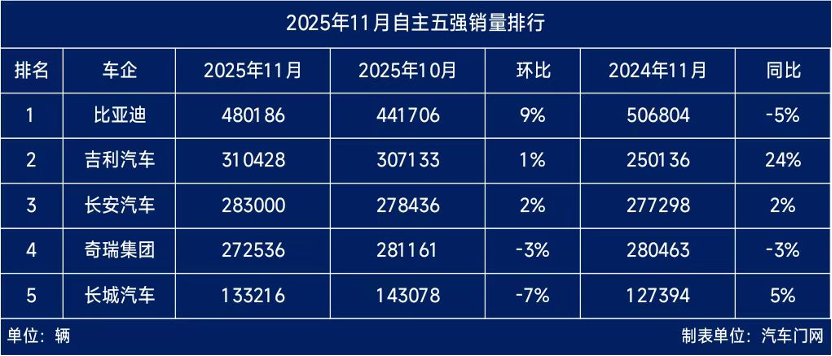
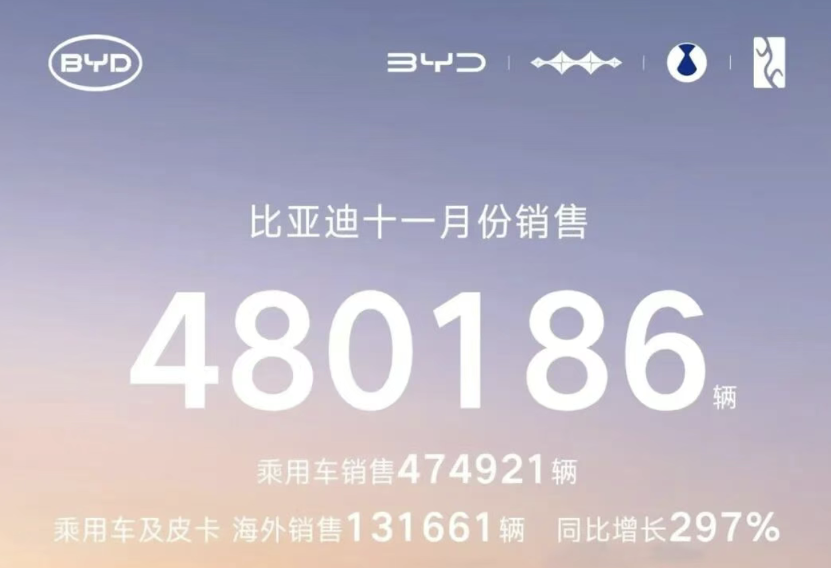
In November, BYD once again dominated the sales charts with an absolute lead. Data indicates that BYD sold a total of 480,186 vehicles in November, marking a 9% increase from the previous month.
Analyzing the sales by brand, the Dynasty and Ocean series remained the primary drivers for BYD, with a combined total of 423,558 units sold. Models such as the Qin, Song, Yuan, Seagull, Dolphin, Seal, and Sea Lion families all contributed to BYD's sales growth. The Denza brand sold 13,255 units, with the Denza D9 and Denza N8L together accounting for 11,150 units, forming the core of the brand's sales. The Yangwang brand sold 37,405 units, with the Titan 7 model contributing 24,019 units as the mainstay. The high-end Yangwang brand sold 703 units.
Currently, BYD's core sales base is being gradually eroded by brands such as Geely Galaxy, Changan Qiyuan, Shenlan, and Leapmotor, diminishing its leading edge in the mass market. Maintaining market share has become an unavoidable challenge for BYD. However, given the increasingly fierce competition in the domestic market, nearly all automakers are facing unprecedented pressure. Against this backdrop, BYD's ability to still achieve month-on-month sales growth demonstrates its strength. From January to November this year, BYD sold a total of 4,182,038 vehicles, falling short of its 4.6 million sales target by 417,962 units. Some observers point out that BYD is likely to achieve its annual target this year.
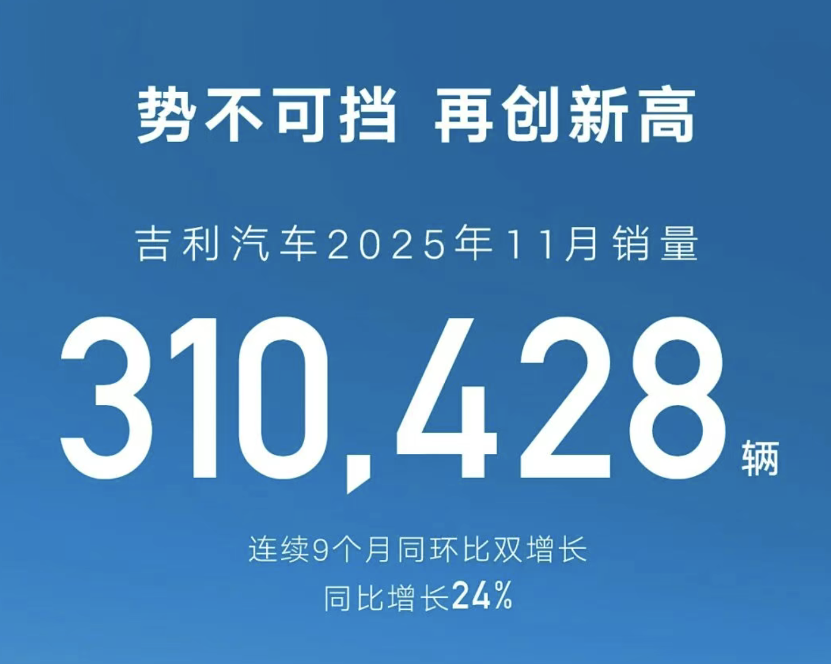
Compared to BYD, Geely delivered an outstanding performance. Data shows that Geely sold a total of 310,428 vehicles in November, marking a 24% increase year-on-year and setting a new historical record.
New energy vehicles emerged as the core growth engine. In November, Geely's new energy vehicle sales reached 187,798 units, up 53% year-on-year. Specifically, the Galaxy brand delivered 132,652 units in November, a 76% increase year-on-year. The Xingyuan model alone sold 44,007 units, while models such as the Galaxy A7, Galaxy E5, Galaxy Starship 7 EM-i, and Galaxy M9 each sold over 10,000 units in a single month. The Lynk & Co brand sold 35,059 units, a 7% increase year-on-year, with new energy models accounting for as much as 75% of its sales. The Zeekr brand sold 28,843 units, a 7% increase year-on-year, setting a new single-month record.
From January to November this year, Geely's cumulative sales reached 2,787,750 units, a roughly 42% increase year-on-year. Based on its annual sales target of 3 million units, Geely has achieved a 93% completion rate so far and only needs to sell an additional 212,250 units to meet its full-year goal. For Geely, this target is not only achievable but may even be exceeded. Looking ahead to next year, the company expects to launch 1-2 new products each quarter, laying a solid foundation for sustained growth in 2026.
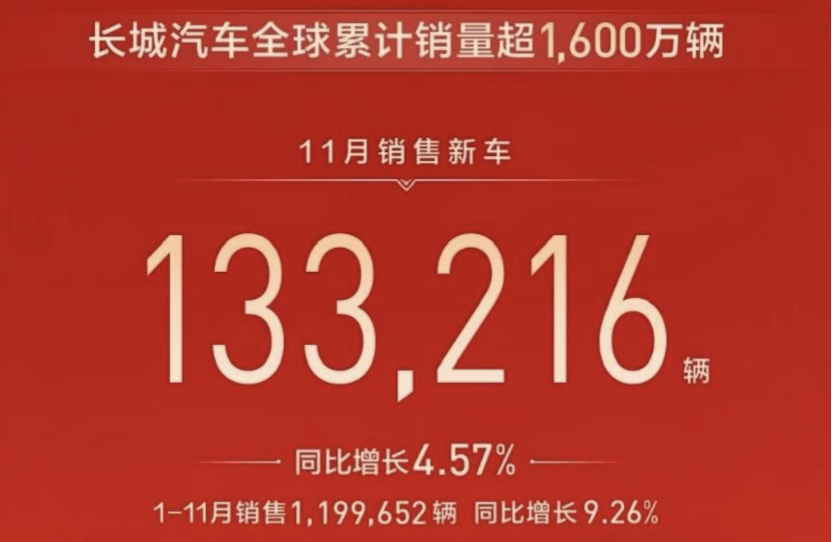
Changan demonstrated relatively stable market performance. In November, Changan sold a total of 283,000 vehicles, marking a 2% increase both year-on-year and month-on-month. Notably, Changan's new energy vehicle sales reached 125,000 units in November, a 23% increase year-on-year. It is worth mentioning that Changan's new energy vehicle sales have exceeded 100,000 units for three consecutive months.
Analyzing the sales by brand, Changan Qiyuan sold 46,909 units in November, a 31% increase year-on-year, with the Qiyuan Q07 and Qiyuan A07 as the main sales drivers. The Shenlan brand sold 33,060 units. Avita delivered 14,507 units, a 21.4% increase year-on-year, setting another new historical record. Recently, models such as the Qiyuan A06, Qiyuan Q05, and Shenlan L06 have been launched, all contributing to breakthroughs in sales for the Changan Qiyuan and Shenlan brands. It is reported that the Qiyuan A06 received over 30,000 orders in its first month with price incentives, the Qiyuan Q05 received over 13,000 orders within 10 days of launch, and the Shenlan L06 garnered over 20,000 orders in just one hour.
Over the past 11 months, Changan's cumulative sales reached 2.658 million units, achieving an 88.6% completion rate for its annual target. To meet its annual sales target of 3 million units, Changan needs to sell approximately 343,000 units in December, which poses some pressure. However, with the implementation of various preferential policies and the launch of new models, Changan still has the potential to fully sprint and achieve its target.
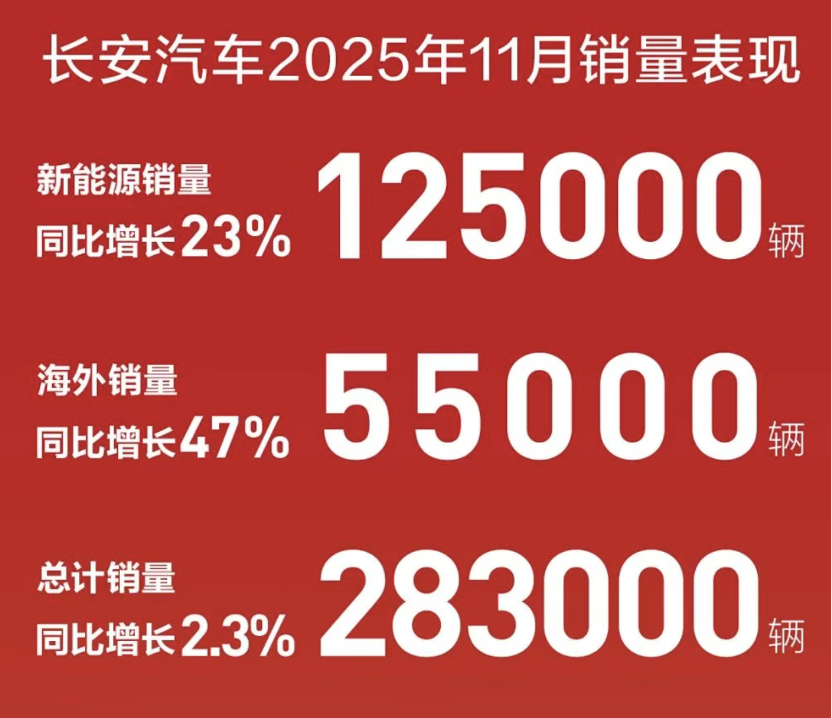
Recently, Chery Group has shown particularly strong performance in new energy vehicles and exports. Data shows that Chery Group sold a total of 272,536 vehicles in November.
Among them, Chery Auto sold 255,809 units. By brand, Chery's cumulative sales reached 165,511 units in November, roughly flat year-on-year. The Jetour and Exeed brands each sold over 60,000 units, with models such as the Jetour Traveler and Exeed ES continuing to gain momentum. The iCAR brand sold 11,428 units, a 99% increase year-on-year, while the Luxeed brand sold 11,761 units, a 3% increase year-on-year.
According to official sources, Chery's new energy vehicle sales reached 116,794 units in November, a 50.1% increase year-on-year. More impressively, Chery Auto maintained its leading advantage in exports, shipping 136,700 units in November, a 30.3% increase year-on-year, continuing to rank first in Chinese automobile exports.
Currently, Chery Group is demonstrating strong growth momentum in both new energy vehicle and export sales. Some observers point out that, given the current trends and substantial end-of-year promotional efforts, Chery Auto's sales are expected to achieve steady growth of approximately 10%.
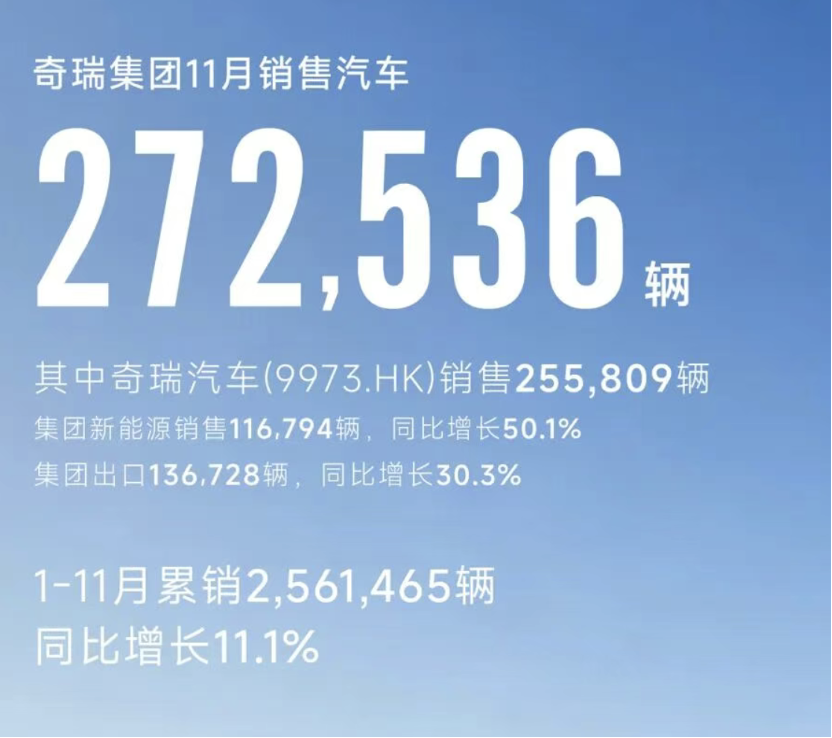
Recently, Great Wall Motors has shown signs of market improvement. In November, Great Wall sold a total of 133,216 vehicles, a 5% increase year-on-year. Among them, Great Wall's new energy vehicle sales reached 40,113 units, a 11.43% increase year-on-year, while overseas sales hit 57,309 units, a 32.7% increase year-on-year. In the first 11 months of this year, Great Wall sold a cumulative total of 1,199,652 units, a 9.26% increase year-on-year.
Specifically, the Haval brand sold 75,383 units in November, remaining Great Wall's mainstay. The Tank brand saw sales increase by 19.55% year-on-year to 24,135 units, with the Tank 300 as the top-selling model. Wey's new energy vehicles sold 12,763 units in November, an 81.14% increase year-on-year—the highest growth rate. The Ora brand sold 4,821 units, while the Great Wall Cannon sold 16,011 units.
Recently, models such as the Wey Gaoshan 7, Haval H6L, and Ora 5 have been launched into the market. Next year, Great Wall plans to introduce several new models, including a flagship six-seater SUV, which will help enhance its market competitiveness and narrow the gap with the other top four automakers.
Summary:
Judging by the sales of the top five independent Chinese automakers, competition in the automotive market continues to intensify, with widening gaps among them. Some independent automakers have not achieved year-on-year sales growth, but this does not significantly impact their overall performance.
Looking ahead, with various manufacturer incentives and the countdown to purchase tax subsidies, the sales rankings of major automakers may once again see changes. The editor and readers alike eagerly anticipate what comes next.
(Images sourced from the internet. Removal upon infringement notice.)
-
![]()
Optical Industry Chain's 'Little Giant' Faces the Listing Challenge! Yuanli Optoelectronics Set for BSE IPO Review Tomorrow
-
![]()
There's No Such Thing as a Free DeepSeek
-
Five Consecutive Quarters of Revenue Decline: Baidu Sets Sights on 'Reclaiming Top-Tier Status in Foundational Large Models'
-
![]()
Global Vehicle-Mounted Optics Leader Reports RMB 358 Million Loss in H1!
-
![]()
Global Computing Power Behemoth Nvidia Faces Emerging, Formidable Rivalry!
-
![]()
Generative AI Fuels Global Cloud Market Boom, Three Cloud Titans Amass Trillions in Pending Orders
-
![]()
Semi-annual Report | Global Large-Size Interactive Flat Panel Market Grows by 9.4% in H1 2026; Analysis of Domestic and International Brand Strategies
-
![]()
Can Tencent Still 'Buy a Ticket' Onboard with an Extra 20 Billion?