246,229 Vehicles Recalled, Followed by Quarterly Turnaround: Is NIO's 'Rapid Progress' Secure?
 02/27 2026
 543
543
Writer | He Wei
Source | Bedo Business & Bedo Finance
On one hand, a recall notice is issued; on the other, quarterly operational performance shows a turnaround. The same company is conveying two entirely contrasting messages within a very short span—is this a sign of rapid progress, or is it moving too hastily?
The automotive industry has never been short on speed; what it lacks is the ability to uphold safety, cost control, and user experience at high speeds without any compromise. On February 9, 2026, the State Administration for Market Regulation issued a recall notice, stating that NIO (hereinafter referred to as 'NIO,' NYSE: NIO, HK: 09866) needs to recall 246,229 vehicles through software upgrades.
Recalls often hinge on specific details but can have an impact on trust at a macro level. Especially when a recall coincides with a profit forecast on the timeline, questions arise: What does the recall indicate? What does a quarterly operational turnaround mean? Are the 2026 targets achievable?
I. The 'Significance' of the Recall
The basic facts of this recall are straightforward. The recall notice issued by the national market regulatory authority, numbered S2026M0017I, states: Effective immediately, 246,229 pure electric vehicles (ES8, ES6, and EC6) manufactured between March 16, 2018, and January 16, 2023, are being recalled. Due to software issues, some vehicles in this range may experience brief instrument cluster and central display blackouts under specific conditions, during which essential vehicle information and functions (e.g., speed, fault alerts, defrosting/defogging) become unavailable, posing safety risks. The notice specifies that the issue will be resolved through remote software upgrades, with in-person service center upgrades as a backup option if remote updates fail.
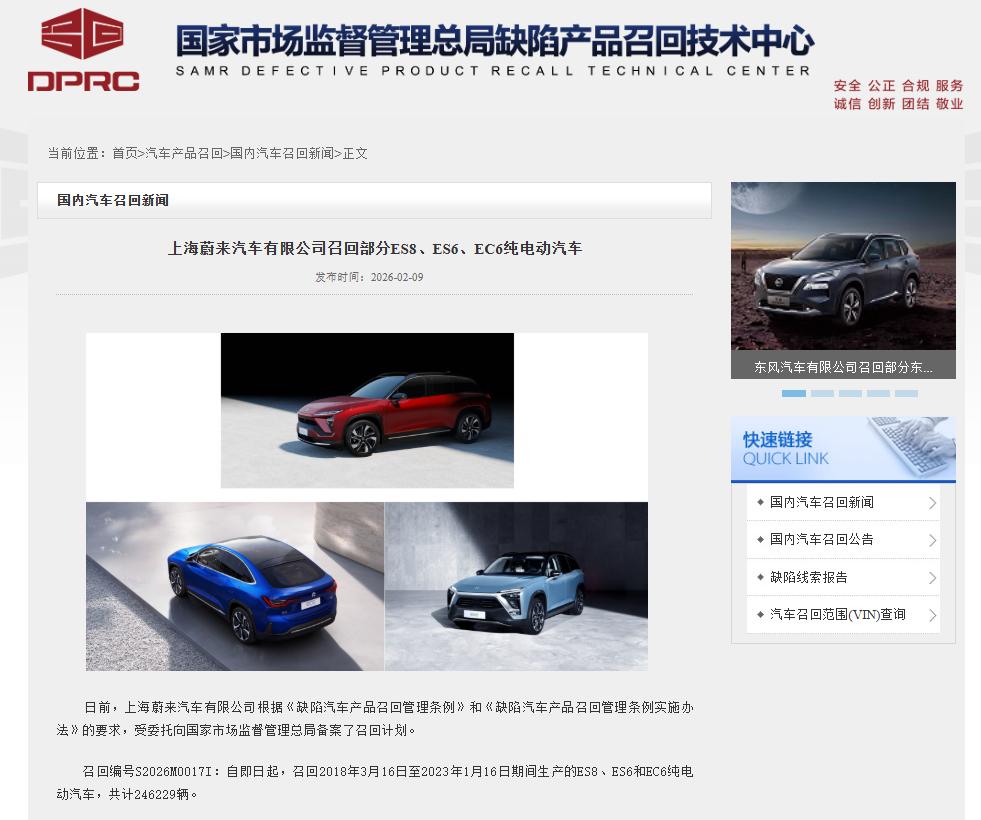
Source: Official website of the Defective Product Recall Technical Center under the State Administration for Market Regulation
Industry-level data provides a more precise reference. According to the Defective Product Recall Technical Center under the State Administration for Market Regulation, 105 passenger vehicle-related recalls were carried out in China in 2025, involving approximately 6.825 million defective vehicles. Based on these figures, the average recall size is approximately 65,000 vehicles. Placing 246,229 vehicles within this ~65,000-vehicle average gives a clearer sense of the scale of this recall.
Thus, this recall can be analyzed separately in terms of the 'nature of the issue' and the 'remediation method.' At the issue level, the defect is described as a safety hazard. At the remediation level, questions arise about whether remote upgrades can cover all vehicles, reduce owner visits to service centers, and achieve rapid widespread adoption—all of which are tied to execution efficiency.
However, several questions about this recall warrant discussion:
First, what does the large number of affected vehicles (246,229) signify? This is NIO's largest recall since its inception. Why are so many vehicles impacted?
Second, with the recall announced just before the Spring Festival, how will NIO ensure owner peace of mind during travel? The recall notice was issued on February 9, 2026, roughly eight days before the February 17, 2026, Spring Festival. NIO primarily uses OTA (Over-the-Air) upgrades, so most owners won't need to visit stores. However, can all vehicle upgrades be pushed within a week? For owners who do not upgrade, will NIO provide emergency safeguards or other specific, feasible solutions?
Third, what exactly are the 'specific conditions' and 'brief period'? Owners cannot determine whether their driving scenarios align with 'specific conditions' or predict whether 'brief' means seconds or longer.
Fourth, will this affect future sales? Recalls and sales are not simply inversely correlated. From a regulatory disclosure perspective, recalls include both voluntary submissions by companies and those prompted by regulatory investigations. Sales impact depends more on upgrade coverage progress and communication transparency than on the announcement itself. These questions cannot be answered at the time of the announcement. A more appropriate approach is to track delivery and order changes post-recall through consecutive monthly public data. Until then, it is inappropriate to simply conclude whether sales will be affected.
A recall is not the endpoint but the starting point for quality governance; the true impact on sales depends on whether every step after this starting point is executed properly.
II. Q4 2025 Operational 'Turnaround'
In a February 5, 2026, announcement, NIO stated that based on a preliminary assessment of its unaudited consolidated management accounts and currently available information to the board, it expects to record an adjusted operating profit (non-GAAP, defined as operating profit excluding share-based compensation expenses) of approximately RMB 700 million (~USD 100 million) to RMB 1.2 billion (~USD 172 million) in Q4 2025. This marks its first single-quarter adjusted operating profit (non-GAAP).
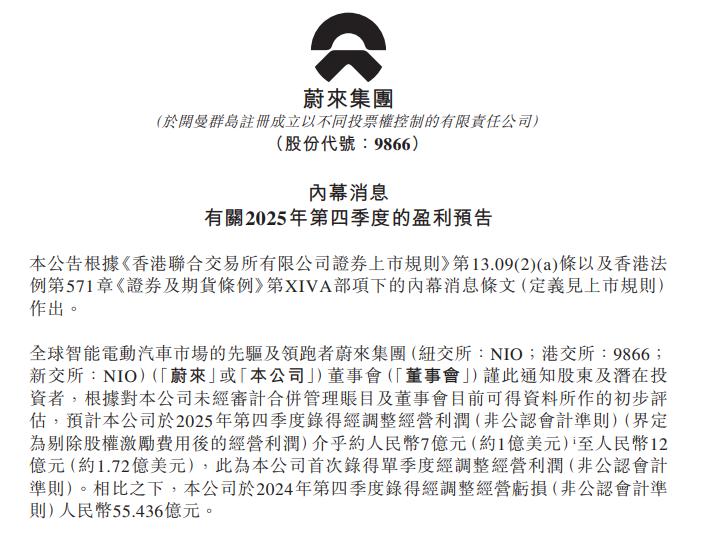
Source: Screenshot of NIO Group's Q4 2025 profit forecast announcement
Additionally, under GAAP, it expects to record an operating profit of approximately RMB 200 million (~USD 29 million) to RMB 700 million (~USD 100 million) in Q4 2025. In contrast, it recorded an adjusted operating loss (non-GAAP) of RMB 5.5436 billion in Q4 2024.
The significance of these figures lies not in the 'turnaround' itself but in the scale of the difference. Adjusted operating profit (excluding share-based compensation expenses) improved from -RMB 5.5436 billion to RMB 700 million–RMB 1.2 billion. The announcement attributes this primarily to sustained sales growth in Q4 2025, a favorable product mix driving automotive gross margin optimization, and ongoing comprehensive cost-reduction and efficiency-improvement measures.
Notably, these operating profit figures are preliminary estimates based on unaudited consolidated management accounts and currently available board information, with final figures subject to the official results announcement. In other words, the operational turnaround is a 'forecast,' not a 'final draft.' This does not diminish its significance but necessitates a more restrained evaluation, focusing on the ranges and benchmarks explicitly stated in the announcement rather than extending additional conclusions beyond them.
Another reality is that cost reduction and efficiency improvement are cited as key factors in the profit forecast. Operational turnaround does not rely solely on higher sales but also on expense compression capabilities.
When viewed alongside the recall, there is a recall announcement on one hand and an operational turnaround forecast on the other. This raises a practical question: As companies tighten operational efficiency, how can they sustainably ensure rapid response to quality issues?
This also highlights a reality companies face during growth: When operational data improves, how they simultaneously maintain product and service fundamentals often reflects their true character. For manufacturing companies, optimizing financial metrics and stabilizing product support systems are two pillars supporting long-term development.
This scenario also reflects that while a company presents operational progress externally, its ability to handle various situations warrants equal attention. Operational quality is reflected not only in financial statement changes but also in response efficiency across all links. How to make efficiency gains and quality assurance mutually reinforcing remains an ongoing challenge for many companies.
III. 2026 Targets: Are There Uncertainties?
Discussing 2026 requires referencing the company's publicly stated goals.
According to a January 9, 2026, report by China Securities Journal, NIO founder, chairman, and CEO William Li mentioned, 'Standing at a new milestone of one million vehicles, NIO designates 2026 as the year of dual breakthroughs in profitability and scale. 'The first phase's 100% sales growth was momentum; now, 40–50% growth is steady and more sustainable.'
Comparing delivery figures among new-force players provides clearer context. NIO's announcement states it delivered 326,028 vehicles in 2025. XPeng delivered 429,445 vehicles in 2025. Li Auto's cumulative 2025 deliveries reached 1,540,215 vehicles. Leapmotor's cumulative 2025 deliveries reached 596,555 vehicles.
When these figures are placed side by side, the scale gaps are evident. NIO's 326,028 vehicles are substantial among new forces but not leading enough to relax. Especially compared to Leapmotor's 596,555 and XPeng's 429,445, achieving NIO's 40–50% growth target requires continued delivery increases—and substantial ones at that. Merely placing the target growth rate alongside the current delivery baseline reveals the pressure.
More critically, the 2026 target is not just about higher deliveries but also about full-year profitability. The profit forecast provides a single-quarter operating range and is preliminary in nature. Full-year profitability requires more quarters to remain in sustainable ranges while withstanding common industry price competition fluctuations. Industry-level production and sales data indicate a large market but also abundant supply. More supply makes price stabilization harder and cost control more critical. NIO must simultaneously achieve two objectives: sustained delivery growth and transitioning from a single-quarter operational turnaround to a full-year one.
The recall becomes pivotal here. Recalls are essentially quality governance actions requiring companies to allocate engineering and service resources while managing deliveries and expenses. NIO's use of remote upgrades for this recall makes resource occupation relatively controllable but does not eliminate costs.
When cost reduction and efficiency improvement are cited in the profit forecast while resources must be allocated to recalls, can service quality and operational efficiency be maintained in parallel? The key lies in granular data: the coverage ratio of upgraded vehicles, the time required for upgrades, and whether special in-store scenarios arise. These are the core figures that transform the recall from an announcement into execution. Regulatory notices do not disclose these details; the onus lies on the company.
At the macro level, new energy vehicle production and sales exceeded 16 million units in 2025, with domestic new vehicle sales surpassing 50%, making competition intensity self-evident. At the meso level, delivery divergence among new forces already exists, with the 596,555–326,028 vehicle gap requiring no further elaboration. At the micro level, NIO's simultaneous release of a single-quarter operational turnaround forecast and a recall covering 246,229 vehicles indicates that operations and quality governance are both operating at high intensity. Achieving 2026 targets does not stem from a single statement but from these figures posing rigid challenges to organizational execution and resource allocation.
A recall is not a 'good' or 'bad' choice but a quality governance step manufacturing companies must take post-product delivery. Regardless of sales volume or financial performance, feedback and corrections after product market entry are unavoidable links in a company's operational chain.
Similarly, quarterly operational turnaround is not a symbol for 'turning the tide' or 'storytelling.' It represents the distance between a range of figures and benchmark figures: RMB 700 million–RMB 1.2 billion versus last year's RMB 5.5436 billion loss. This difference exists objectively, requiring no extra embellishment or premature extrapolation.
As for the 2026 targets, they are not just bold statements. They require delivery scale to continue rising from current levels and operational turnaround to extend from a single quarter to a full year. These cannot be accomplished through announcements alone but require validation through actual figures each subsequent quarter.
Viewing these events together reveals no cancellation effect between them. Quality actions and operational figures follow their own logics. A company simultaneously addressing product-level feedback and financial-level expectations at the same timepoint is business as usual, not exceptional.
What truly matters is whether quantities, ranges, year-over-year changes, and cumulative figures continue to align in subsequent disclosures. In today's industry, only the numbers themselves are persuasive.
-
![]()
Can the Brand-New Hongqi H7 Forge Its Own Identity in the Hybrid Vehicle Market?
-
![]()
Challenges in Redeeming Certificates for New Cars: Mercedes-Benz Dealership Group Grapples with Operational Hurdles Once Again
-
![]()
Porsche Returns to Volkswagen, Ending the 'Electric Ferrari' Story
-
![]()
"Chinese Version of Mythos": Can It Rise to the Challenge and Keep Pace?
-
![]()
Equity Changes Hands Three Times in Seven Years: JMCG Leans on Contract Manufacturing for Survival Amid Brand Deficits
-
![]()
Automotive Market News: Nine Departments Jointly Roll Out Aftermarket Consumption Initiatives
-
How Electronic Fabric Became the Critical Chokepoint for AI’s Trillion-Dollar Computing Infrastructure
-
![]()
Depreciation Rate on Par with Mobile Phones: Just 40% Value Retention After Three Years—Why Do Battery Electric Vehicles Lose Their Worth?