Electric Vehicles: The Battle of Configurations Extends to Every Detail, Including Glass
 05/11 2026
 354
354
Lead-in
Introduction
Ultimately, the deciding factor is whether consumers are willing to open their wallets.
In the nascent stages of the new energy vehicle market, automakers wooed customers with extravagant features such as in-car refrigerators, color TVs, and plush sofas. However, as competition intensified, these so-called premium features were democratized, with prices plummeting from the 300,000-yuan tier to the 100,000-yuan range. Suddenly, these once-exclusive features lost their luster and no longer justified a premium price tag.
Consequently, automakers shifted their focus to innovating within the confined space of a vehicle's cabin. Seats, once a luxury reserved for high-end models with optional ventilation and massage functions, became standard across almost all vehicle segments. Some manufacturers even took it a step further, incorporating features like massage, physiotherapy, foot heating, and SPA-like experiences.
Take audio systems, for instance. Initially, most vehicles were equipped with four speakers, sufficient for playing the radio. Now, anything less than 20 speakers seems inadequate, and power outputs of two to three kilowatts are becoming commonplace.
When it comes to intelligence, both smart cockpits and autonomous driving systems are engaged in an arms race, piling on chips and computational power to vie for top rankings. In this fiercely competitive industry, no one wants to be left behind. Regardless of the actual user experience, the goal is to at least appear superior on paper.
Nowadays, it seems there are no more configurations left to compete on. However, in the eyes of astute businesspeople, there are always untapped avenues—such as a single piece of glass.
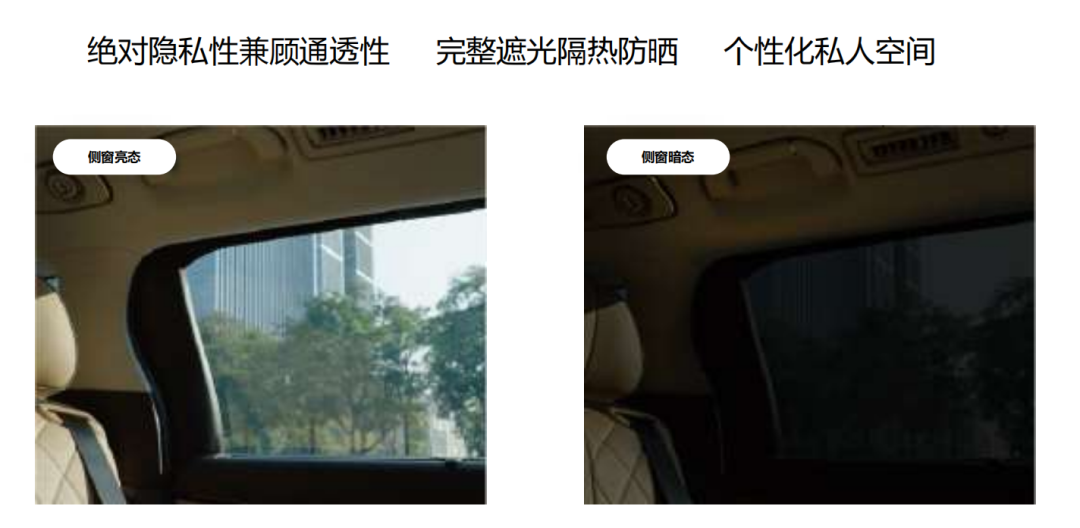
This month, several upcoming flagship models, including the NIO ES9, XPeng GX, and the next-generation Seres M9, have all chosen electrochromic privacy glass as a key selling point.
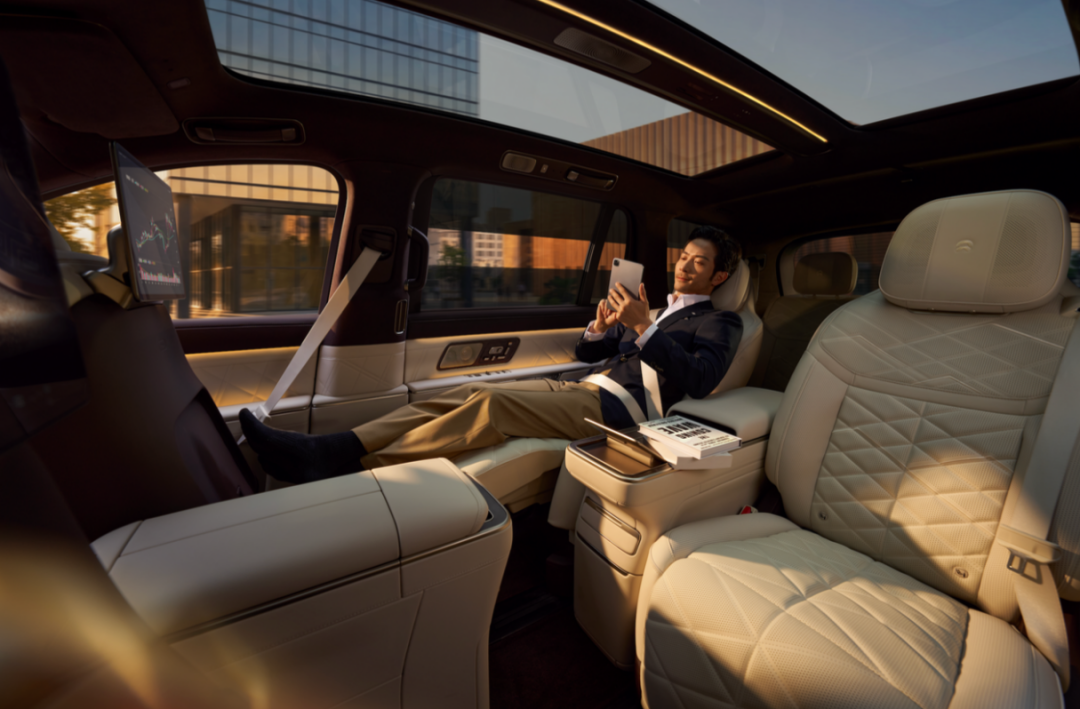
From tinted sunroofs that transform into private compartments for rear-seat passengers to seamless transitions between two-stage switching, stepless dimming, zoned control, and simulated blind effects—a piece of glass once solely responsible for shielding occupants from wind and rain has now evolved into a "super intelligent carrier" that integrates sun protection, heat insulation, privacy, quietness, technological sophistication, and emotional value.
Why has something as mundane as a curtain become a symbol of sophistication and advancement in the eyes of many new-force automakers? Some ordinary consumers may find this baffling or even disagree.
But there's always a way to reframe it as something more high-end. For instance, this isn't just about stacking configurations—it's portrayed as a century-long evolution, an industry-wide revolution, and an experience redefinition led by Chinese brands.
From different perspectives, both sides seem to have valid points. But regardless, those in the business of automotive glass tinting and car window tinting shops are truly feeling the pressure.
01 The Evolution of Automotive Glass
Automotive glass, often overlooked and rarely considered a "configuration," is seldom a focal point for consumers. However, delving into its development history reveals a fascinating journey. Over more than a century, it has transformed from a mere "windshield tool" to a "safety barrier" and finally to an "intelligent interactive panel," mirroring the evolution of automotive safety and comfort.
In 1904, cars were first equipped with windshields—ordinary flat glass whose sole purpose was to block wind and sand. However, it was fragile and dangerous, shattering into sharp fragments that caused secondary injuries in accidents, earning it the nickname "deadly glass." At this stage, glass merely addressed the "presence or absence" issue, with no consideration for safety.
In 1919, Ford's Model T mass-adopted laminated glass, which sandwiched a PVB film between two layers of glass. When broken, it didn't shatter or injure occupants, ending the history of injuries caused by glass fragments and laying the foundation for modern automotive safety glass. By 1938, tempered glass emerged, its strength increased severalfold through heat treatment. When broken, it formed blunt, small particles under 5mm, further enhancing the safety of side and rear windows.
For decades thereafter, laminated and tempered glass became industry standards, with safety remaining the glass's core mission.
However, with consumer upgrades, glass began to take on more functions. Double-layer laminating improved NVH (Noise, Vibration, and Harshness) and interior quietness, while coatings provided heat insulation and UV protection. Glass transitioned from a mere "safety component" to a comfort feature. As Xiaomi mentioned with its first-generation SU7, "For 140 years, no one solved the issue of sun protection in cars." Other models required aftermarket tinting films to address sun exposure.
Thus, whether as a factory-installed configuration or an aftermarket addition, automotive glass remained a passive component without active adjustment capabilities.
The true game-changer for automotive glass was electrochromic technology, which adjusts light transmittance under an electric field and selectively blocks thermal radiation. Early applications included Ferrari's 2005 Superamerica convertible and Boeing's 2008 787 Dreamliner smart windows.
Subsequent material technology iterations gradually popularized the technology in high-end automotive panoramic sunroofs. In 2016, MIT researchers achieved a breakthrough in electrochromic materials, significantly improving response speed, energy efficiency, and shading performance. This laid the technical foundation for large-scale upgrades in energy-efficient building glass and high-end automotive sunroofs.
In 2021, Gauzy partnered with Zeekr 001 to introduce EC electrochromic sunroofs, marking the official entry of smart dimming glass into mass production. By the end of 2025, Gauzy's EC electrochromic technology had evolved to its third generation, making it the world's largest supplier of automotive-grade EC dimming sunroofs/glass. With over 300,000 units supplied, it covered more than 20 mainstream models, including NIO, BYD, Xiaomi SU7, and Audi, and gradually expanded to side windows.
Today, LC dye liquid crystal side windows, represented by the XPeng GX and NIO ES9, have made their debut. With response times as low as 0.1 seconds, nearly 100% shading rates, and independently controllable zones, glass has fully evolved into an active, intelligent interactive terminal, completing its transition from the mechanical to the intelligent era.
02 Smart Cockpits Demand Smarter Glass
We have always believed that everything exists for a reason. The emergence and proliferation of smart or tinted glass in the automotive industry are inevitable results of electrification trends, cockpit competition, and user pain points.
After all, when powertrains, range, large screens, audio systems, and seats have reached their limits in competition, automakers must turn to more nuanced experiences. Glass addresses three major needs: sun protection, as tinted sunroofs solve the issue of excessive heat in electric vehicles; privacy, as high-end executive cockpits, business receptions, and rest scenarios require glass that allows light but not visibility (while aftermarket films exist, factory-installed options offer superior safety, aesthetics, and odorlessness); and functionality, as glass transitions from a passive component to an active one.
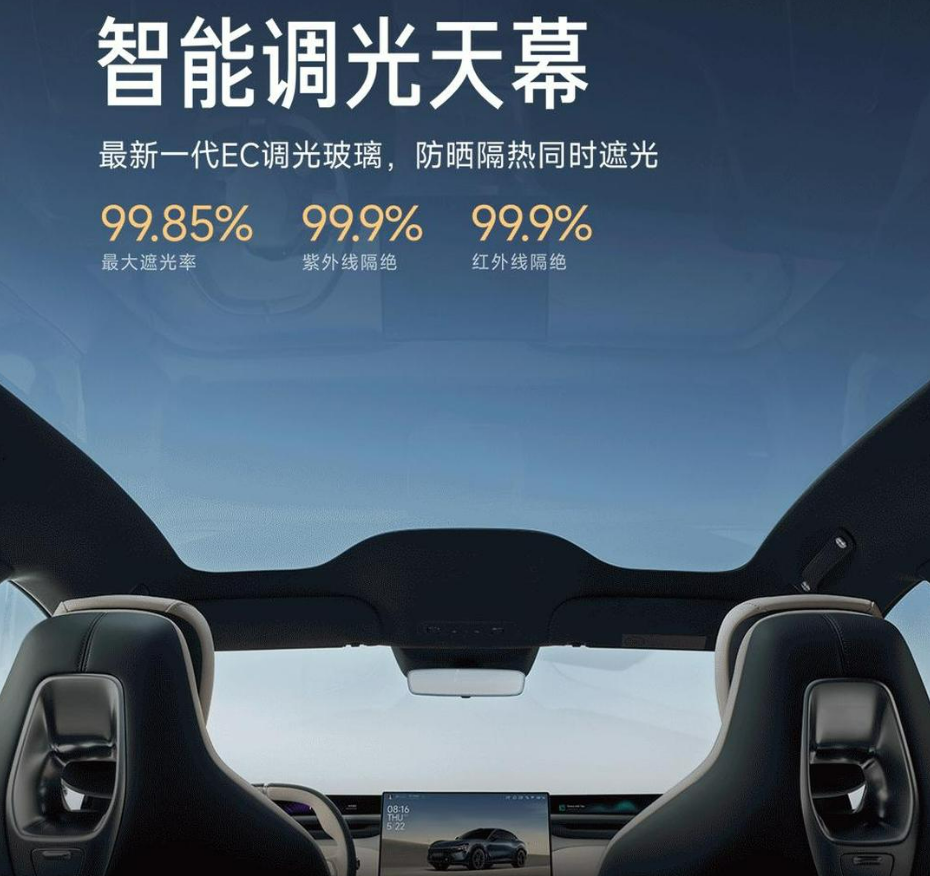
Tinted glass first appeared on sunroofs because pure electric vehicles, with batteries occupying chassis space, have compressed vehicle heights. Traditional sunroofs encroach on headroom, making panoramic sunroofs the only solution. They offer advantages like spaciousness and reduced wind resistance but also introduce a critical issue: excessive heat.
Take Tesla's early large-scale adoption of panoramic sunroofs as an example. These sunroofs only blocked UV rays, not infrared rays, leading to sweltering interiors and scalding heads in summer—a major user complaint. Users were forced to apply tinting films or install sunshades, which were cumbersome, cheap-looking, and aesthetically displeasing.
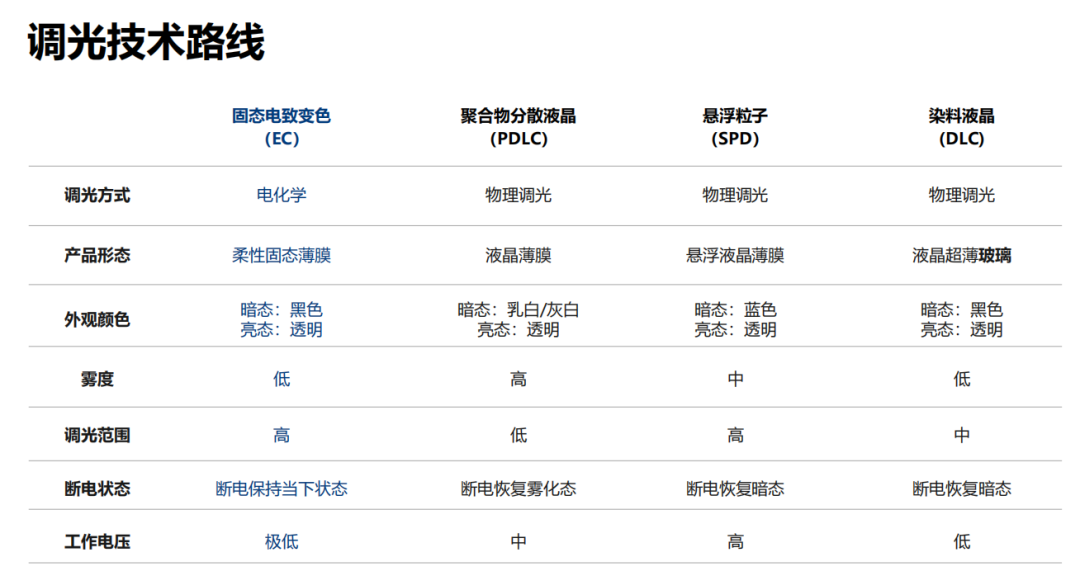
Pain points create opportunities. Chinese automakers, collaborating with their supply chains, seized the moment and introduced actively tinting, heat-blocking electrochromic glass. This technology has two main branches: EC electrochromic glass and LC dye liquid crystal glass.
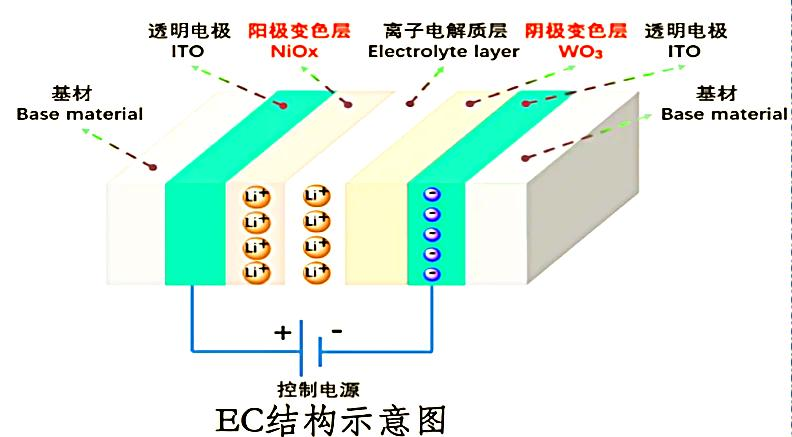
EC electrochromic glass is the optimal solution for sunroofs. It works through ion migration and redox reactions, similar to battery charging/discharging, but requires time to change states. It offers advantages like state retention when powered off, energy efficiency, large-curvature applicability, and stepless dimming. Performance-wise, it achieves up to 99.6% shading, blocks 99.99% of UV rays, and 97% of infrared rays.
LC dye liquid crystal glass, on the other hand, is the king of side-window privacy. It operates through electric field-controlled alignment of liquid crystals and dye molecules, enabling pure physical changes. Its strengths include instant 0.1-second switching, full-black privacy, and zoned control. Models like the NIO ES9, XPeng GX, Seres M9, and ZEEKR S800 exemplify this technology. Like tinted sunroofs, the Zeekr 009 was the first to adopt it.
A clear industry trend is emerging: intense competition is turning aftermarket necessities—modifications, tinting films—into factory-installed standards. Dashcams, soft-closing doors, aviation seats, and ambient lighting followed this path, and so does dimming glass.
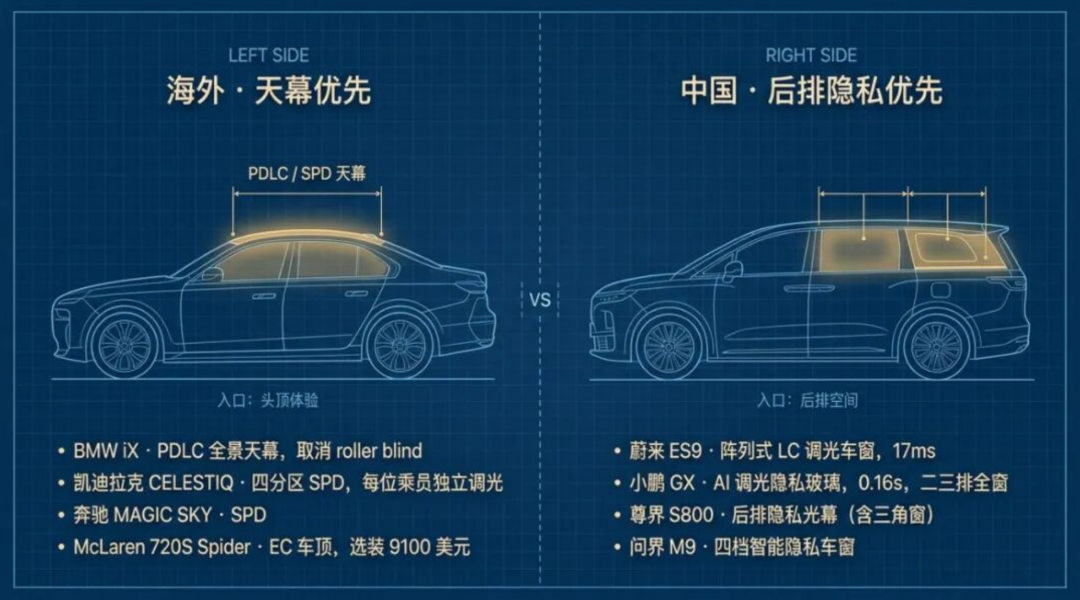
On the positive side, this "user experience frontloading" spares consumers the hassle and expense of post-purchase modifications. On the negative side, it disrupts downstream supply chains and ecosystems, as automakers seek higher profits by "upgrading" their offerings.
Regardless, Chinese technology and supply chains are transforming automotive manufacturing from mere vehicle assembly into "space creation," fully shifting cockpit definition rights. Under the smart cockpit paradigm, glass is no longer just glass—it's a control switch for cockpit scenarios. During commutes, it can be transparent and bright; during rests, it can turn fully black for privacy; in business settings, it enables zoned dimming without interference; in summer, it blocks heat to reduce AC load.
From sunroof sun protection to side-window privacy, from EC technology to LC solutions, from aftermarket modifications to factory-installed standards—Chinese brands are redefining automotive glass value through intense competition, marking a new stage in automotive rivalry.
In the future, smart glass may evolve further, incorporating photovoltaic power generation, virtual reality, display integration, or omnidirectional sensing. However, no matter how the technology iterates, the underlying logic remains unchanged: user-centricity, ultimate experience, and proactive problem-solving. This is the ultimate answer to China's automotive industry competition.
Ultimately, the deciding factor is whether consumers are willing to open their wallets.
Editor-in-Charge: Du Yuxin Editor: Chen Xinnan
THE END
-
![]()
Can Doubao's Paid Subscription Model Succeed?
-
![]()
Understanding China Through DeepSeek's Triple Leap in Valuation
-
![]()
Samsung Home Appliances Exit China: A Strategic Withdrawal Rather Than a Forced Retreat
-
![]()
The Inseparable Dilemma of Gasoline and Electric Vehicles: A Challenge for New Car Sales
-
![]()
Unity Stabilizes Amid AI Disruption Concerns
-
![]()
Shop Till You Drop: Chinese Automakers Step Up Overseas Acquisitions
-
![]()
Electric Vehicles: The Battle of Configurations Extends to Every Detail, Including Glass
-
![]()
Replacing a Rearview Mirror Costs 6,000 Yuan: Why Are New Energy Vehicles Cheap to Buy but Pricey to Fix?