Facing Its First-Ever Loss, Honda Must Reassess Its Pace
 05/18 2026
 527
527
Lead
Introduction
Honda's ambitious push towards electrification has strained its finances, yet it has also illuminated a potential path forward from its current困境 (predicament, a term more commonly used in English to convey difficulty).
In recent years, the new energy transition's impact on the automotive industry has surpassed all expectations, with traditional automakers bearing a heavier cost than anticipated.
In 2025 alone, major European and U.S. automakers faced tens of billions of dollars in direct losses due to adjustments in their electrification strategies. Stellantis reported losses of up to $26 billion, while Ford wrote off $19.5 billion by canceling several pure EV models amid business restructuring—a stark reflection of this seismic shift.
Initially, it was believed that Japanese automakers, with their stringent cost control measures, would fare better. However, reality has proven otherwise.
Toyota saw a 5.5% year-on-year increase in sales for FY2025 (April 2025 to March 2026), but its net profit plummeted by 19.2%, falling into the trap of "increased revenue but decreased profit." Nissan also reported a net loss of 533.1 billion yen. Although this was lower than the previous year's 670.9 billion yen loss, the challenges it faced remained undiminished.
Similarly, Honda's FY2025 results served as both a warning and a clear indication to the outside world that the development challenges it encountered during its corporate transformation were far more complex than they appeared.
Compared to the profit of 1.2134 trillion yen (approximately RMB 57.1 billion) in the same period last year, Honda reported a loss of 414.3 billion yen (approximately RMB 17.787 billion) in FY2025. This marked Honda's first annual loss in nearly 70 years since going public and represented a significant price paid in this transformation battle.
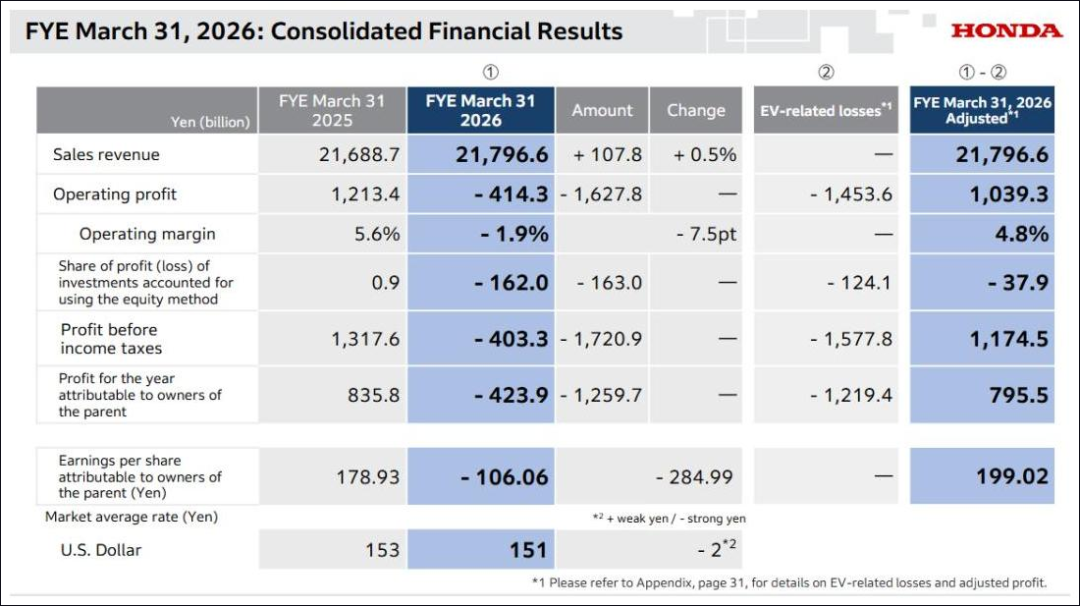
During this fiscal year, Honda's cumulative losses and related expenses from restructuring its EV business amounted to 1.45 trillion yen (over RMB 62.3 billion), the primary cause of the loss.
However, for Honda, the sting of wasted investments paled in comparison to the helplessness of watching the electrification trend reshape the industry landscape while it remained adrift amid the rise of the East.
Perhaps, aside from its electrification investments, Honda maintained its usual prowess in its core business, suffering only a slight hit to profitability. But in the same fiscal year, things cannot be dissected piece by piece. What Honda needs in 2026 is not a paper plan but clear, substantive actions that provide a more definitive judgment.
01
Reckless Electrification Leads to Bitter Consequences
Honda's moves in recent years have been widely interpreted within the industry. Some say Honda has not been proactive enough in its electrification efforts or has misjudged the situation. However, claiming that Honda's stubbornness led it to make wrong choices about the industry's future is overly simplistic.
As early as 2022, Honda announced plans to invest 8 trillion yen (over RMB 400 billion) in R&D to transition toward electrification, aiming to launch 30 pure EV models globally by 2030.
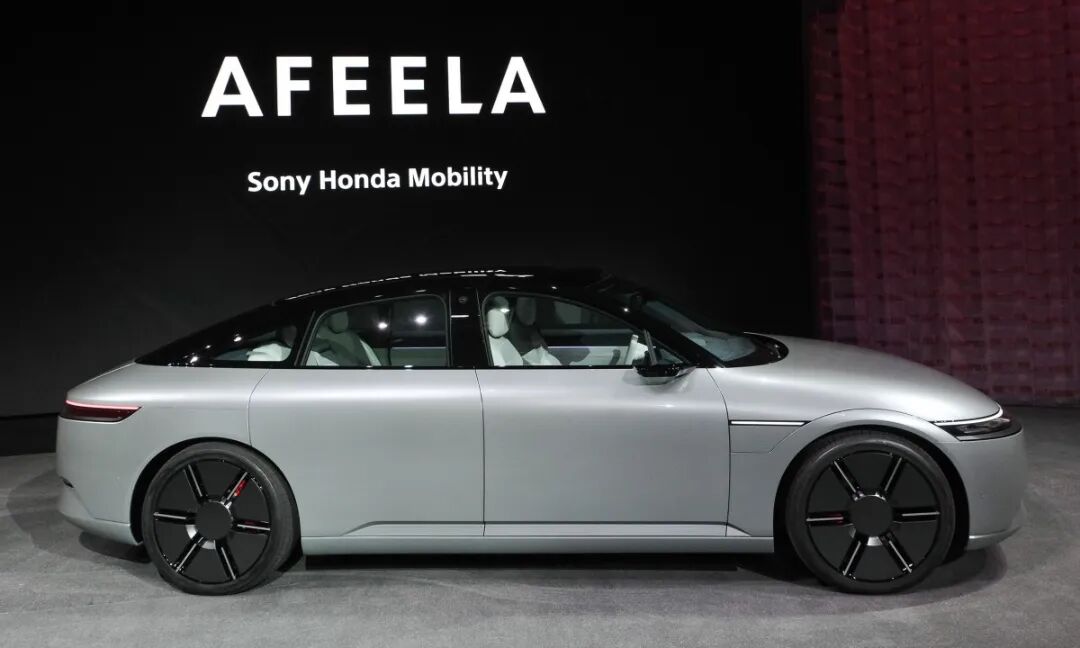
In practice, Honda has been steadily solidifying its electrification strategy. It has introduced one pure EV model after another in major global markets through collaborations or independent R&D.
Honda's efforts in the Chinese market are evident to all and need no further elaboration.
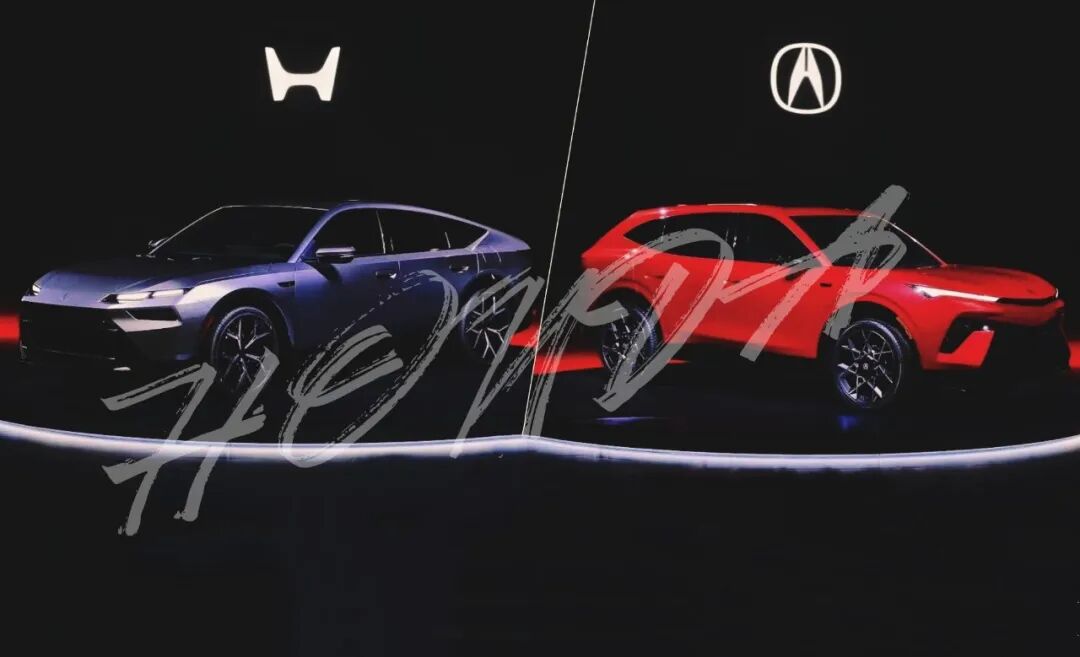
Even in the U.S., the last stronghold for internal combustion engine vehicles, Honda announced a partnership with General Motors in 2024 to launch the Honda Prologue and the all-new Acura ZDX using GM's Ultium platform. During this period, Honda also advanced its Afeela EV project with Sony, introducing several concept models.
Meanwhile, Honda placed an early bet on CATL in 2020, acquiring a stake through a private placement. It invested RMB 3.7 billion to purchase 41.4 million shares at RMB 161 per share and has not reduced its holding since. This move yielded Honda nearly RMB 15 billion in total gains, thanks to CATL's rising stock price and dividends over the years.
Thus, from any perspective, Honda's electrification investments were not as half-hearted as outsiders claimed, nor did it ignore the trend. Instead, these investments left Honda caught between a rock and a hard place during these turbulent times.
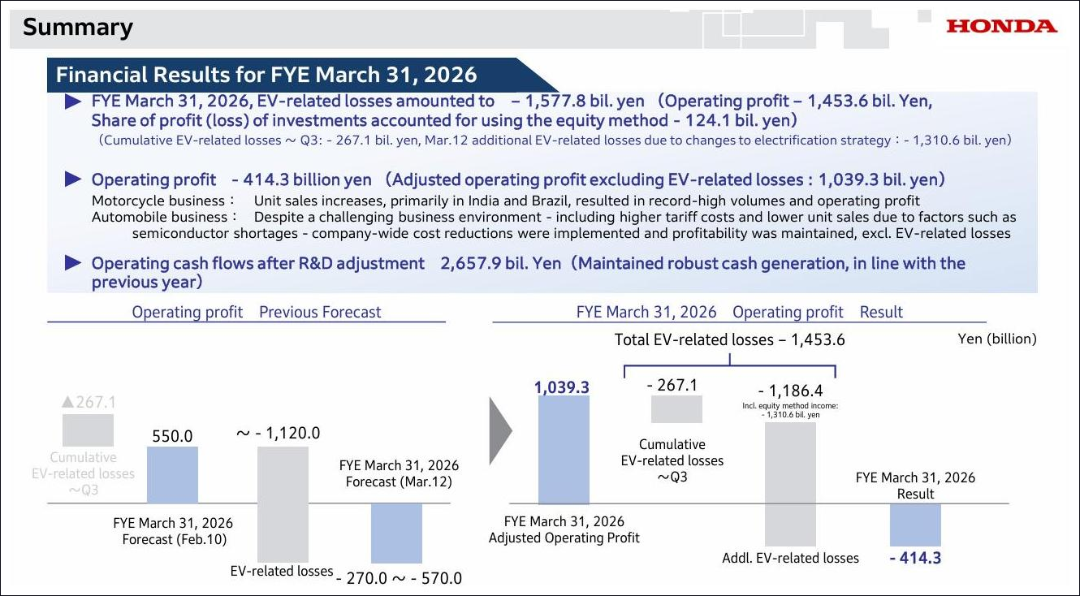
Throughout the reporting period, Honda frequently attributed its losses to one-time impairments from its bet on pure EVs. In other words, without such rapid and massive resource allocations, whether Honda would have incurred a loss this fiscal year remains debatable.
Earlier this year, after halting the mass production of the China-exclusive Ye GT model, Honda CEO Toshihiro Mibe quietly visited China to inspect the local EV supply chain, including tours of automotive component suppliers' factories and production lines. All of this was to refine Honda's electrification strategy further.
Back in Japan, regardless of whether Mibe's summary of his trip was that "Honda has 'no chance of winning,'" one fact remains unchanged: Honda has fully halted all existing EV projects.
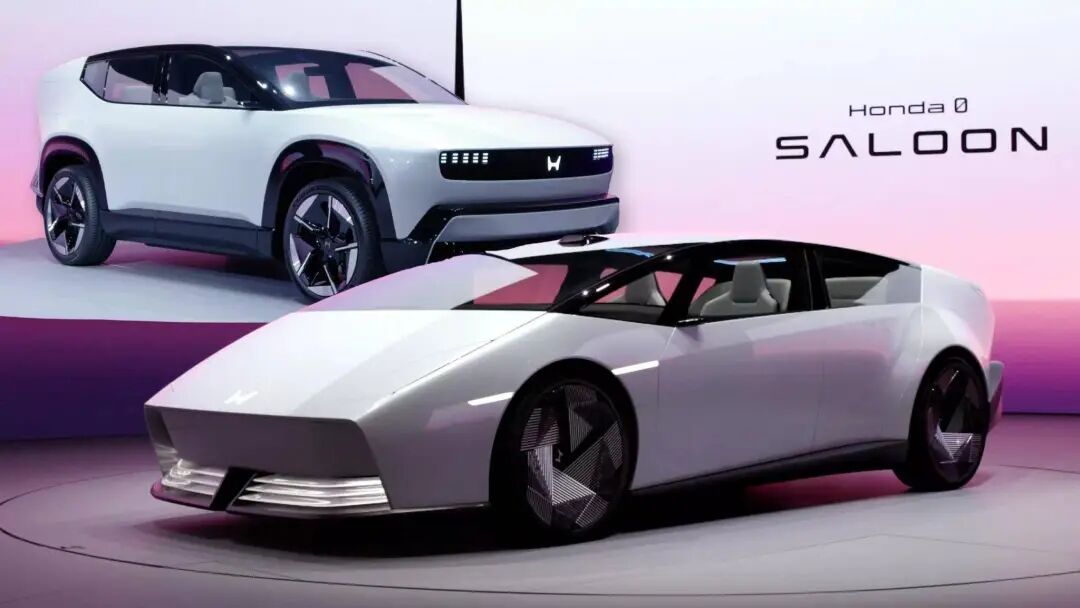
By scrapping long-term goals such as "EVs accounting for 20% of global sales by 2030" and "a full transition to pure EV/fuel cell models by 2040," Honda chose to indefinitely suspend its $11 billion Canadian EV value chain project (including vehicle and battery production). Simultaneously, it fully paused mass production plans for its 0 Series concept cars and terminated its vehicle collaboration project with Sony.
The cost of EV R&D is evident from the collapse of domestic new forces in China. Shutting down so many related projects at once has inflicted considerable losses on Honda. According to statistics, the total annual loss reached 1,577.8 billion yen (approximately RMB 68.3 billion).
Thus, even though Honda's two-wheeler division contributed a record-high profit of 731.9 billion yen with an 18.2% profit margin, the overall result remained unsatisfactory.
02
Learning Lessons and Finding a New Path
The energy transition has made succeeding in electrification feel like a gamble. As a traditional automaker, Honda bet on fuel cells and lost, then eagerly sought to make up for lost ground in the electric era. However, Honda seemed to overlook that the global automotive market's development is far from a simple commercial game.
In the early stages of electrification, subsidy policies in various countries meant that automakers who secured early access could enjoy policy dividends. In the U.S. and China, where Japanese automakers once thrived, they never anticipated how uncontrollable the automotive market's evolution would become.
In the U.S., Honda's pure EV factory renovations were not yet complete when a change in government led to a sharp decline in EV subsidies, causing demand to plummet and extending the payback period for massive upfront investments. The imposition of tariffs further impacted existing operations.
In China, beyond the objective factor of subsidy reductions, Honda was caught off guard by the rapid evolution of Chinese automotive technology.
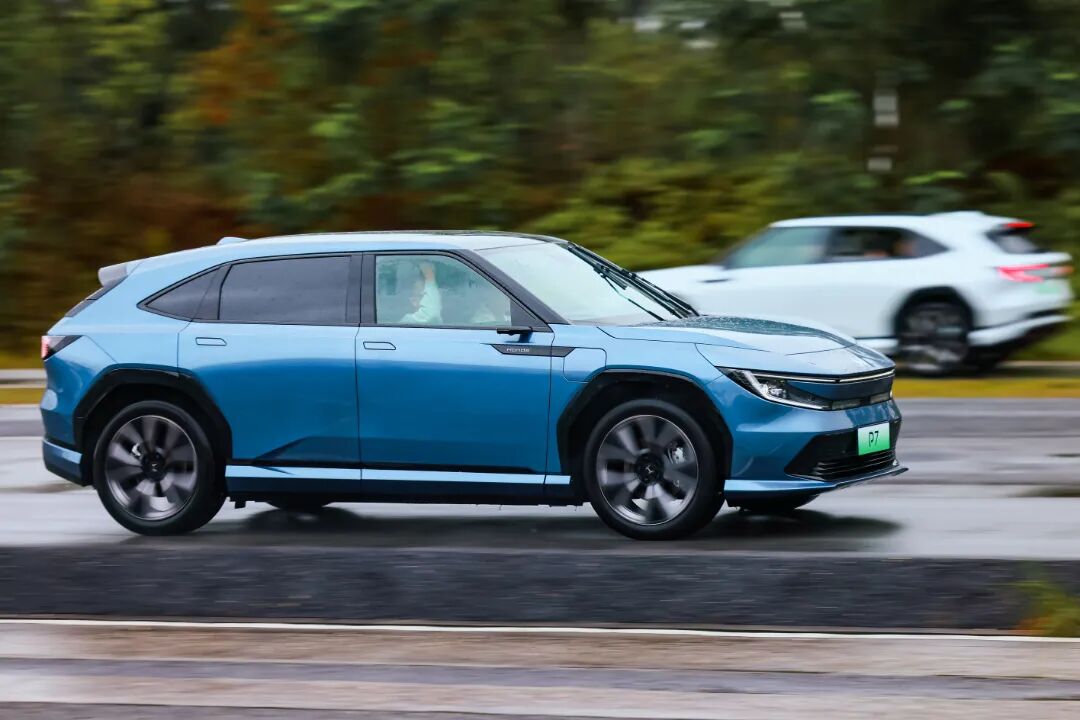
While competitors advanced from electrification to simultaneous electrification and intelligentization in Phase 2.0, Honda continued to promote driving pleasure for its P7/S7 models. The level of interest among Chinese users in advanced intelligent driving systems was inversely proportional to Honda's EV sales.
Once the root causes of the problems were identified, Honda's financial report for 2025 revealed that its revenue from traditional businesses reached 21.80 trillion yen, up slightly by 0.5% year-on-year. This merely indicated that Honda, with a solid foundation, had taken a detour.
More intriguingly, when Suzuki set a new sales expectation based on current conditions, claiming it would surpass Honda to become Japan's second-largest automaker in the next fiscal year, it indirectly proved that Honda's issue was not its inability to tell an electrification story but that it had been telling the wrong story.
Especially in the Chinese market, relying on outdated narratives for future development made little logical sense.
Electrification is not achievable overnight. Honda's first-ever annual loss in 2025 has historical specificity, serving as a wake-up call that a large ship cannot turn on a dime and cannot gorge itself into success.
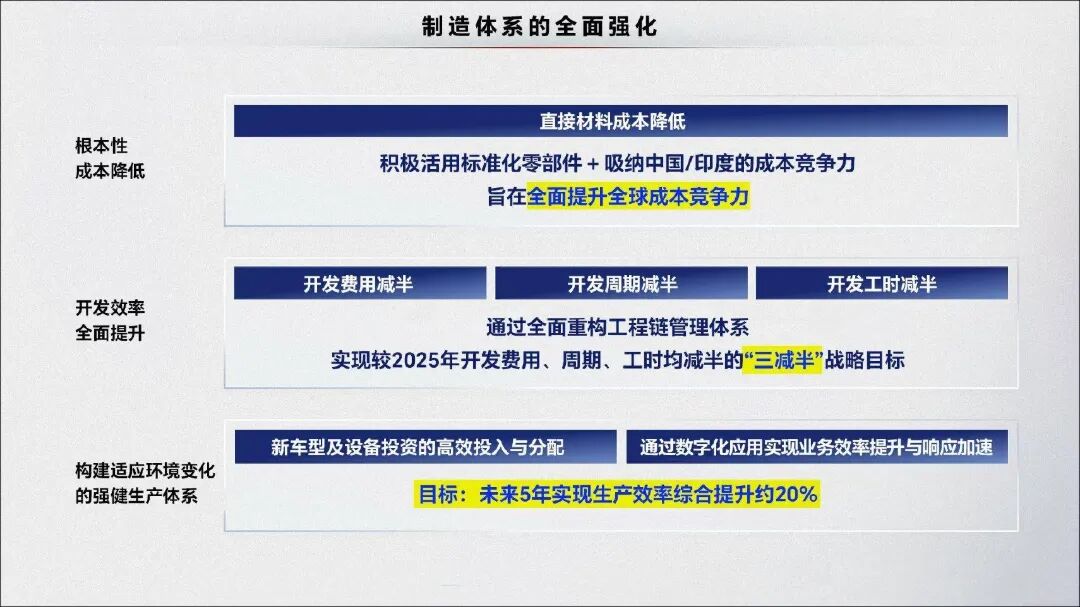
Under the new plan, Honda aims to enhance market competitiveness by optimizing its cost structure, improving R&D efficiency, concentrating operational resources in key regions, and enriching its product lineup with attractive offerings. In simpler terms, after suffering significant losses, Honda finally remembered the importance of tailoring strategies to local conditions.
"Starting in 2027, Honda will introduce next-generation hybrid models featuring an all-new hybrid system and platform. Focusing on North America, it plans to launch 15 models globally by 2029."
In the U.S., where electrification progress has slowed, the hybrid route is gradually replacing the pure EV route—a pragmatic shift based on reality for Honda.
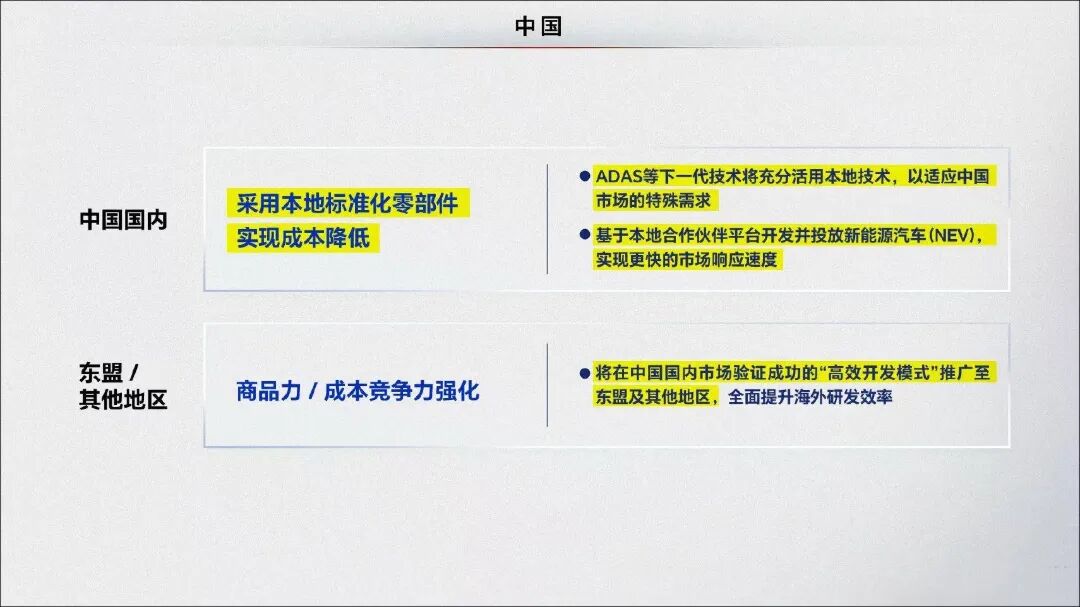
Similarly, in China, Honda announced plans to adopt localized standard components, actively leverage local resources in new technology fields, and launch new energy products based on local partner platforms, enhancing product strength and cost competitiveness at the unbeatable speed of China.
Essentially, after witnessing Toyota, Volkswagen, and General Motors initiate localized R&D and actively collaborate with Chinese enterprises, Honda finally recognized its own shortcomings.
GAC Honda and Dongfeng Honda, Honda's joint ventures, have both revealed plans to leverage Chinese resources to deliver products more suited to the Chinese market by 2027—a direct response to this strategic adjustment.
Perhaps there has been little to celebrate in Honda's news since the beginning of the year. Watching Honda struggle amid relentless doubts and public scrutiny is undoubtedly painful. However, to erase all of this, Honda must rely on a comeback driven by strength—no amount of rhetoric will suffice.
Time is silent but will eventually clarify the causes and consequences of stories from the past, present, and future. Thus, Honda's self-redemption will be reassessed at this time next year.
Editor: Du Yuxin Contributor: Chen Xinnan
THE END
-
![]()
BMW Didn't Bet on the Wrong Path, But Lacks a Toyota-Style Solution
-
![]()
Global Stock Markets Surge in AI-Driven Structural Boom
-
![]()
Leapmotor's Q1 Earnings: Trading Short-Term Losses for Long-Term Growth—Can This Strategy Pay Off?
-
![]()
Gazing into the Future at the 2026 Beijing International Automotive Exhibition: A Peek into the Evolution of Automotive Culture | Cover Story: China-Made for the Global Market – In-Depth Report on the
-
![]()
Leapmotor: Aiming for One Million Sales, but Gross Margin Slips First?
-
![]()
Huazhu: Lightening the Load and Marching Ahead with Agility, Remaining a Leader in the Hotel Industry!
-
![]()
Facing Its First-Ever Loss, Honda Must Reassess Its Pace
-
![]()
Qingdao Fortifies Gas Pipeline Network with 'Unmanned Patrol Vehicles': Ultra-Precise Sensing, Round-the-Clock Vigilance