Qingdao Fortifies Gas Pipeline Network with 'Unmanned Patrol Vehicles': Ultra-Precise Sensing, Round-the-Clock Vigilance
 05/18 2026
 637
637
Introduction
Gas pipelines, often dubbed the 'invisible lifelines' of cities, extend for thousands of kilometers beneath our feet. When issues arise, the consequences can be catastrophic—far beyond mere traffic disruptions; they can lead to explosions.
How does traditional manual inspection work? Inspectors wield handheld detectors and trudge along pipelines, covering just a few kilometers daily. In inclement weather or at night, they rely heavily on 'experience-based judgment.' Blind spots, infrequent inspections, and high risks have plagued the industry for decades.
In 2026, Qingdao unveils a groundbreaking solution: unmanned inspection vehicles paired with humanoid robots, transitioning from 'human-led prevention' to 'technology-driven prevention.' The goal isn't to replace humans but to accomplish tasks beyond human capability.
Here comes the unmanned vehicle (follow us on WeChat Official Account: 'Here Comes the Unmanned Vehicle') to delve into this topic with everyone!
(For further reading, click: 'Hebei's First: Completing a 40-Kilometer Gas Pipeline Inspection Task in 2 Hours—How an Unmanned Vehicle Safeguards a City's 'Gas Heartbeat')
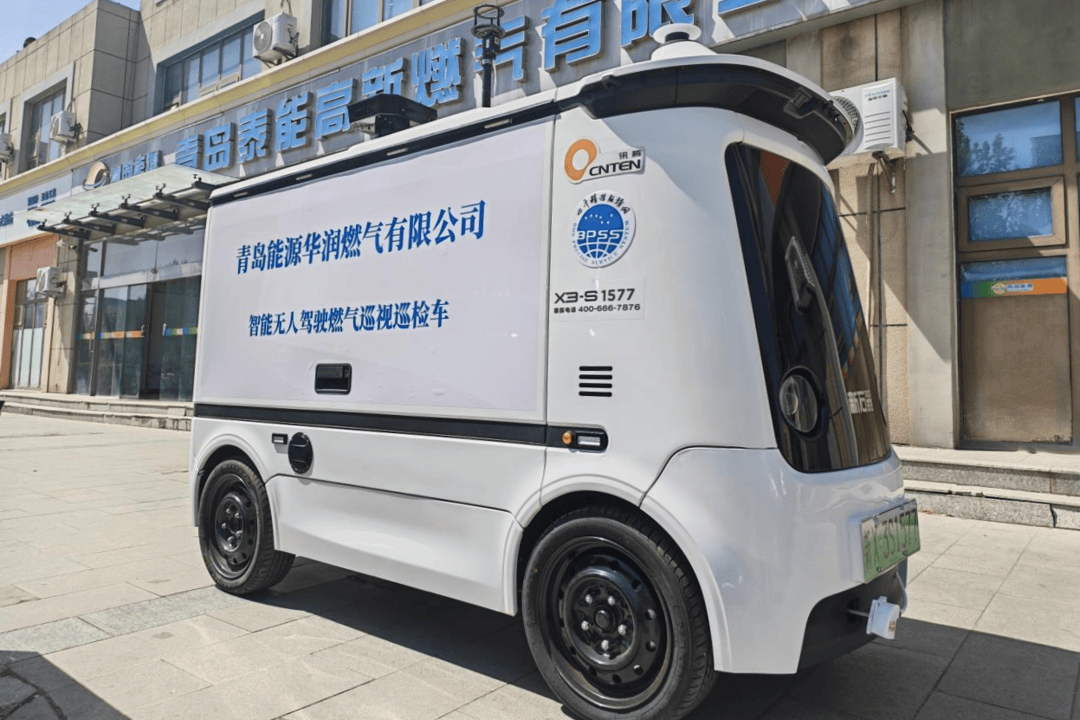
Image Source: Qilu Evening News · Qilu One Point
I. Ground 'Scouts': PPB-Level Sensitivity, Detecting Leaks from 150 Meters Away
Traditional handheld detectors operate at PPM-level (parts per million) accuracy. In contrast, Qingdao's deployed unmanned inspection vehicles boast PPB-level (parts per billion) laser methane detection equipment, enhancing sensitivity by a staggering 1,000 times compared to traditional handheld instruments.
In simpler terms, they can accurately detect a single methane molecule amidst one billion air molecules.
With a detection radius of 150 meters (covering both sides, not just a straight-line distance), the gas pipeline networks within 75 meters on either side are under constant surveillance as the vehicle moves.
Powered by Beidou centimeter-level positioning and GIS systems, the error in locating leak points is no larger than a fist.
In the core area of Qingdao's High-Tech Zone, six preset routes span over 200 kilometers of pipelines. The vehicles autonomously navigate and avoid obstacles 24/7, handling rain, fog, darkness, and complex road conditions—filling in the gaps left by manual inspections in terms of timing and coverage.
Beyond leak detection, these vehicles are equipped with multi-lens AI cameras and edge computing modules to automatically identify third-party damage risks, such as construction excavation.
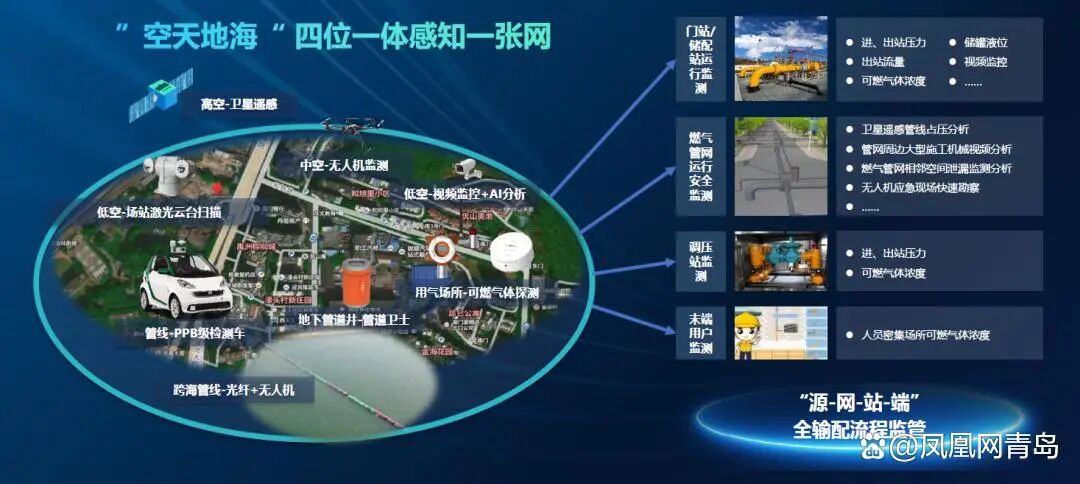
Image Source: Ifeng Qingdao
A remote shouting function has successfully completed laboratory testing—upon detecting illegal excavation above pipelines, the unmanned vehicle can directly issue verbal warnings to halt the activity. This creates a closed-loop process from 'detection' to 'early warning' to 'intervention.'
Qingdao Energy Group is constructing a four-dimensional inspection system encompassing 'air, land, space, and sea':
Drones serve as 'eyes in the sky,' having identified 620 meters of corroded pipelines and covered over 30 kilometers of elevated pipelines;
Iron tower surveillance acts as 'sentinels in the clouds,' with 36 high-position towers across the city, each covering a radius of approximately 2 kilometers;
Undersea pipeline vibration fiber optics function as 'deep-sea touch,' safeguarding 72 kilometers of undersea pipelines in Jiaozhou Bay;
Unmanned inspection vehicles serve as 'ground elites.'
Their collaboration enables the city's 8,323 kilometers of gas pipelines to transition from 'passive investigation' to 'proactive early warning.'
II. Cloud 'Commanders': Humanoid Robots Take Over the Dispatch Hall
In May 2026, the humanoid robot 'Xiaoqiang' will officially commence work in the dispatch hall of Qingdao Energy Group.
With flexible joints and a multimodal perception system, it not only handles security tasks such as environmental monitoring and abnormal behavior recognition but also becomes an intelligent hub connecting the virtual digital space with real-world dispatch operations—assisting in work order processing and on-site coordination, freeing human operators from repetitive tasks.
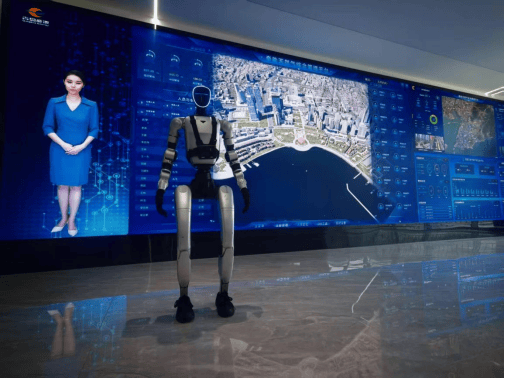
Image Source: Qilu Evening News · Qilu One Point
Working alongside 'Xiaoqiang' is the digital employee 'Xiaowei.'
Leveraging a large-screen visualization system, 'Xiaowei' captures real-time inspection data across the network and uses AI algorithms to conduct millisecond-level risk assessments and early warning notifications.
While humans are still monitoring screens, AI has already identified the risks.
This represents a dispatch revolution underway in Qingdao. Shifting from 'passive response' to 'proactive defense' and from 'human monitoring' to 'AI assessment,' the role of the dispatch center is upgrading from an 'information relay station' to an 'intelligent decision-making hub.'
III. From Gas to Environment: The 'Scenario Dividends' of Unmanned Vehicles
Qingdao's application of unmanned vehicles extends beyond gas pipelines.
In April 2026, Laoshan District pioneered the use of unmanned environmental monitoring vehicles across the province. Equipped with air quality monitoring microstations and intelligent navigation systems, these vehicles continuously monitor seven pollutants in the air, including PM2.5, PM10, and ozone, in real-time.
Measuring 2.6 meters in length and 1.6 meters in height, with 12 surveillance cameras and a 100-kilometer range, these vehicles seamlessly traverse key areas such as industrial parks, residential zones, and forest edges, operating day and night, even in adverse weather conditions.
The vehicle roof features a drone landing platform, enabling drones to monitor larger areas. This 'ground + aerial' approach maximizes environmental monitoring dimensions.
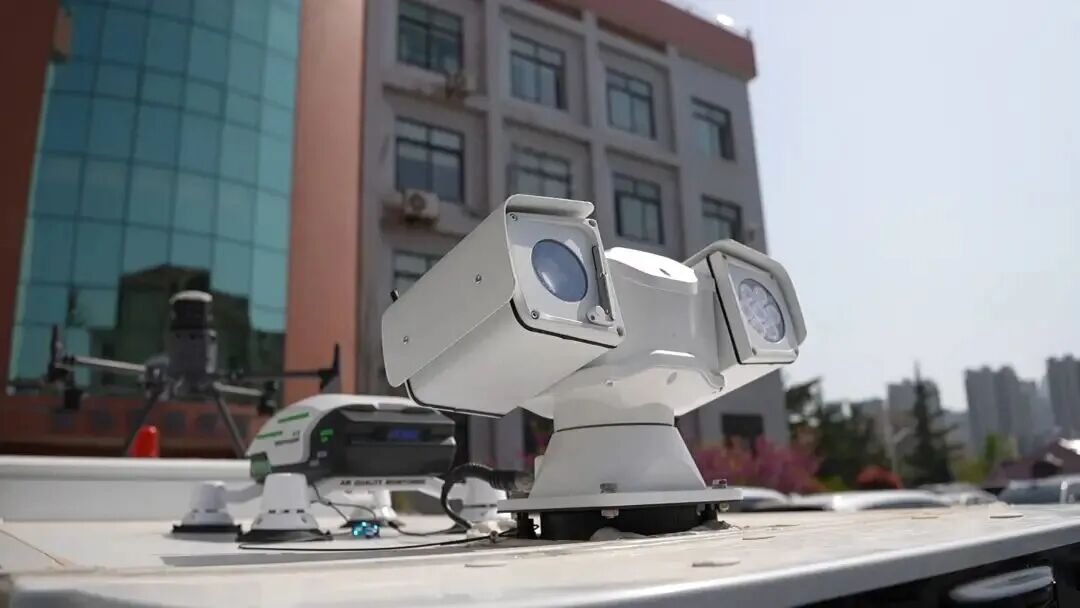
Image Source: Laoshan Release
Previously, Laoshan District had already introduced unmanned boats and drones; with the addition of unmanned vehicles, a 'sky-land-water' three-dimensional monitoring network has been established.
In the first quarter, Laoshan District ranked first in the city for both PM2.5 and PM10 concentrations, with an air quality excellence rate of 81.6%—also ranking first. The continuous enrichment of unmanned monitoring methods is contributing to cleaner air and seas.
In January of this year, Qingdao's first multifunctional urban management unmanned inspection vehicle went online.
It can automatically identify illegal activities such as street vending and improperly stacked materials, issuing immediate verbal warnings to deter them. Covering over 20 kilometers per hour, it operates more than five times faster than manual inspections; during peak hours, it captures over 200 urban management issues per hour, equivalent to a full day's work for ten collectors.
Qingdao has set clear goals for the next three years: by 2027, deploy over 100 intelligent devices, including unmanned inspection vehicles and cleaning robots; by 2028, achieve full coverage of AI application scenarios across six major urban management industries.
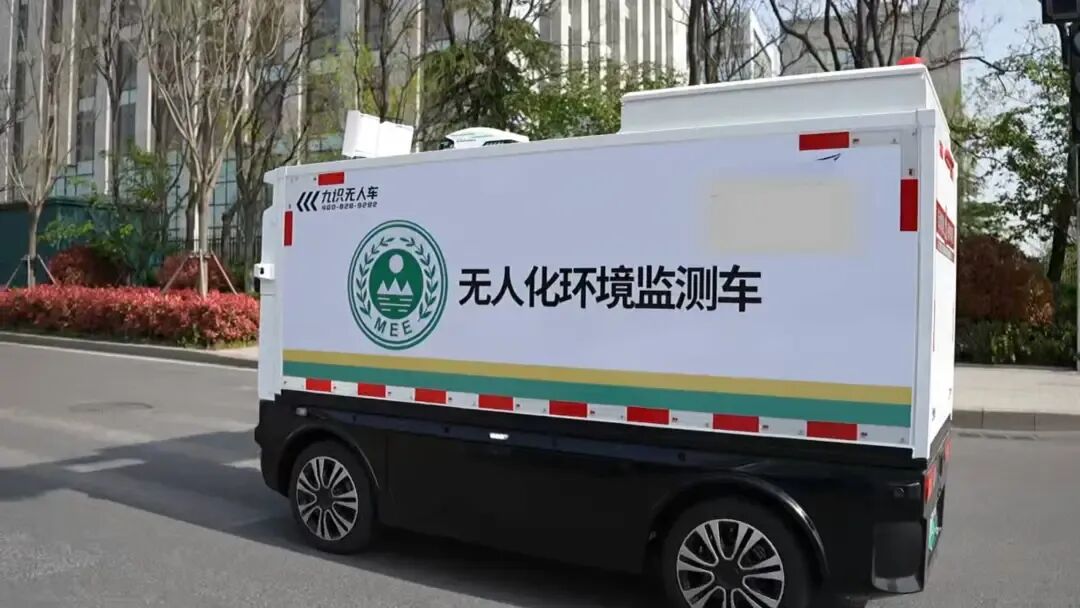
Image Source: Laoshan Release
Qingdao has made a strategic move: it has shifted unmanned vehicles from the narrow realm of 'logistics delivery' into the in-depth battlefield of 'urban public safety.'
Gas pipeline inspection, environmental monitoring, urban management—these fields don't need '9.9 yuan free shipping'; they require '24/7 vigilance, one-in-a-billion sensitivity, and millisecond-level response.'
The technical capabilities of unmanned vehicles precisely match these stringent demands. PPB-level laser methane detection, AI edge computing, and Beidou centimeter-level positioning are not just 'good enough'—they must be this advanced.
Conclusion
Here Comes the Unmanned Vehicle (WeChat Official Account: 'Here Comes the Unmanned Vehicle') believes:
When 8,323 kilometers of gas pipelines acquire 'olfactory senses,' when dispatch halls gain 'AI assessors,' and when street obstructions are deterred by unmanned vehicles' verbal warnings—the 'intelligence' of urban governance truly gains substance.
This is not just a unilateral technological advancement but an upgrade in urban governance philosophy. As unmanned vehicles operate on city streets, they convey more than just goods—they signal that 'this city is becoming smarter, safer, and more compassionate.'
References: Reports from Qilu Evening News · Qilu One Point, China News Service Shandong, Qingdao Daily, Dazhong Daily, Qingdao Evening News, The Paper, Xinhua Net, Laoshan Release, Ifeng Qingdao, and other media outlets.
#HereComestheUnmannedVehicle #UnmannedDriving #AutonomousDriving #UnmannedVehicles
-
![]()
Breaking the Mold: LG, Haier, and Hisense Redefine Online and Offline Home Appliance Sales Strategies in India
-
Lenovo's AI Goldmine: How Long Can Yang Yuanqing Keep 'Feasting'?
-
![]()
Samsung Galaxy Z Fold 8 Review: Ultra-Slim Dual Design Shines, but Telephoto Absence is a Bummer
-
![]()
Dongfeng VOYAH’s New Car Makes a Splash, Targeting More Than Just the 30s and 40s Crowd
-
![]()
Annual Salary of 700 Million Fails to Retain Him! AI Genius Jiahui Yu Departs Meta to Launch His Own Startup
-
Qianwen Seeks to Move Beyond Its 'Alibaba Identity'
-
![]()
How Can We Comprehensively Resolve Ctrip's Monopoly Issue?
-
![]()
From Computing Power Supply-Demand Dynamics to Capital Integration: Jin Jing New Energy Embarks on a New Business Phase