European Cars, Made in China
 05/27 2026
 443
443

「 Global Realignment of Electric Vehicle Production Bases 」
Compiled by | Yang Yuke Edited by | Li Guozheng Produced by | Bangning Studio (gbngzs)
In the early 1970s, Dongfeng Motor imported American trucks and attempted to manufacture off-road vehicles.
Nearly six decades later, Stellantis Group—the parent company of the Jeep brand—is collaborating with Dongfeng Motor to produce a new electric version of this iconic American vehicle, intended for sale in China, the Middle East, and Southeast Asia.
This partnership is the latest example of a broader trend reshaping the global automotive industry: multinational corporations struggling with the costly transition to electric vehicles are turning to China's technologically advanced and cost-effective factories as manufacturing bases for their global operations.
Data from the U.S. consulting firm Rhodium Group shows that when including joint ventures with Chinese companies, foreign automakers account for roughly two-fifths of China's automotive exports to Europe.
Yale Zhang, founder of Shanghai-based automotive consultancy Automotive Foresight, said, "Many joint-venture automakers now use China as an export manufacturing base. Its automotive manufacturing advantages are very clear."
Multinational automakers such as Volkswagen Group, BMW Group, Nissan, and Hyundai Motor Group are leveraging idle capacity in Chinese factories to expand exports to markets outside Europe and the United States.
With the United States strengthening technological scrutiny of China and imposing import tariffs as high as 100%, the U.S. market is effectively closed to Chinese vehicles. In contrast, Europe—despite imposing tariffs of up to 45% on Chinese cars—remains an attractive market.
Automakers from Mazda to Nissan are striving to export Chinese-made vehicles to Europe. Even Volkswagen Group, Europe's largest automaker, has not ruled out this possibility.
Yuqian Ding, a senior China automotive analyst at HSBC, believes this upheaval reflects a "global realignment of production bases," comparable to the shift of U.S. automakers' capacity from Detroit to Mexico over the past 40 years.
"China is playing an increasingly vital role—not just as a low-cost production hub but also as a leader in advanced technology and a massive supply chain advantage."
Western automakers' executives insist that using China—the world's largest automotive market—as an export manufacturing base can benefit their other operations through lower costs and more advanced technology.
However, some European automakers argue that this move is a desperate measure. In reality, they are struggling with declining sales and idle capacity in Europe while contending with a wave of Chinese imports into the European market.
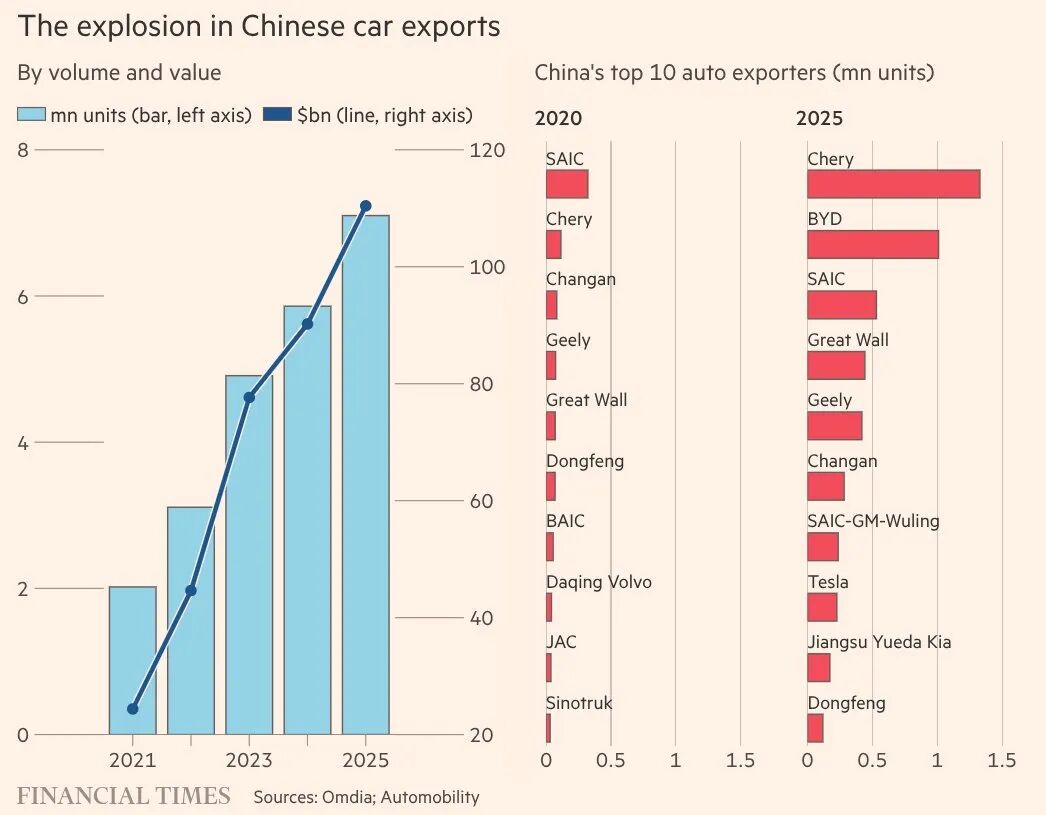
Data from Shanghai-based consultancy Automobility shows that China is already the world's largest automotive exporter. By 2025, Chinese passenger vehicle exports surged from less than 1 million units in 2020 to over 7 million, with momentum still growing. In the first four months of 2026, China exported 3.1 million vehicles, a 61% year-on-year increase.
"We must acknowledge that China is setting the pace of innovation in many industries," said Robert Cisek, CEO of Volkswagen Passenger Cars China, in April. "The fierce competition from China will always be there—either accept it or struggle."
However, some warn of devastating consequences, as Chinese imports could erode production in Europe and other high-cost countries, weakening local manufacturing and supply chains.
Ford and Opel have already begun discussions with partners to produce Chinese-designed vehicles in underutilized European factories.
In the view of Sander Tordoir, chief economist at the Centre for European Reform, "The real risk is that a significant portion of the automotive industry's engineering, production, innovation, and supply chains will ultimately become more concentrated in China."
He added, "The EU must decide whether it is willing to confront China with tougher trade and industrial policies... This could not only encourage Chinese automakers to produce in Europe but also enable their multinationals to continue manufacturing cars here."
 ▍01 China's Automotive Export Surge
A significant view holds that severe overcapacity and slim profit margins are the primary drivers of China's automotive exports.
Last week, Rhodium Group, commissioned by the U.S. Chamber of Commerce, released a report emphasizing that China's $2 trillion trade surplus in manufactured goods is partly fueled by weak domestic demand and hefty subsidies in key sectors like electric vehicles.
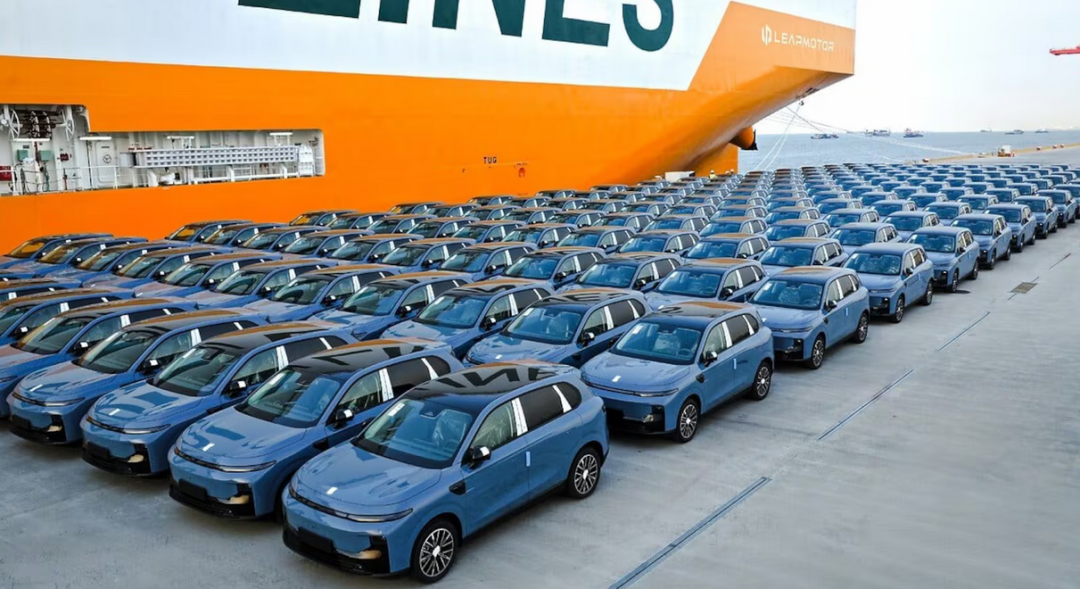
Last year, domestic automotive sales in China totaled 23.9 million units, far below the estimated production capacity of 45 million to 50 million. Since subsidies driving the electric vehicle boom were phased out, growth in the sector has slowed sharply. As a result, brands like BYD, Chery, and MG are flooding overseas markets.
In 2025, Chinese passenger vehicle exports to Europe surged 29% year-on-year to 922,000 units. Rhodium Group data shows this trend accelerated further in the first quarter of this year, with exports rising 72%.
The most notable manifestation of this phenomenon is the surge in Chinese models exported to Europe and other regions. Geely Automobile—owner of Volvo, Polestar, and Zeekr—raised its export target for this year and aims to capture a 5% market share in key regions.
Chery International's growth in Europe has been so rapid that in March, just 14 months after entering the UK market, its Jetour 7 model became the country's best-selling new car.
Guibing Zhang, executive vice president of Chery International, commented in a written interview with the Financial Times that the company's domestic and overseas operations should support each other, with overseas sales driving "brand influence and profitability quality."
Bill Russo, founder of Automobility, added that while Chinese automakers initially turned to exports as "a mechanism to absorb overcapacity," it is now also about improving profitability. Overseas consumers will bear higher prices, yielding fatter margins (compared to the saturated domestic market).
Automobility data shows that in the first four months of 2026, fully electric and plug-in hybrid models accounted for 44% of China's automotive exports, compared to just 7% five years ago—when exports were dominated by internal combustion engine vehicles.
Russo emphasized that this demonstrates China's "long-term export competitiveness," not just in scale and cost efficiency but also technologically.
Foreign brands—often joint ventures between multinationals and Chinese companies—have drawn similar conclusions, leveraging Chinese production capacity for exports while meeting domestic demand.
 ▍02 'Made in China' Sets Global Benchmark
For some time, Western automakers have exported some electric vehicles produced in Chinese factories, but the broader economic environment has reshaped the landscape for multinationals in China.
Chris Liu, a senior analyst at consulting firm Omdia in Shanghai, believes that as competition intensifies and capacity pressures mount in China, exports have become a more practical way to leverage local manufacturing scale.
Initially, these multinationals sought to reclaim market share in China by developing what Volkswagen Group calls "In China, For China" products. When these proved attractive, Hyundai Motor Group swiftly pivoted to use them to boost sales in other markets—a strategy dubbed "In China, For China, Go Global."
Nissan has laid out plans to gradually increase Chinese automotive exports to 300,000 units by 2030. The company plans to export two Chinese electric vehicles—produced in collaboration with Dongfeng Motor—to Latin America, Southeast Asia, and the Middle East.
Dongfeng Motor also collaborates with Stellantis Group.
"The beauty is that when we export these cars, we are profitable," Ivan Espinosa, CEO of Nissan, revealed at the Financial Times' "Future of the Car" summit last week. "Of course, Europe will be one of our potential destinations in the future."
For European and Asian automakers that spent decades transferring expertise and technology to Chinese joint ventures in exchange for access to China's vast market, this shift is an embarrassing moment.
Moreover, it undermines U.S. efforts to push other countries to decouple from China's supply chains.
Automotive executives privately acknowledge that Chinese manufacturing—particularly in electronics and software—is setting a global benchmark, potentially soon displacing models produced elsewhere.
Zhang said Chery is still learning premium craftsmanship from European automakers and "the ability to operate across cultures and languages in a mature way."
He added that China has successfully built the "world's most complete industrial supply chain for electric and plug-in hybrid vehicles," including "clear leads" in battery technology and product development speed.
If Chinese manufacturing has achieved leapfrog development in certain areas, he said, it represents an era of standardization—a model of faster technological innovation and an obsession with user experience.
 ▍03 Import or Collaborate
According to the International Energy Agency (IEA), producing a small gasoline or electric SUV in China costs at least 30% less than in developed economies, partly due to much lower battery pack prices.
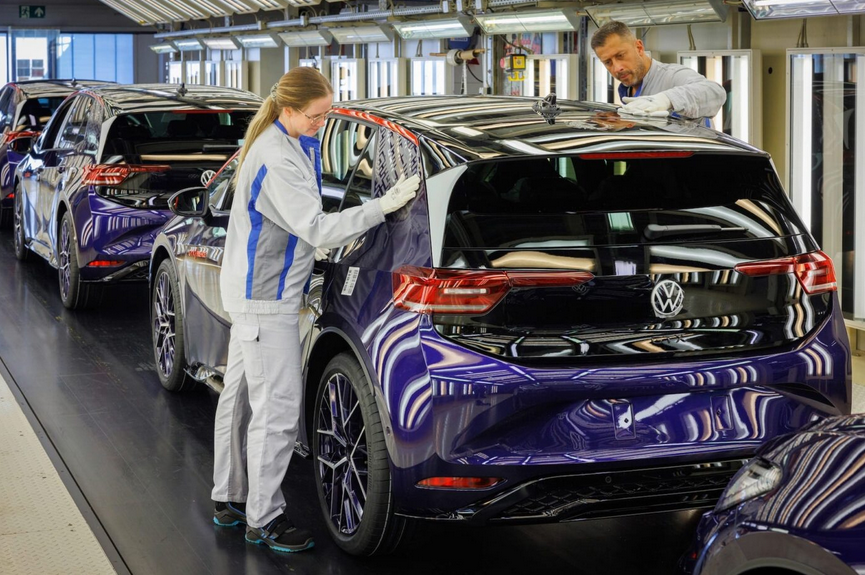
Late last year, Volkswagen Group executives admitted that their electric vehicle production costs in China are half those elsewhere.
Data from S&P Global Mobility and S&P Global Ratings show that for European manufacturers, ramping up exports from their Chinese operations is a double-edged sword, as some factories closer to Europe are operating at less than 50% capacity amid sluggish demand.
Gregor Willinger, an associate director at Roland Berger, said companies like Volkswagen Group and BMW were previously reluctant to export heavily from China due to the risk of cannibalizing European production.
"At this stage, it doesn't make sense for brand image. But if you want to do it, you can," Thomas Schäfer, CEO of Volkswagen Passenger Cars, said at the "Future of the Car" summit.
The move is also politically sensitive. EU leaders and U.S. President Donald Trump have criticized China's export-focused policies, alleging that China has weaponized its manufacturing prowess and made other regions' industrial zones pay the price.
One solution to Europe's underutilized factories is to seek Chinese partners.
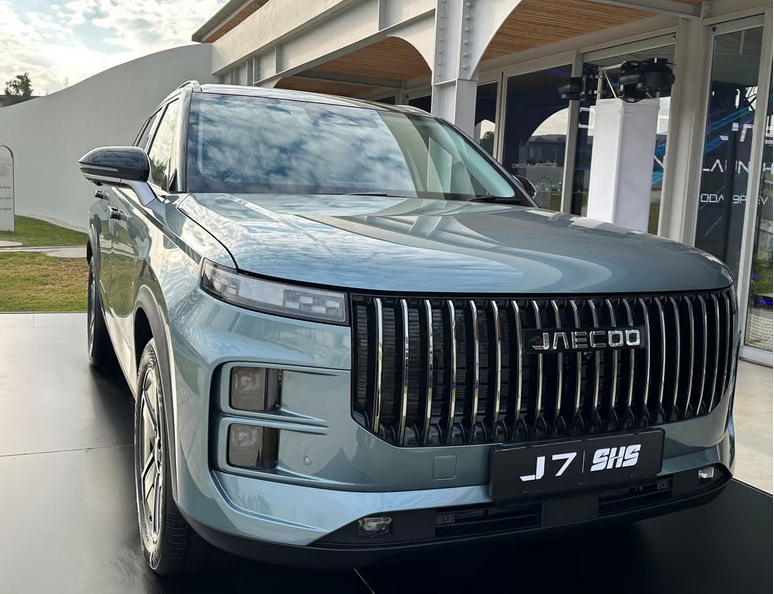
Stellantis Group plans to produce Dongfeng's premium electric vehicles at a French factory currently operating at about half capacity. Another Stellantis brand, Opel, plans to manufacture an electric SUV in Spain using motor and battery technology from Chinese partner Leapmotor.
For global automakers, importing Chinese-made vehicles into their home markets and utilizing idle capacity at Chinese partner factories may dilute their market share, but the cost of inaction could be higher.
"If they don't act, their electric vehicle market share will be taken by the Chinese," said Alasia Zhang, an electric vehicle and battery supply chain analyst at Wood Mackenzie in Shanghai. "Their only option is to compete... either import the cheapest models from China or collaborate with Chinese partners."
 ▍04 EU Caught in Dilemma
European automotive policymakers are attempting to reverse this trend. In March, the European Commission began formulating plans to increase incentives for localization.
The Industrial Accelerator Act makes "European-made" a condition for government subsidies. An official said the bill proposes restricting Chinese technology in vehicles and compelling production to "shift to a certain extent" to Europe.
By 2030, the EU requires at least half of a vehicle's major electronic systems to be manufactured in the bloc to qualify for public funding and corporate fleet business.
However, analysts question the effectiveness of the final measures, as the Industrial Accelerator Act does not aim to completely block Chinese vehicles from the European market.
The EU could adopt more restrictive measures, such as following U.S. rules to ban Chinese software and hardware in vehicles sold in the bloc.
"I think that's something that could happen, and we just have to adapt to it," Håkan Samuelsson, CEO of Volvo Cars, said at a Financial Times conference.
As European and Chinese manufacturers become increasingly interdependent, Brussels faces a delicate task—imposing technology restrictions without triggering a full-blown trade dispute with China.
Ding Yuqian predicted that despite security concerns, cars from China, possibly with the help of European partners, may "gradually" bring more cutting-edge technologies into foreign markets.
Williams from Rhodium Group believes that the fact that European companies are increasingly reliant on Chinese technology and components may put EU regulators in a dilemma.
If they cut off the supply of Chinese technology to Europe, they will stifle their own automotive industry. "But if you don't know the know-how for manufacturing electric vehicles, that would be fatal," he added.
(Part of the content of this article is based on reports from Financial Times by authors Kana Inagaki and Edward White, and some images are sourced from the internet.)
-
![]()
Is the Ultra-Luxury Electric Vehicle a Misguided Concept?
-
![]()
Xiaomi: Facing Decline and Doubting the Future? The Tide Has Turned
-
![]()
European Cars, Made in China
-
![]()
"My Parents Have Been Driving Their Gasoline Car for Over a Decade, Yet My Electric Vehicle Needs Replacing After Just 4 Years"
-
![]()
Qwen: A Driving Force Behind Alibaba Cloud’s Evolution
-
![]()
SAIC’s Milestone of 100 Million Vehicles: A Testament to SAIC Volkswagen’s Contribution!
-
![]()
New Energy Online Taxis: A Smooth Ride, Except for the Non-Stop Vomiting
-
![]()
Alipay Unveils the Globe’s Pioneering Token-Based Payment Service: Will the AI Era Revolutionize How We Pay?