The Underestimated 'Cash Cow' and Its Transformation Potential: Unveiling the Long-Term Value of Autohome
 06/02 2026
 492
492

From the era of personal computers to smartphones, and now into the AGI age, China's automotive industry is undergoing unprecedented transformations. Energy sources are transitioning from traditional fuels to electrification, with new energy vehicle adoption surpassing 50%. Domestic automotive brands are on the rise, consistently ranking first globally in production and sales for many years.
Amidst this dynamic environment, automotive media must not only keep pace with advancements in media technology and shifting audience preferences but also undergo self-renewal. Simultaneously, the profound restructuring of the automotive industry and accelerated changes in vehicle sales models necessitate a comprehensive reshaping of their business models.
As the most established and largest automotive information platform in the industry, Autohome has embarked on a new round of self-transformation after becoming part of the Haier family.
The current groundwork being laid is precisely in preparation for a significant leap forward.
[Synergistic Acquisition: Value Set to Flourish]
Impacted by the traditional off-season in the first quarter and the phase-out of subsidy policies, China's auto market experienced its "toughest" start in a decade this year.
According to data from the China Automobile Dealers Association, retail sales of passenger vehicles in the first quarter reached 4.226 million units, a year-on-year decline of 17.4%, marking the worst performance for the same period in a decade (excluding the extraordinary COVID-19 period in 2020).
Not only did sales volumes decline, but profit margins in the automotive industry remained under pressure. The industry-wide profit margin in the first quarter stood at just 3.2%, its lowest level on record.
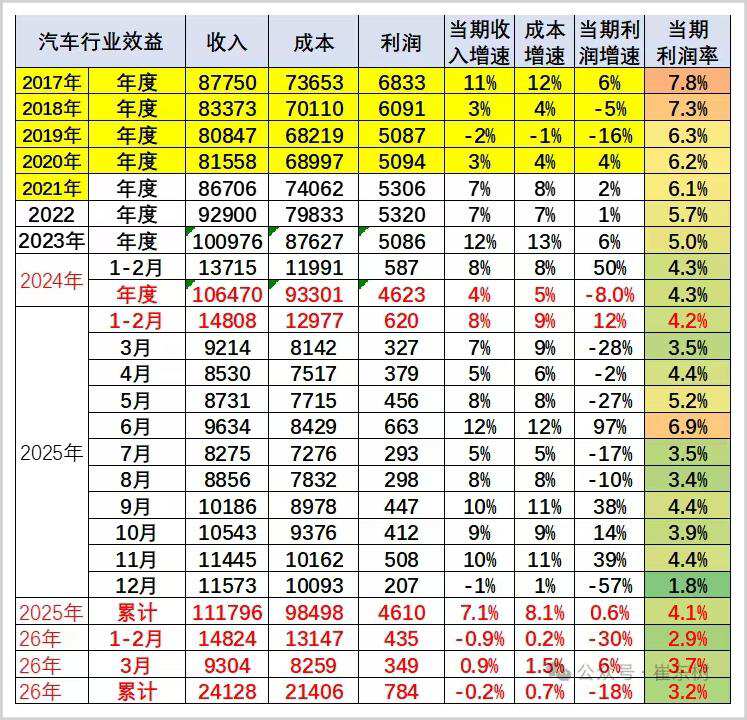
▲Source: Cui Dongshu's WeChat official account, Secretary-General of the China Automobile Dealers Association Automotive Market Research Branch
Amidst the dual pressures of an overall market downturn and intensified competition, Autohome, the largest domestic automotive content platform, demonstrated relative stability in the first quarter, with total revenue reaching RMB 1.048 billion.
According to the latest earnings report, the company adhered to its transformation strategy of becoming a "one-stop automotive ecosystem service platform" in the first quarter. This involved deepening its content ecosystem barriers, accelerating AGI implementation, and exploring overseas incremental markets.
Notably, the company boasts a total cash balance of RMB 20.04 billion. Its cash position is not only abundant, but its asset structure is also very healthy, with no short-term or long-term borrowings and a low debt ratio of just 14%, indicating high asset quality.
Autohome can be considered a highly undervalued asset among A+H shares. Given its abundant cash and healthy financial structure, Haier's acquisition of Autohome for USD 1.8 billion last August was a steal, with the purchase price even falling below the acquired company's cash holdings.
From the perspective of the acquisition's purpose, this integration is poised to generate significant synergies. The acquiring entity, Haier's Catarchi Holdings, is an industrial internet platform that integrates used car trading, automotive customization, and new energy infrastructure. Its used car business revenue exceeded RMB 10 billion in 2024, with over 300 offline franchise stores, placing it among the top players in China's used car sector.
By the end of 2025, Autohome's TianTianPaiCar had facilitated over 1.5 million used car transactions, with a cumulative transaction volume of RMB 170 billion.
Following Haier's acquisition, the company will promote deep online-to-offline (O2O) integration, forming a closed-loop "content→transaction→service" ecosystem that seamlessly connects content reach, transaction conversion, and service closure. Looking ahead, it can further collaborate with Haier to create a "vehicle-home interconnected ecosystem," bridging "vehicle" and "home" scenarios.
Haier's acquisition is clearly not just about acquiring a website but securing a super entry point for Chinese automotive users, massive data assets, a national-level APP, and a mature online service network. It aims to build a "vehicle-home integration" ecosystem and seize dominance in automotive circulation and the aftermarket.
Three months after the acquisition, Autohome officially launched its mall business, with 15 leading automotive brands such as BYD, Leapmotor, and Avatar setting up shops.
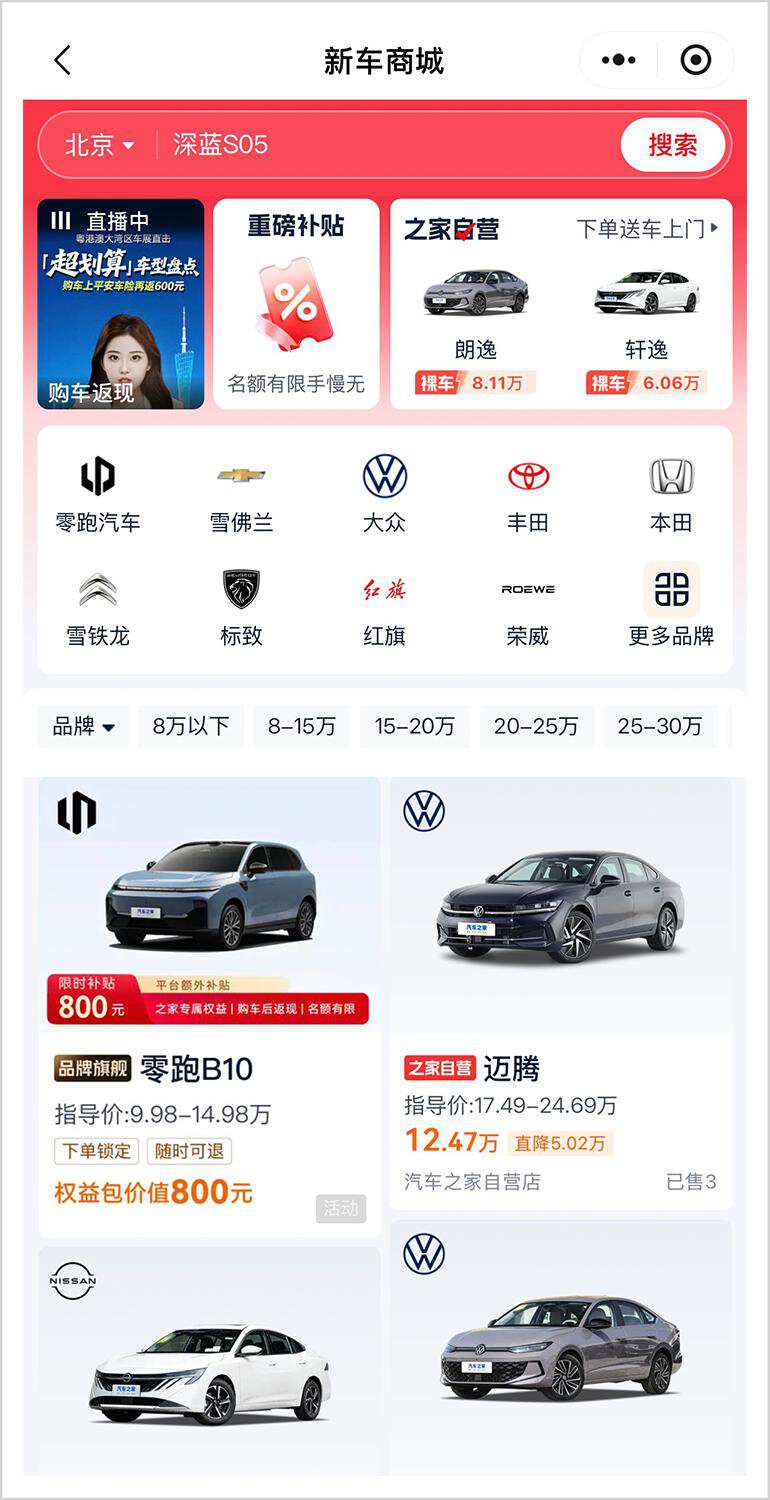
▲Autohome Mall
On April 21 this year, Autohome announced an upgraded new retail strategy, continuing its transformation from a single automotive content platform to a one-stop comprehensive service ecosystem platform. It pioneered the launch of a new "online car purchasing" function in Shenzhen and Xi'an, allowing users to complete the entire process of selecting a car, placing an order, financial approval, and invoicing online.
Judging from its performance in 2025 and the first quarter of this year, the company continues to deepen its strategic transformation. However, this inevitably brings short-term "growing pains," affecting earnings growth.
In the automotive circulation industry, transformation costs are incurred upfront, while profit release is delayed, which is unavoidable. Investors need to view this objectively and rationally.
Last year, the company increased operating costs by RMB 385 million to build an omnichannel, nationwide dealer ecosystem network and boost AI investments, with R&D spending exceeding RMB 1 billion. Nevertheless, Autohome's cash flow remains stable, with sufficient capital reserves to confidently pursue business transformation.
As a world-class home appliance leader, Haier adheres to a long-term investment philosophy in both biopharmaceuticals and technology. As a company insider stated, "For Autohome to truly transform from a vertical media platform to a transaction platform, this battle may take three to five years. We pursue long-term value. Current fluctuations will not affect shareholders' confidence in Autohome, nor will they alter the established strategic direction."
As reforms deepen, its long-term value release is worth anticipating.
[Business Model Reconstruction: A Profound Transformation]
Transforming from a single automotive content platform to a one-stop comprehensive service ecosystem platform covering content, transactions, and after-sales services is Autohome's current business narrative logic.
Since Li Xiang founded Autohome on June 1, 2005, the company rapidly grew during the golden age of PC-era portals and quickly became an absolute giant in the automotive vertical media space, leading Li Xiang to admit, "After 2009, we never encountered any significant competition."
Born in an era of information asymmetry, Autohome grew rapidly by building trust. However, with dramatic changes in media forms and audience attention shifting to platforms like short videos, coupled with intensified competition in the automotive industry and pressure on profitability, automakers' rigid advertising spending gradually declined.
In 2025, China's passenger vehicle sales grew by 3.8% year-on-year, further slowing from the over 5% growth in 2023 and 2024. Automakers slashed advertising spending by 18.5%.
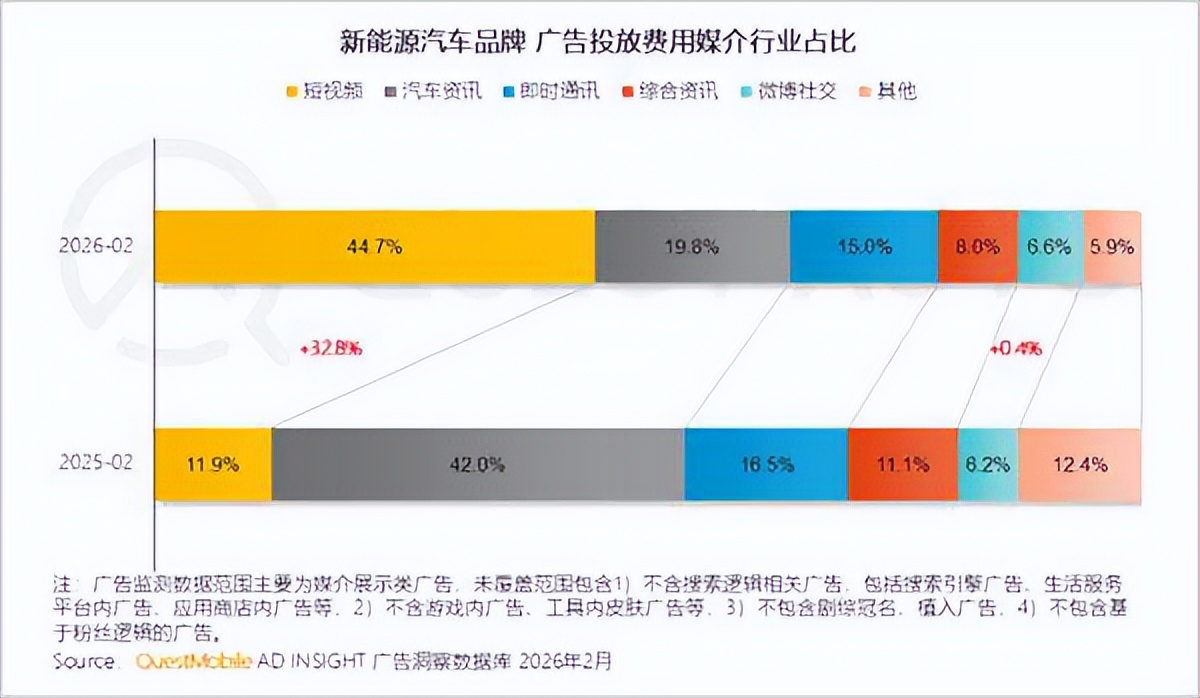
Moreover, automakers' advertising efforts now focus on platforms like short videos. QuestMobile data shows that in February this year, short video platforms accounted for 45% of new energy vehicle brand advertising spending, while automotive information platforms saw a sharp decline.
Meanwhile, new forces are ramping up self-operated channels, putting immense survival pressure on automotive dealers. Autohome's traditional businesses—media services and lead generation services—inevitably declined, making transformation imperative.
After 20 years, Autohome is no longer content with being a mere "reference manual" for consumers before buying a car but aims to become a "steward" for the entire automotive lifecycle, accelerating its expansion into content ecosystems, new and used car transactions, and after-sales services.
In the first quarter of this year, the company continued to deepen its new retail strategy centered around the "Autohome Mall."
Car transactions are low-frequency, high-ticket, and strongly trust-dependent. Leveraging its 20-year trust assets, the company is accelerating their conversion into transaction value, addressing industry pain points of "lack of trust and cumbersome transactions." From "helping users choose cars" to "helping users buy good cars," it truly completes the last mile of "car viewing-selection-purchase."
For example, the "online car purchasing" function launched in Shenzhen and Xi'an allows users to complete the entire car-buying process online. By integrating its dealer ecosystem, Autohome Mall even offers "home delivery" services, significantly enhancing the car-buying experience.
Autohome has also deeply integrated its self-developed Changjie Large Model, achieving full-scenario smart coverage through AI assistants to precisely capture user needs, greatly improving transaction efficiency and experience. Meanwhile, it leverages AIGC technology to boost original content productivity.
In the used car sector, the collaboration between the two parties holds even greater promise. Leveraging the mature ecosystem of "Used Car Home" and Catarchi's strengths, a full-chain trust model has taken shape.
Unlike the chilly spring in the new car market, China's used car market is thriving, especially for new energy used cars, which are growing rapidly. In the first quarter of 2026, used car transactions reached 4.822 million units, up 4.66% year-on-year, with new energy used car transactions surging by 40%.
In 2025, China's used car transactions reached approximately 20.11 million units, with a turnover rate (used car sales/passenger vehicle parc) of less than 5.5%, far below Europe and America's 10%-15%.
Given that China's automotive production and sales have ranked first globally for 17 consecutive years, the used car market's explosion is only a matter of time.
Just two days before the brand renewal press conference, Catarchi held a national investment promotion conference for its automotive ecosystem platform, signing over 70 partners on-site. With Autohome's comprehensive new retail strategy upgrade, the two sides officially established a one-stop ecosystem for "new car transactions + used car trade-ins + full-cycle vehicle services."
Meanwhile, Autohome launched a used car cross-border export service platform in the first quarter, creating a dual-wheel-driven pattern of "domestic service quality and efficiency improvement + global market expansion."
As this profound transformation advances, Autohome will break through the commercial model ceiling of its past reliance on "advertising + leads," ushering in a new chapter in its business narrative.
[Building Automotive Ecosystem 'New Infrastructure': Unleashing Hidden Value]
Across A+H shares, Autohome is a rare high-quality asset; as reform results materialize, the release of its capital value is worth watching.
First, Autohome remains the national-level super platform in the vertical automotive space, with a solid position. It boasts over 80.73 million mobile DAUs (QuestMobile), over 500 million cumulative APP downloads, covers 100% of domestic car models in its database, and produces over 100,000 pieces of professional content annually.
Second, it has abundant cash, stable profitability, and generous dividends. Currently, the company has net assets of RMB 22.17 billion and total cash of RMB 20.04 billion, yet its total market capitalization is just HKD 16.3 billion. Its market value is not only below its net assets but also less than its cash holdings, making it a classic "cigar butt stock" in Graham's terms.
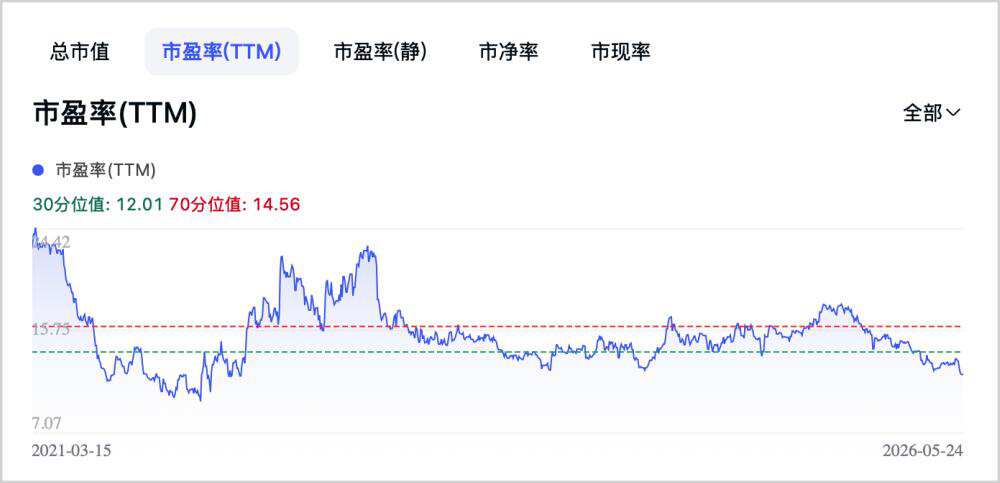
▲Autohome (H-share) P/E ratio, Source: Finscope
Third, its transformation scarcity is significant. As an industry expert noted, "China doesn't lack automakers, but in the domestic automotive circulation industry, a deeply integrated online-offline service ecosystem is still absent."
After Haier's entry, compared to peers like Dongchedi and Yiche, Autohome has built a differentiated competitive barrier of "vertical depth + ecological breadth." Not only does it leverage Haier's resources to secure more automaker partnerships and collaborate with Catarchi to create an "O2O" industrial internet platform, but it can also synergize with Haier Smart Home's ecosystem to build a "human-vehicle-home" full-scenario IoT ecosystem, which is unique in the industry.
Fourth, compared to its U.S. counterparts (Carvana, Copart, CarGurus), the company's P/E is far lower.
The more mature U.S. automotive aftermarket, valued at over USD 414 billion, has spawned giants like CarMax, Carvana, and AutoZone. However, China's automotive aftermarket remains a "sleeping gold mine" awaiting excavation.
Notably, Carvana's revenue grew from USD 352 million in 2016 to USD 20.322 billion in 2025, with a compound annual growth rate of 57%. Last year, its used car sales grew by 43%, with an annual refurbishment capacity of 1.5 million units. After Haier's acquisition of Autohome, it is approaching Carvana's business model.
In comparison, Carvana's current market capitalization is approximately USD 75 billion, with a P/E (TTM) exceeding 50x; AutoZone has a total market cap of USD 56 billion, with a P/E over 23x; Copart, which specializes in online car auctions and vehicle remarketing, has a total market cap exceeding USD 32.5 billion, with a P/E over 20x.
Autohome, however, has a P/E of just around 10x and a P/B of only 0.6, indicating it is historically undervalued.
Meanwhile, to reward investors and demonstrate its long-term value, the company planned on March 5 to repurchase up to USD 200 million worth of shares over the next 18 months, representing up to 10% of its total share capital, while also planning to distribute RMB 500 million in cash dividends, further solidifying investor confidence.
Share buybacks and dividends support the stock price, while future transformation offers growth potential.
For 17 years running, China has held the top spot globally in terms of automotive production and sales. This vast market boasts annual production and sales figures that exceed 34 million units, along with a vehicle parc that has surpassed 366 million.
What China's auto market needs most urgently is not yet another new car manufacturer, but a company that can drive industrial transformation and cater to evolving consumer needs through the establishment of "new infrastructure" within the automotive ecosystem.
Autohome emerges as one of the most promising contenders in this regard.
Disclaimer
The information concerning listed companies in this article is grounded in the author's personal analysis and assessments, which are drawn from publicly available information (including, but not limited to, interim announcements, periodic reports, and official interaction platforms) as mandated by law. The information or viewpoints presented herein should not be construed as investment advice or any other form of business recommendation. Market Value Observer disclaims any liability for actions taken based on the content of this article.
——END——
-
![]()
Users’ Willingness to Pay for Office Intelligent Agents Is Taking Shape, with Business Model Validation and Experience Optimization as Key Challenges for the Next Phase
-
![]()
AI-Driven Shopping Frenzy Unfolds at This Year's 618 Festival
-
![]()
AI-Powered Photo Editing is All the Rage! Is GPT Image 2 Being Overused, Leading to a Surge in ‘Photo Deception’?
-
![]()
Guide to Avoiding Pitfalls When Buying a TV
-
![]()
AI Cloud Midfield Battle: Alibaba Bets on Scale, Volcano Showcases Traffic, Baidu Deepens Moat
-
![]()
From Chips to Safety Guarantee, BYD Completes the 'Last Mile' of Assisted Driving
-
![]()
The Underestimated 'Cash Cow' and Its Transformation Potential: Unveiling the Long-Term Value of Autohome
-
![]()
A Staggering 2.3 Billion Yuan Loss: What's Ailing Li Auto?