Honda is not giving up; it's teaming up with Nissan to keep fighting
 07/03 2026
 437
437
Lead
Introduction
The cooperation is “progressing quite smoothly, and in some aspects, it is close to being announced.”
At Honda's annual shareholders' meeting last Friday, current CEO Toshihiro Mibe secured support for his re-election as director. The atmosphere at the meeting was as tense as that of Nissan's previous shareholders' meeting. Just last month, Honda delivered its first annual loss in seven decades, prompting Mibe to apologize to shareholders at the outset.
The direct cause of the loss was the more than $9 billion restructuring cost of its electric vehicle business, while aggressive pursuit by Chinese competitors has added significant pressure in key markets. Management was further caught off guard by the full implementation of U.S. tariff policies and the concurrent cancellation of subsidies for electric vehicles, making Honda's bet on North American electrification suddenly much more challenging.
Mibe admitted at the meeting that after the subsidies disappeared, the actual market share of all-electric models in the U.S. was far lower than the company's earlier projections. If the original plan proceeded as scheduled, that sales model would mean the entire electric vehicle business would remain unprofitable for at least five, possibly seven years—an extremely critical situation for the company.
He acknowledged that shareholders' calls for management accountability were reasonable but emphasized that his true responsibility as CEO was not to step down but to quickly return the company to a growth trajectory, delivering “mobility solutions that only Honda can provide” and acting with a sense of urgency.
Another focal point for shareholders was Honda's apparent strategic pivot. A few years ago, Mibe boldly proposed an “electric vehicles first” approach, but now the company has quietly abandoned this route, instead prioritizing hybrid vehicles. Some shareholders saw this as validation of their initial concerns, while others viewed it as a pragmatic adjustment to reality.
In fact, Honda has canceled the development plans for two next-generation 0-Series all-electric models, including one originally planned under the Afeela brand, a joint venture with Sony. The project to build electric vehicles and a supporting supply chain in Canada has also been frozen. Last month, Mibe abandoned the goal of completely halting sales of gasoline-powered vehicles by 2040.
Currently, Mibe's strategic focus has clearly shifted toward hybrids, while significantly scaling back all-electric ambitions. His new target is for next-generation hybrid models to become the mainstay of recovery before 2030, with the first model debuting next year. A total of 15 new hybrid models are planned globally, primarily targeting North America. By 2030, the global sales target for hybrids has been raised from 2.2 million to 2.5 million units.
01 Honda-Nissan-Mitsubishi: Still an Alliance?
While acknowledging mistakes and adjusting strategy, Honda also actively showcased another path forward at the shareholders' meeting, heavily promoting its upcoming cooperation with Nissan. Mibe stated that the cooperation is “progressing quite smoothly, and in some aspects, it is close to being announced,” with both sides advancing various projects in a mutually beneficial relationship.
In fact, Honda, Nissan, and Mitsubishi Motors have entered the final negotiation stage on standardizing next-generation automotive electronic control units (ECUs). The ECU is the foundation for software operation and a core component controlling functions such as autonomous driving and in-vehicle information systems. By jointly procuring this key part, the three Japanese companies hope to develop more cost-competitive vehicles.
Data shows that the combined global sales of Honda, Nissan, and Mitsubishi reached 7.3 million units in fiscal year 2025. The expanded procurement scale brought by parts standardization will directly reduce per-unit costs, helping them better compete against Chinese automakers and Tesla in the U.S. After all, these two parties are clearly ahead in the intelligent vehicle sector.
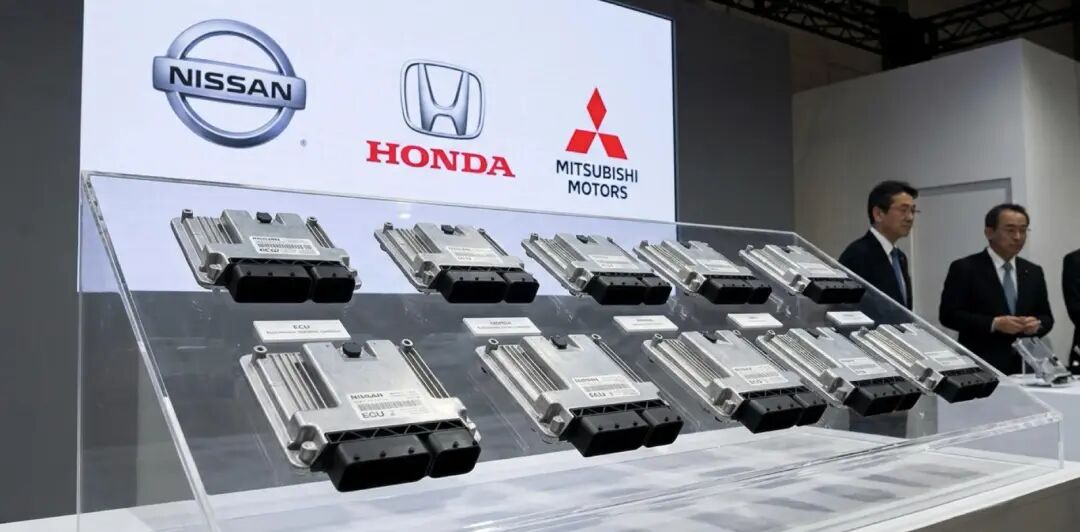
It is reported that the three companies are considering applying this common ECU to both all-electric and hybrid models, with the specific development and procurement framework to be finalized later. Mitsubishi Motors will also contribute funding. Additionally, Honda and Nissan are discussing the standardization of in-vehicle operating systems because, beyond hardware, unified software and operating systems are equally crucial for the development efficiency of intelligent driving vehicles.
In North America, the two sides are also rushing to finalize a joint production agreement, with Nissan considering supplying pickup trucks to Honda and Mitsubishi while exploring joint development of large vehicles. Although details such as R&D funding allocation have not been fully agreed upon, all parties aim to reach a final agreement within weeks, with vehicles equipped with common ECUs potentially launching as early as 2029–2030.
Mibe believes that once the first project is successfully completed, cooperation in other areas will proceed much more smoothly.
However, this cooperation is not without variables. Honda and Nissan announced in August 2024 that they would explore cooperation in five areas, including software-defined vehicles, and began discussing a merger in December of the same year. However, negotiations broke down in February 2025, after which they shifted to project-level cooperation.
Renault, the French automaker holding a 15% voting stake in Nissan, has now become the biggest potential obstacle. At Nissan's shareholders' meeting held last week, Renault subtly influenced shareholder voting, rejecting Nissan's proposal to appoint Motoo Nagai, from Mizuho Financial Group and closely tied to Nissan, as an external director.
A Nissan insider bluntly stated, “This shows that if Renault opposes what we want to do, it probably won't happen.” Since shareholder approval is crucial for Nissan to make important decisions such as director appointments, business transfers, and even capital alliances, if Renault opposes further deepening cooperation, negotiations between Honda and Nissan could grind to a halt at any time.
At Honda's shareholders' meeting, voices questioning management's delayed decision-making also emerged. A 70-year-old attendee complained, “They need to cooperate with Nissan as soon as possible, but the negotiations are progressing too slowly.” Indeed, Honda's current situation is more difficult than when negotiations began two years ago.
However, according to Honda's forecast, the company expects to return to profitability in fiscal year 2026, with net profit reaching ¥260 billion and operating profit estimated at ¥500 billion. However, achieving this goal largely depends on the strong performance of its two-wheeler business to offset weakness in the automotive sector. For example, the automotive division's sales in the Chinese market remain sluggish, with an operating profit margin of just 2.2%.
At the end of the meeting, Mibe expressed determination: “Within three years, we will master the means to overcome emerging forces, such as new competitors like Chinese automakers. If we fail to do so, our four-wheeler business will be in trouble. We will meet this challenge with unwavering determination.” For shareholders, whether this promise can be fulfilled will require time to provide an answer.
02 Localization in China is Already Evident
In fact, Honda's problems extend far beyond just strategic missteps in electric vehicles. Like most established automakers, it is facing unprecedented challenges in the Chinese market. In just a few years, sales have plummeted from a peak of 1.62 million units in 2020 to 640,000 units in 2025. Based on current trends, full-year production in 2026 may even fall below 600,000 units.
In April of this year, Mibe personally visited China. According to Japanese media reports, his purpose was straightforward: to see firsthand how Chinese companies managed to produce so many vehicles in such a short time. After touring a factory of an automotive parts supplier in Shanghai, he said, “We simply cannot match them.”
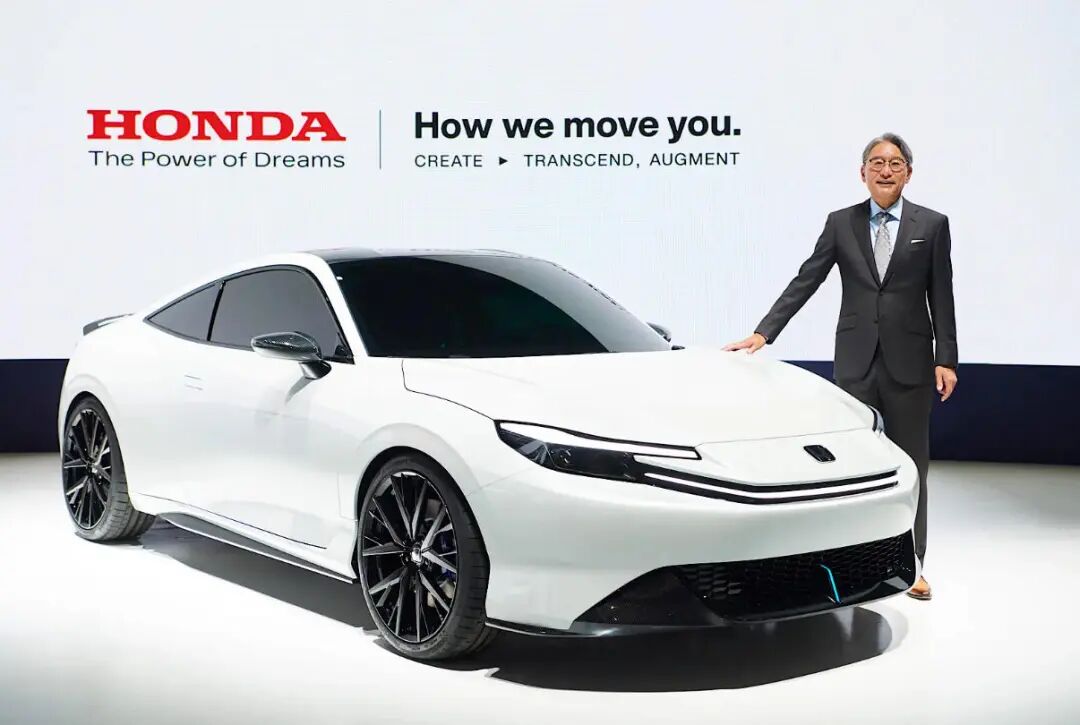
All international automakers have heard of “China speed,” but few have truly witnessed it firsthand. Chinese domestic automakers can launch a completely new model in two years or even less, while traditional brands often take twice as long or more, giving the impression that the Chinese market is launching new products almost every day.
Chinese suppliers not only keep up with this pace but also deliver with cost efficiency that industry giants can only dream of. This systemic efficiency does not rely on a single technological breakthrough but on the collaborative approach and decision-making mechanisms of the entire industrial chain, which are entirely different from the processes Japanese automakers are accustomed to.
However, Mibe's remark does not equate to surrender. Upon returning to Japan, he immediately told suppliers, “We must act quickly.” To this end, Honda is accelerating its R&D process, relocating thousands of engineers to a newly established engineering subsidiary and restoring its independently operated R&D department, which had been weakened in the past.
For the previous six years, R&D had been centrally operated, with all decisions made at headquarters, resulting in long decision chains and slow responses. Under the new structure, engineers will gain greater autonomy. While it remains uncertain how much energy this newfound freedom will unleash, it at least shows that management recognizes that the original R&D pace can no longer keep up with the competition.
Subsequently, in May of this year, Honda released its latest global strategic plan, stating that for the Chinese market, it would adopt locally standardized parts, actively utilize local resources in new technology areas, and launch new energy products based on local partner platforms. By leveraging the absolutely superior “China speed,” it aims to enhance product strength and cost competitiveness.
In simpler terms, this means full localization. Earlier, at the Beijing Auto Show in April, executives from Dongfeng Honda and GAC Honda, two joint ventures, expressed attitudes starkly different from their previously conservative styles in interviews.
Cao Dongjie, executive deputy general manager of Dongfeng Honda, stated that regarding new energy models, Dongfeng Honda would increase joint development and introduction of platforms with Dongfeng and high-end platforms. In the future, we will deeply integrate the advantages of fuel vehicles in power, chassis, quality control, and handling with local intelligence to ensure fuel vehicles keep pace with China's market rhythm. Additionally, we will form strategic partnerships with leading domestic tech companies for new energy products to achieve co-creation.
Lin Zhibin, deputy general manager of GAC Honda, revealed that both shareholders are discussing a shift from one-way technology introduction to two-way empowerment and deep collaborative R&D. The Chinese and Japanese sides have also upgraded to an equal partnership for technology co-creation and ecosystem building. Both sides have unified their thinking to formulate product strategies based on the Chinese market, transitioning from a global strategy to a combination of global and China-local strategies. They will continuously integrate localized resources for product definition and develop self-researched models based on China's new energy platform by 2027.
In fact, cooperation has already begun to materialize. The CR-V from Dongfeng Honda and the Breeze Shadow (Breeze) from GAC Honda have already been equipped with cloud-based infotainment applications powered by Huawei Cloud, replacing reliance on onboard computing power with cloud computing, significantly enhancing the entertainment ecosystem and voice interaction experience.
As domestic brands build differentiated barriers through intelligent experiences, Honda's solution in China is to combine its century-old advantages in chassis, power, and quality control with China's most advanced intelligent capabilities. Whether this path will succeed remains to be seen, but at least the direction is clear.
 ",
",
-
![]()
Rokid's Ambition and Embarrassment: 300,000 Sales Can't Support Its Ecosystem Dream
-
Are Gaming Ventures No Longer in Vogue Among Tech Titans?
-
![]()
Kuaishou’s Keling AI, Valued at $18 Billion with a Five-Year IPO Pledge, Faces a Make-or-Break Challenge
-
![]()
Valued at $18 Billion with a Five-Year IPO Plan: Kuaishou’s Kling AI Takes a Bold Leap
-
![]()
NVIDIA Launches 'Computing Power Financing'
-
![]()
Following Up on the 'Safety Net' for Intelligent Driving: Is Huawei's Strategy Astute or Perilous?
-
![]()
ICML 2026 | One Model to Unify Humans, Objects, Sounds, and Actions: OmniShow Revolutionizes Multimodal Controllable Video Generation as a Systematic Engineering Feat!
-
![]()
Mid-Year Sales Analysis: Leapmotor Faces Challenges Alone, NIO Breaks Free from the 'NIO 30K' Stigma