Battery Makers Outshine Car Manufacturers
 07/29 2026
 464
464
Lead
Introduction
Ten Chinese automotive-related companies have made it onto the Fortune Global 500 list, with BYD ranking highest and CATL emerging as the most profitable.
On July 28, the 2026 Fortune Global 500 list was officially unveiled. This year's list encompasses 35 vehicle and component companies from around the world, covering the entire industrial chain, from vehicle manufacturing to core components.
Meanwhile, China's automotive industry has delivered impressive results on this globally authoritative list. A total of 10 Chinese automakers and component companies have made the Global 500, ranking among the highest globally and underscoring the robust strength of China's automotive industry in achieving large-scale growth.
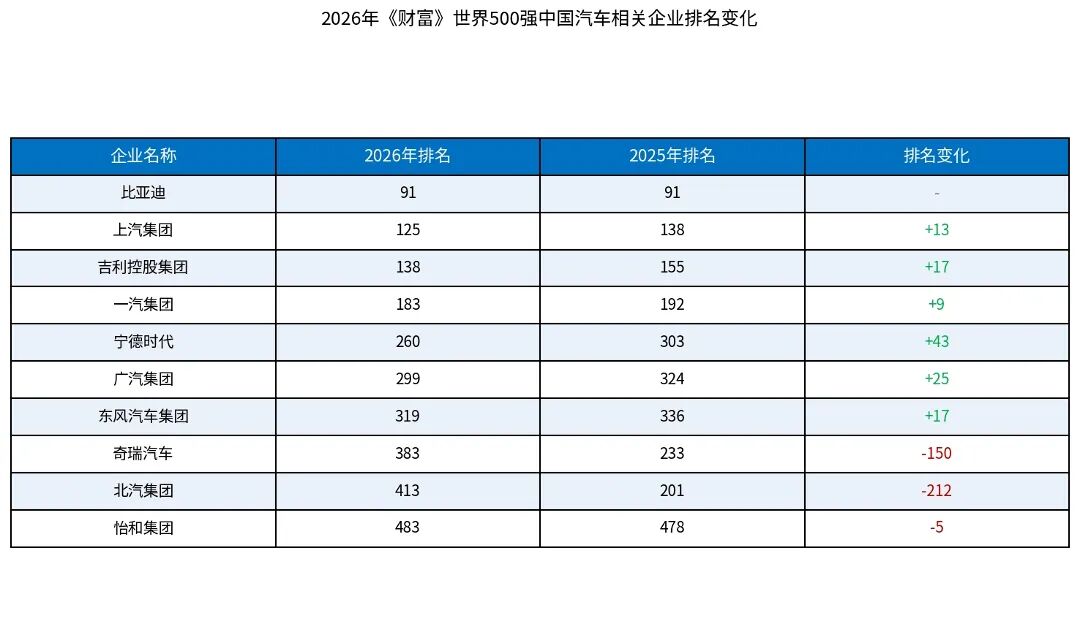
Among them, BYD ranks highest among Chinese automakers at 91st place, maintaining its position from last year and remaining the sole Chinese automaker in the top 100. CATL surged 43 places from last year to 260th, showcasing China's absolute advantage in the power battery sector.
Overall, the 10 Chinese automakers and component companies on the list cover all aspects of the automotive supply chain, from traditional automakers to new energy vehicle (NEV) companies and core component firms, forming a preliminary complete industrial matrix.
This also confirms that China's automotive industry has achieved significant leaps in global competitiveness, industrial influence, and brand impact.
01 Ten Chinese automotive-related companies make the list
As is widely known, the Fortune Global 500 ranks companies based on total revenue from the previous fiscal year, reflecting corporate market scale and industry presence. The 10 Chinese automotive-related companies on this year's list exhibit clear revenue stratification, with leading NEV firms and traditional automakers each having their strengths, while the competitive landscape and transformation pace between Chinese and foreign automakers are starkly evident.
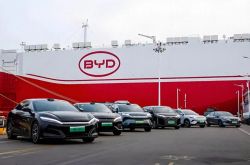
Among them, BYD remains China's highest-ranked automaker.
In 2025, its revenue reached $111.853 billion, far surpassing other global vehicle and component companies on the list. BYD sold 4.602 million NEVs in 2025, with significant overseas growth, exporting 1.05 million units (up 145% year-on-year) and overseas revenue accounting for 38.6% of total revenue.
Meanwhile, traditional leading automakers maintained stable operations.
SAIC Motor ranked 125th, leveraging its mature production-sales system and dual-track strategy of joint ventures and independent brands to sustain stable revenue. Geely Holding Group ranked 138th, advancing steadily in both traditional fuel vehicles and NEV transformation through global mergers and acquisitions and a diversified product portfolio, enhancing its market resilience.
Newly listed Chery Automobile achieved a breakthrough. In 2025, Chery participated for the first time as a listed entity, ranking 383rd and becoming the sole new entrant in mainland China's automotive sector that year. Chery's revenue reached $41.778 billion in 2025.
Unlike automakers, CATL followed a unique growth trajectory. While its total revenue lags behind leading automakers, its profitability is far superior. As the global leader in power batteries, CATL is deeply integrated into the global NEV supply chain, with its significant rank improvement reflecting sustained global market share growth and technological barriers.
Notably, Tesla, once the global NEV leader, saw its first-ever annual revenue decline in 2025, with car deliveries dropping year-on-year for two consecutive years, ultimately missing the top 100 this year.
Under performance pressure, Tesla is accelerating its strategic transformation, halting Model S and Model X production, shifting capacity to the Optimus robot project, and planning to launch the Cybercab autonomous taxi, fully committing to the AI-powered smart mobility sector.
Additionally, global traditional giants remain high on the list.
Volkswagen retained its title as the world's largest automaker at 13th place for the fourth consecutive year, with Toyota at 14th. Ford, General Motors, Stellantis, BMW, Mercedes-Benz, Honda, Hyundai, and other European and American and Japanese and Korean automakers all made the top 100, maintaining a stable global automotive leadership structure, though most giants show signs of growth fatigue, highlighting industry iteration pressures.
02 Car manufacturers can't compete with battery makers
For a long time, the market has widely believed that China's automotive industry suffers from thin profits and struggling corporate earnings.
However, the full 2026 Fortune Global 500 data reveals that profitability challenges are a common issue in the global automotive industry, not unique to Chinese automakers. Meanwhile, profitability in the automotive sector has become increasingly differentiated along the supply chain.
Specifically, the 35 global vehicle and component companies on the list belong to one of the five core pillar industries, alongside finance, energy, technology, and healthcare, collectively accounting for 61% of total listed companies and 66% of total revenue, with significant industrial weight.
Yet, the industry's overall profitability is low, with a global average return on sales of just 1.7%, making it a typical high-revenue, low-profit sector.
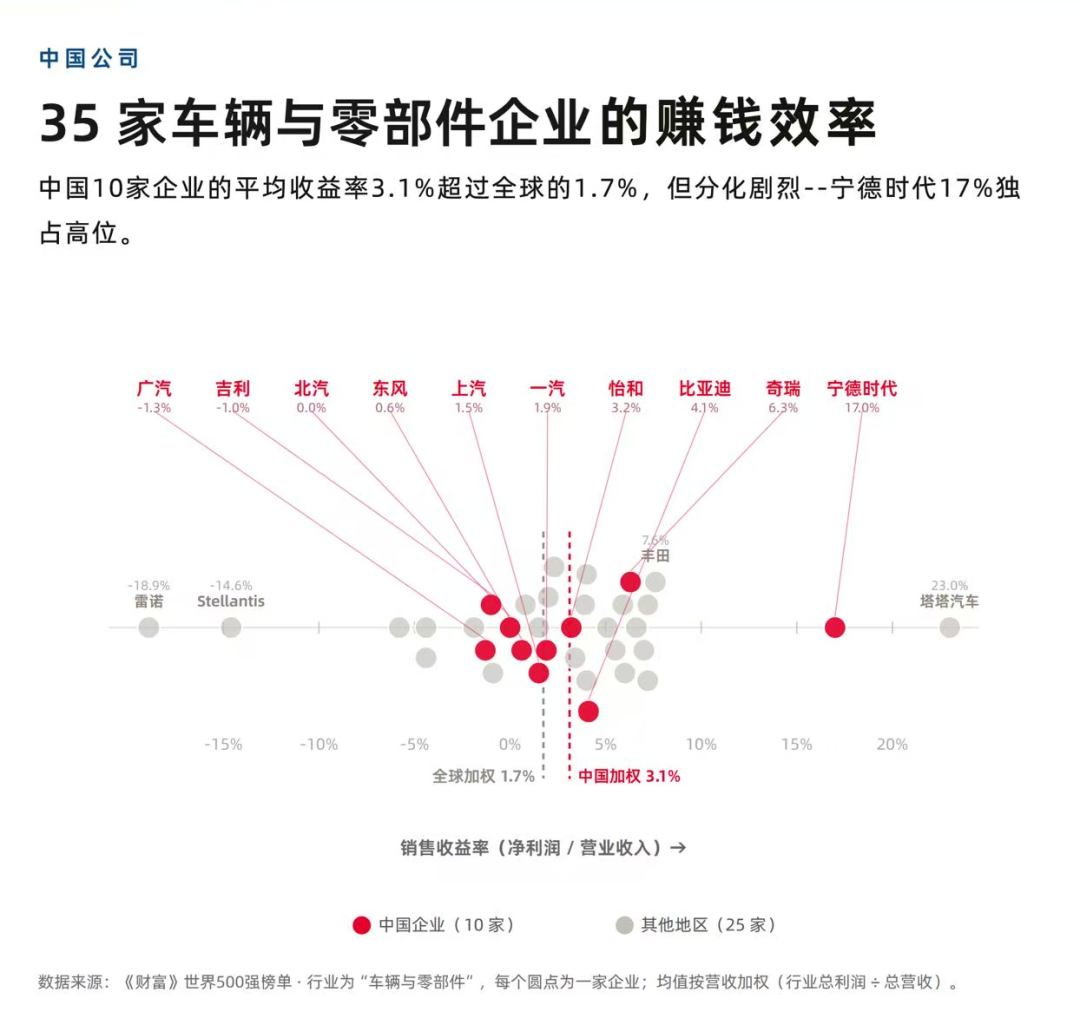
In contrast, the 10 Chinese companies on the list outperformed the global average in profitability, with an average return on sales of 3.1%, leading the global industry average. However, internal differentiation is severe, with profitability highly concentrated among upstream core component companies.
CATL led with an ultra-high return on sales of 17.0%, over 11 times that of Chinese listed automakers, and ranked among the top 50 companies globally for return on net assets.
Excluding CATL and Jardine Matheson Group, the remaining eight Chinese automakers averaged just 1.5% return on sales, slightly below the global industry average of 1.7%.
Specifically, profitability among automakers varies widely: Chery and BYD achieved returns on sales of 6.3% and 4.1%, respectively; SAIC, FAW, and Dongfeng all fell below 2%; BAIC saw zero profitability, while GAC and Geely operated at a loss. This clearly reflects the industry reality that upstream NEV component sectors are far more profitable than downstream vehicle manufacturing.
Globally, leading automakers also face clear profitability challenges.
Among the top 10 global automakers, only BMW and Hyundai saw profit growth, while the rest all experienced profit declines. For example, Volkswagen's revenue rose 3.4% but profits plummeted 32.7%; Toyota's revenue increased 6.7% while profits dropped 18.3%. General Motors and Mercedes-Benz saw declines in both revenue and profits, with GM's profits crashing 55.1% and Mercedes-Benz's profits falling 47.5%.
Additionally, industry losses are widening.
This year, over 30 listed companies globally reported losses, with the automotive sector being the hardest hit. Europe's Stellantis Group topped the loss list with over $25.2 billion in losses, Ford lost $8.182 billion (down 239.2% year-on-year), Honda lost $2.813 billion (down 151.3% year-on-year), and Tesla saw declines in both revenue (2.9%) and profits (46.5%).
Thus, while Chinese automakers' average return on sales of 1.5% is low, it is roughly in line with the global industry average of 1.7%, with no significant gap. This suggests that the global automotive industry is currently in a painful transition period of electrification and intelligence, with all automakers facing profit pressure from technological iteration and intensifying market competition.
Editor: Du Yuxin Copy Editor: He Zengrong

THE END
-
![]()
Sales Soar: Has Ora Staged a Remarkable Comeback?
-
![]()
What Kind of AI Phones Do We Actually Need?
-
![]()
DingTalk, Feishu, and WeCom's Silent 'March Eastward'
-
![]()
Is 'Data Scarcity' More Fatal Than 'Computing Power Shortage'? Is It Bringing Disaster?
-
![]()
Yutong Bus Steps Up the Rollout of an External Circulation Marketing Model Among Listed Companies
-
![]()
The US Wants to Strangle Chinese Automakers, but Mercedes-Benz Becomes the First 'Sitting Duck'
-
![]()
Earning Foreigners' Money Is a Breeze: China's Car Exports Rock Europe and America!
-
![]()
"Meituan Retreats into the Background of AI", "Meituan, AI, API, local services, business strategy", "Meituan has announced a partnership with Tencent Yuanbao, enabling users to place takeout orders t