Lynk & Co Engineer Suggests Xiaopeng's 400V Battery Platform Is Obsolete; Xiaopeng Executive Calls It 'Unprofessional'; Xiaopeng Customer Service Denies Direct Performance Comparison
 07/31 2026
 460
460
Lynk & Co and Xiaopeng have entered into a social media debate over the merits of 400V and 800V high-voltage platforms, each advocating for distinct technical approaches tailored to cost considerations and user scenarios.
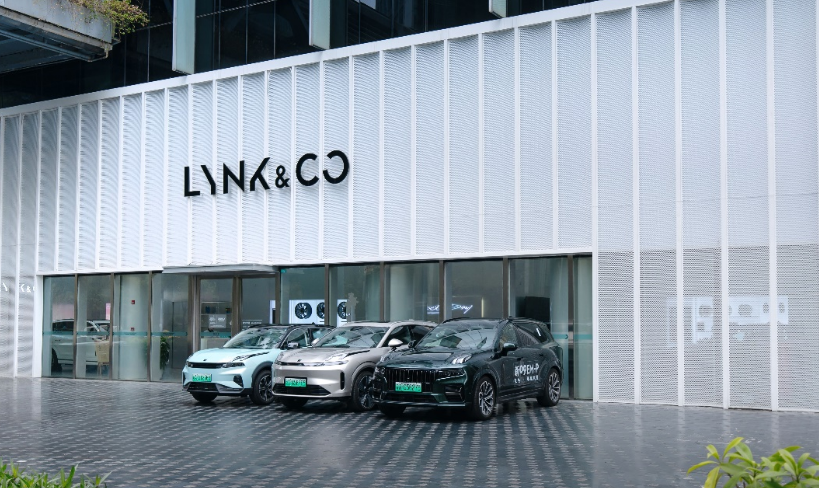
According to Electric Vehicle World, the recent debate over the technical merits of 400V versus 800V high-voltage platforms has ignited fervent discussions, as Lynk & Co and Xiaopeng engage in a public exchange on social media. Lynk & Co engineers have subtly suggested that Xiaopeng's technology is outdated, prompting a response from Xiaopeng executives labeling such remarks as "unprofessional."
The controversy began on the morning of July 27th, when XP-Jacky, Senior Director of Powertrain at Xiaopeng Motors, posted a comprehensive explanation detailing why the MONA L03 opted against the 800V platform.
XP-Jacky stated that the MONA L03 employs a 400V platform in conjunction with a 3C battery pack, achieving a peak charging power of 229kW as measured. This setup allows for an addition of 140km of range in just 5 minutes, with a 10%-80% charge time of approximately 19 minutes and a 30%-80% charge/discharge cycle taking about 15 minutes. He emphasized that this charging performance rivals that of many 800V models on the market when utilizing standard fast-charging stations.
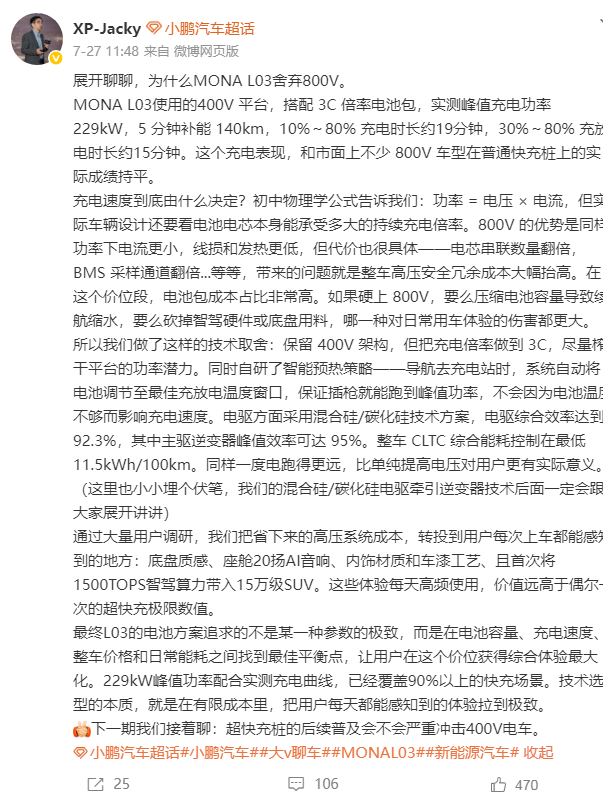
XP-Jacky also noted that while 800V batteries offer advantages such as lower current, reduced line losses, and less heat generation at the same power level, they come with increased costs. Specifically, the number of cells in series doubles, as do the BMS sampling channels, leading to significantly higher expenses for vehicle high-voltage safety redundancy.
He argued that if forced to use an 800V battery at the current price point, either the battery capacity would need to be compressed—resulting in reduced range—or intelligent driving hardware or chassis materials would have to be sacrificed. Both scenarios, he contended, would detract more from the daily driving experience than sticking with a 400V battery. Therefore, the MONA L03 retains the 400V architecture while boosting the charging rate to 3C to fully exploit the platform's power potential.
Regarding the performance disparities between the MONA L03's 400V battery and an 800V counterpart, Xiaopeng's official customer service responded to Xinshi Research Institute, stating that Xiaopeng has not conducted direct performance comparisons. They clarified that the primary distinction between 400V and 800V batteries lies in charging speed, with actual charging power contingent on real-world conditions, as battery charging speed is influenced by a multitude of factors.
On the evening of July 27th, following XP-Jacky's post, a Geely engineer (Fang Ge, known for his automotive expertise) also weighed in, directly challenging the notion that "400V is sufficient" as promoted by "a certain merchant."
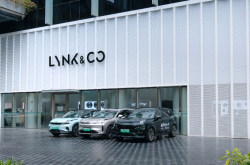
He stated that thanks to the group-scale benefits derived from Geely's technological system upgrades, the Lynk & Co 20 is equipped with a full 800V platform. "Contrary to what a certain merchant claims—that 400V is sufficient and the remaining funds can be allocated to other configurations—this approach sacrifices generational advancement and product sustainability," he asserted. He bluntly added, "Why settle for 400V when 800V is an option?"
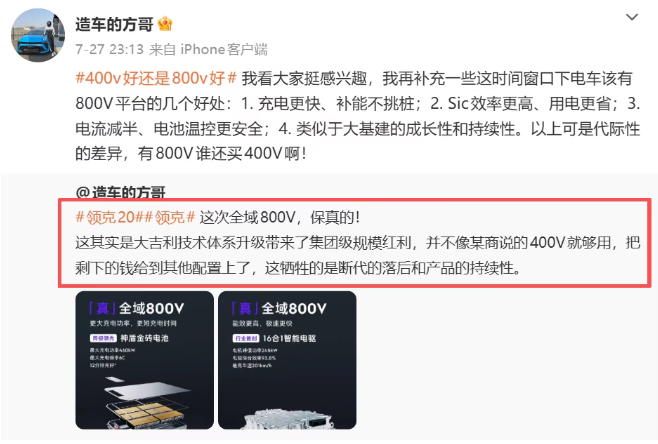
Image source: Electric Vehicle World
Furthermore, this engineer underscored several advantages of the 800V platform: 1. Faster charging speeds and compatibility with a variety of charging stations; 2. Enhanced efficiency of SiC components, leading to reduced power consumption; 3. Halved current, resulting in safer battery temperature control; 4. Growth potential and sustainability akin to large-scale infrastructure projects.
A blogger commented on the matter, stating that while Xiaopeng MONA's market performance is commendable and competition is inevitable, labeling a model as a generation behind based solely on differences in high-voltage platforms is unwarranted.
Subsequently, Xiaopeng Motors' Vice President reposted the blogger's comment and responded, stating that she is preoccupied with addressing daily customer demands for deliveries and has little time to dwell on this issue. Nevertheless, she deemed the behavior "unprofessional."
On July 29th, XP-Jacky posted again, but instead of delving deeper into the MONA L03's use of 400V, he shifted the discussion to the philosophy of energy management design.
He stated that the MONA L03 is positioned as "the first SUV for young people," and what most young people truly require on a daily basis is a commuter vehicle that can reliably last from Monday morning to Friday evening. Therefore, the L03 has been optimized for energy management.
He further pointed out that the L03 continuously refines its intelligent SOC algorithm and BMS integration capabilities, introduces forward-looking power budgeting based on platform-level energy management, and systematically optimizes areas such as electric drive efficiency, aerodynamics, and active grilles. Ultimately, he said, these efforts culminate in a superior range experience.
-
![]()
Unraveling the Decline of the Imported Car Market
-
![]()
Interpretation of the European + UK Automobile Market in the First Half of 2026: Electrification Surpasses Critical Point, Chinese Brands Experience Collective Growth in Sales
-
![]()
Farewell to the 'Little Blue Light': Advanced Driving Assistance Systems Still Require Standardization
-
![]()
Feishu Merges with Doubao, DingTalk Teams Up with Wukong: Are BAT Titans Attempting to 'Corner' AI Talent?
-
![]()
Final Ruling: Fuel-Powered Vehicles Are Far from Being Phased Out and Still Exhibit Robust Vitality
-
![]()
Bypass, Blockade, and Redirection: The Two Debuts of Doubao Phone
-
![]()
Lynk & Co Engineer Suggests Xiaopeng's 400V Battery Platform Is Obsolete; Xiaopeng Executive Calls It 'Unprofessional'; Xiaopeng Customer Service Denies Direct Performance Comparison
-
![]()
Alibaba's AI Investment Spree: Can It Create a New Ecosystem Worth Billions?