Vision: Has Li Auto's Extended-Range Ace 'Misfired,' Turning Guidance into a 'Pipe Dream?'
 08/27 2026
 426
426
Li Auto released its Q2 2026 financial results after market close in Hong Kong and before market open in the U.S. on August 26 (Beijing Time). While Q2 performance was decent, Q3 guidance 'fell flat.' Here are the details:
① Total revenue exceeded expectations, primarily driven by higher-than-expected average selling prices (ASPs): Li Auto's total revenue in Q2 was approximately RMB 25.7 billion (a 15% YoY decline), outperforming market expectations of RMB 25 billion. Vehicle sales revenue reached RMB 24.1 billion, mainly due to a QoQ rebound in ASPs by approximately RMB 20,000 to RMB 245,000 (higher than the market expectation of RMB 239,000).
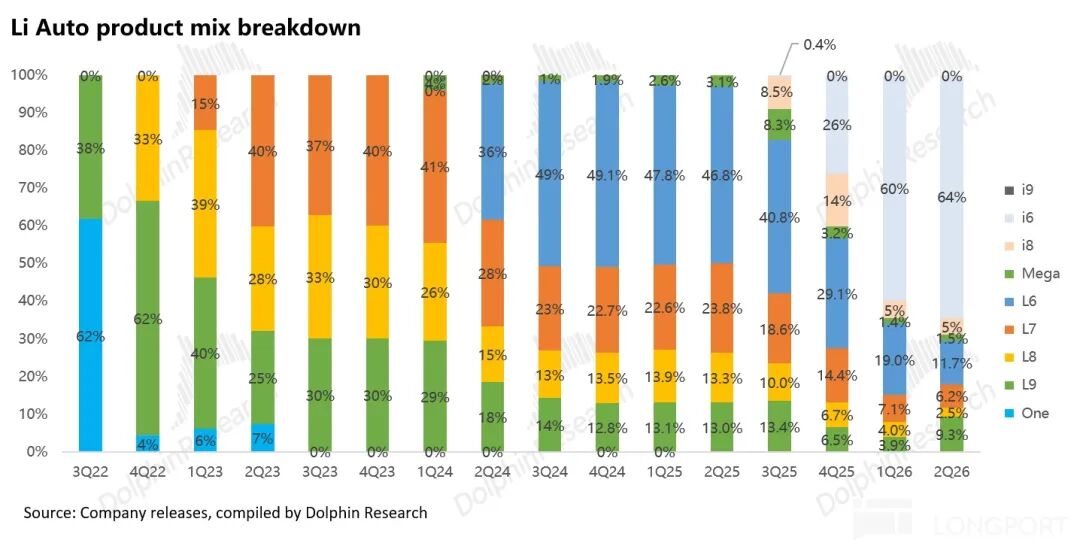
The key reasons for the ASP increase against the trend were: 1) Model mix optimization: The launch of the higher-priced new L9 increased its sales share by approximately 5 percentage points QoQ to 9%, while the relatively lower-priced L6 saw a temporary decline in delivery share to 12% as users awaited its refresh; 2) Reduced terminal discounts: After the launch of the new L9/L8, some discounts on older models were rolled back, and the RMB 15,000 cash subsidy for purchase tax on the i6 model was canceled, collectively pushing up the overall ASP.
② Vehicle gross margin stabilized and rebounded but fell slightly short of official guidance due to cost pressures: The actual vehicle gross margin in Q2 was 9.4%, up 3.3 percentage points from the Q1 low of 6%. Despite the strong ASP performance, the gross margin slightly missed the company's previous guidance of 10%.
The failure to fully unlock gross margin potential was primarily due to persistent upstream cost increases: The cost per vehicle rose by approximately RMB 10,000 QoQ to RMB 222,000 in Q2.
On one hand, Q2 sales volume of 98,000 units represented only a slight 3% QoQ increase, and the scale effect failed to materialize effectively amid model transitions; on the other hand, prices of upstream memory chips, bulk raw materials, and batteries continued to rise (with memory price hikes alone impacting the i6's gross margin by approximately 3-4 percentage points).
This resulted in a rebound in gross profit per vehicle to RMB 23,000 in Q2, but the actual gross margin (9.4%) still lagged behind the historical healthy level of 20%, leaving profit margins per vehicle under pressure.
③ Reasonable control of operating expenses, with net profit barely meeting targets:
Although the company managed to control its operating expenses reasonably in Q2—R&D expenses increased slightly to RMB 2.78 billion QoQ, and selling, general, and administrative (SG&A) expenses rose slightly to RMB 2.28 billion QoQ due to organizational optimization, workforce reduction (approximately 15% turnover in frontline direct sales), and a channel strategy shift from 'expansion to refinement' (a net reduction of 38 retail and service centers)—profit barely met expectations. However, this could not mask the impact of stagnant sales and intense market competition, ultimately leading to a significant downgrade in overall Q3 performance expectations.
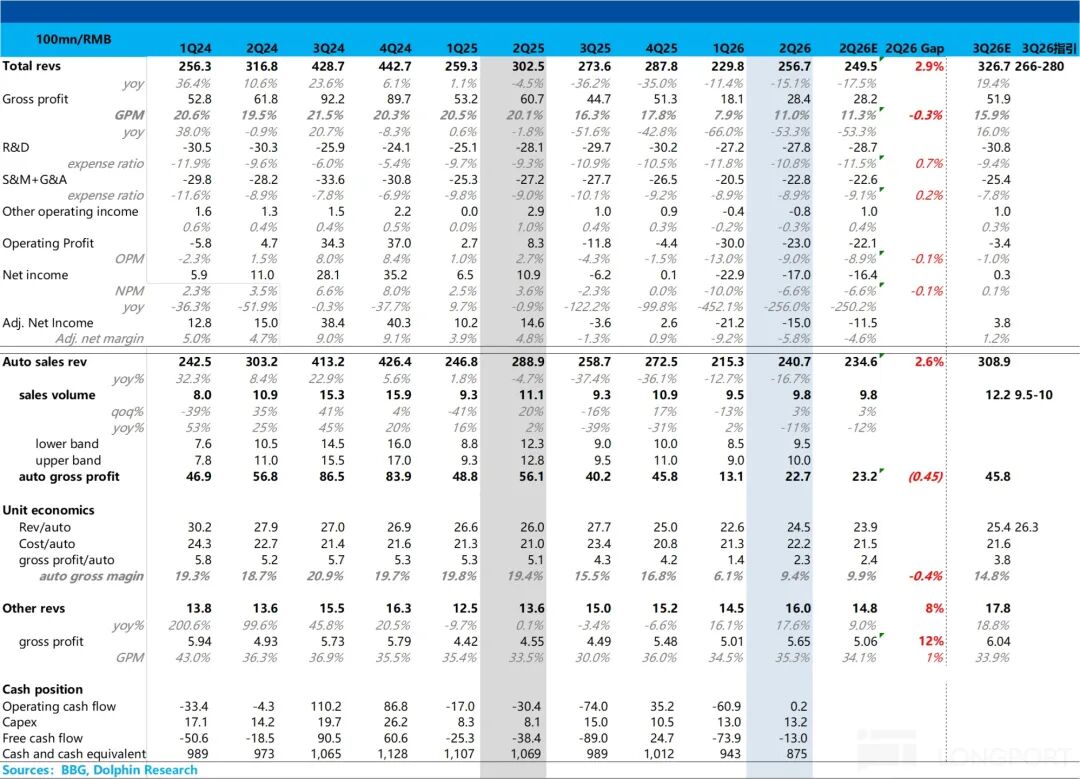
Overall, Li Auto's Q2 performance was not a major issue. The vehicle gross margin of 9.4% slightly missed the company's guidance of 10%, primarily dragged down by continued upstream raw material cost increases. However, the ASP rebounded more than expected due to an improved model mix (higher share of the pricier L9 and lower share of the cheaper L6) and the rollback of promotional discounts on the i6. Ultimately, revenue exceeded expectations, and with reasonable control over operating expenses, profit margins barely met expectations.
The real disappointment lies in the Q3 performance guidance, with both sales and revenue guidance 'falling flat':
a) Sales guidance fell short of expectations, indicating lackluster orders for the refreshed L6/L8
Q3 sales guidance stands at only 95,000-100,000 units. Despite the dense launch of mid-cycle major refreshes for the L series and simultaneous launches of i series refreshes (L9 iterated on May 15, L8 on June 23, new L6 launched in July, and refreshed i8 in August), sales guidance showed no QoQ increase from Q2's 98,000 units and fell significantly short of the market expectation of 122,000 units.
The core factors behind the 'flat' Q3 guidance are: On one hand, orders for the refreshed L6/L8 were lackluster, and the new model cycle failed to effectively boost sales. Even the volume-focused L6 refresh could not drive a sales rebound, with the refreshed L6 even cannibalizing sales of the pure electric i6 within the same brand; on the other hand, the large extended-range SUV market is extremely competitive, with rivals intensively targeting the RMB 250,000-350,000 price band, coupled with the rollback of purchase tax incentives, severely suppressing overall growth potential.
b) Revenue guidance also 'fell flat'
Q3 vehicle revenue guidance stands at RMB 26.6-28 billion, significantly below the market expectation of RMB 32.7 billion, primarily due to the substantial miss in sales guidance.
However, the implied ASP in the revenue guidance is RMB 263,000, up nearly RMB 20,000 QoQ from RMB 245,000 in Q2, driven by the model mix upgrade from the refreshed L9+L8 and a decline in the share of the relatively lower-priced i6. However, this also directly reflects the generally weak order volume for the refreshed L6.
Looking at the full year 2026:
① Li Auto has already launched a dense rollout of fully refreshed L series models + i series refreshes and plans to introduce a new flagship pure electric model, the i9, later
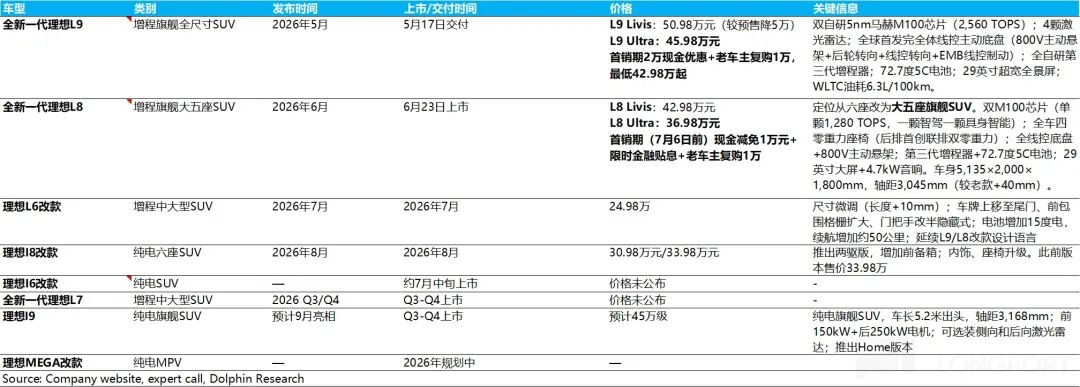
Li Auto has already iterated the L9 on May 15 and the L8 on June 23, launched the new L6, and introduced the refreshed i8 in August. Looking ahead, Li Auto plans to launch the large SUV L7—essentially a spec-upgraded and price-reduced version of the old L8 (six-seater)—priced below RMB 300,000, forming a high-end series alongside the L6 (large five-seater) to further drive sales. Meanwhile, the company plans to launch the flagship pure electric model, the i9, in the second half of 2026 to continue boosting sales.
Based on the already released L series refreshes, Li Auto's model strategy for 2026 follows a 'spec-up, stable pricing + streamlined focus' approach:
a) Pricing strategy of 'more specs, more pragmatic pricing': Taking the new L9 as an example, the Ultra version is priced at RMB 459,800 (a RMB 20,000 increase over the old model but with greater spec upgrades), while the Livis version is priced at RMB 509,800 (a RMB 50,000 reduction from the pre-sale price); the L8 Ultra starts at RMB 369,800, a RMB 30,000 price cut; the i8 introduces an entry-level version priced around RMB 300,000, with additional cash discounts during the initial sales period, making the actual purchase price more competitive.
b) Streamlined SKUs for a more focused product line: The L8 transitions from six to five seats, while the L7 shifts from five to six seats, forming two main lines: a flagship series (L9 six-seater + L8 five-seater, priced above RMB 300,000) and a high-end series (L7 large six-seater + L6 large five-seater, priced below RMB 300,000). All models retain only Ultra and Livis versions, eliminating Pro/Max variants to truly offer 'full specs at entry-level' and avoid internal competition.
c) Addressing shortcomings:
Significant battery and range upgrades: The L9/L8 come standard with a 72.7kWh 5C ultra-fast-charging battery, delivering a CLTC pure electric range of 420km (a 50% increase over the old model); the L6 introduces a 51kWh large battery version, achieving a CLTC pure electric range of 300km (a 42% increase over the old model).
Next-gen extended-range system: The L9/L8 are equipped with the third-generation in-house extended-range engine, with the L9 achieving a WLTC feed-in fuel consumption as low as 6.3L/100km (a significant reduction from the old model).
Upgraded handling system: Adoption of a steer-by-wire active chassis + 800V active suspension + EMB steer-by-wire mechanical braking, with the front suspension compressed by nearly 30mm, the rear suspension extended by nearly 40mm, and the turning radius reduced to 5.1m, addressing the past 'poor handling' pain point of the L series.
d) Reinforcing strengths: In-house chip M100 (5nm, 1,280 TOPS per chip, costing half of externally sourced chips), VLA large model, and four zero-gravity seats to emphasize differentiation and cost reduction.
② Li Auto's strategy of sustained investment in AI is expected to remain unchanged:
a. In-house computing power base has landed: The 5nm in-house 'Mach 100 (M100)' chip has entered mass production, delivering an effective computing power of 2,560 TOPS with a dual-chip configuration per vehicle. The chip is deployed in the L9/L8/L6 models and plans to make the VLA large model standard across all models in 2026.
b. Cross-border embodied AI: R&D efforts have officially extended to 'spatial robots,' integrating foundational models, in-house chips, and robot operating systems. Rumors suggest that Li Auto's first embodied AI two-wheeled robot could make its official debut in 2026.
From the perspective of Li Auto's current stock price:
The company previously maintained a target of over 20% YoY sales growth in 2026, translating to approximately 480,000 units. The increment is expected to come from three major segments: 1) Full refresh of the L series; 2) Driven by refreshes of the i8/i6, with the i6 achieving a full-year delivery cycle (launched in H2 2025); 3) Contribution from the new flagship pure electric i9 (launched in H2 2026).
However, the Q3 performance guidance indicates that orders for refreshed models are below expectations, especially the volume-focused L6, which failed to deliver incremental sales. Additionally, considering intensifying market competition—with rivals launching large extended-range SUVs targeting Li Auto's L series, forming intensive competition in the RMB 250,000-350,000 price band—the rollback of purchase tax incentives driving industry beta downward, and the i9 not being a volume model (serving as a flagship for brand elevation and technology validation with a limited sales ceiling),
Based on sales guidance, Li Auto is expected to achieve only 283,000-293,000 units in the first three quarters of 2026 (a 1.4-4.8% YoY decline). Dolphin Research forecasts full-year 2026 sales of only 420,000-430,000 units, representing a mere 3-6% YoY growth, significantly below the company's official guidance of over 20%.
On the revenue side, with the gradually increasing share of high-priced models (refreshed L9, L8) and steady sales volume of the i6, the full-year average selling price (ASP) for vehicle sales is expected to be around RMB 250,000 (gradually recovering with product mix optimization). Including other business revenue (charging network, accessories, and services) of approximately RMB 6.9 billion, the corresponding total full-year revenue is estimated at RMB 111.9-114.4 billion.
Here's a detailed analysis:
With Li Auto's sales already announced, the most critical marginal information lies in: 1) Q2 vehicle gross margin; 2) Q3 2026 performance outlook.
I. Vehicle gross margin slightly below guidance
Starting with the vehicle sales business, which the market cares about most. Li Auto provided clear guidance in the previous quarter's earnings call—Q2 vehicle gross margin was expected to recover from the Q1 low of 6% to 10%, with margin recovery primarily driven by 1) the cancellation of the RMB 15,000 cash subsidy for purchase tax on the i6 model; 2) the launch of high-gross-margin models like the L9 and L8, optimizing the product mix.
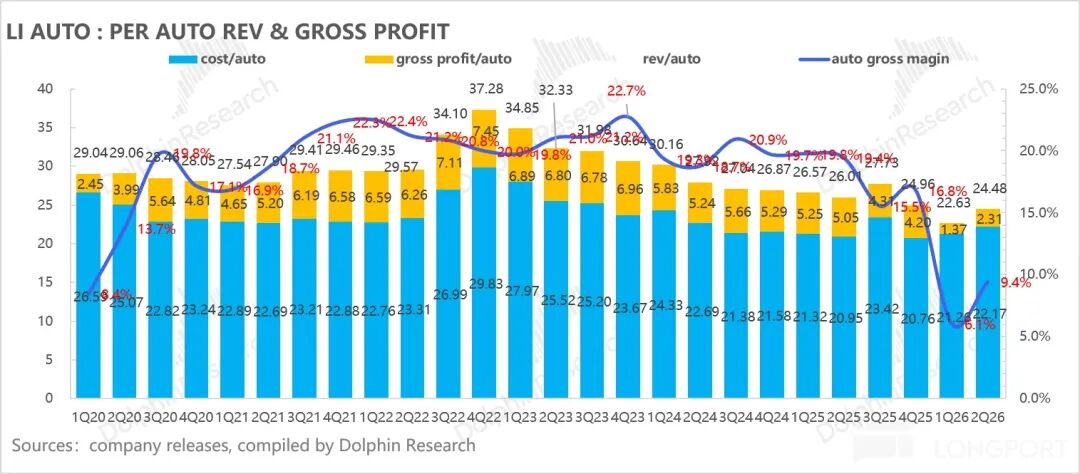
The actual Q2 vehicle gross margin was 9.4%, up 3.3 percentage points QoQ from 6% in Q1, slightly below guidance, mainly due to cost increases suppressing margin release.
(Note: Q2 2022 data reflects automotive gross margin after excluding over RMB 800 million in contract loss impact; Q2 2023 data reflects automotive gross margin after excluding RMB 400 million in warranty provisions.)
From a per-vehicle economics perspective:
1. ASP increased more than expected QoQ, primarily due to an improved model mix and reduced promotional discounts
The Q2 ASP was approximately RMB 245,000, up nearly RMB 20,000 QoQ and higher than the market expectation of RMB 239,000. The QoQ increase was mainly driven by:
① Improved model mix
The Q2 model mix optimized: The new L9 (priced at RMB 459,800/509,800) was launched and delivered in May, driving the L9's share in the model mix up by approximately 5 percentage points QoQ to 9%; meanwhile, the lower-priced L6 (accounting for approximately 19% in Q1 2026) saw its share decline by approximately 7 percentage points QoQ to 12%, mainly due to users delaying purchases to await the L6 refresh launched in July (cross-quarter factor), leading to a temporary decline in Q2 L6 delivery share.
② Discount rollback
After the launch of the new L9/L8 in Q2, Li Auto rolled back some terminal discounts on older models, while also narrowing terminal discounts on the i6 model (canceling the RMB 15,000 cash subsidy for purchase tax on the i6), collectively driving the QoQ increase in ASP.
2. Per-vehicle cost increased by RMB 10,000 QoQ, with continued upstream raw material cost increases suppressing margin release
The Q2 per-vehicle cost was approximately RMB 222,000, up nearly RMB 10,000 QoQ, mainly due to:
① Scale effect not materializing: In Q2, Li Auto sold 98,000 vehicles, up only about 3% QoQ from the Q1 low and down approximately 11% YoY. With two mid-cycle major refreshes (L9/L8) launched in Q2, such sales performance was lackluster, partly due to the L9 refresh underperforming expectations and mainly due to users delaying purchases to await the new L6, causing Q2 L6 sales to decline QoQ instead.",
3. In Q2, the gross profit per vehicle was 23,000 yuan, up by approximately 9,000 yuan sequentially.
From the perspective of profitability per vehicle, in Q2, Li Auto earned a gross profit of about 23,000 yuan per vehicle sold, an increase of approximately 9,000 yuan from the previous quarter's approximately 14,000 yuan, primarily benefiting from the recovery in the average selling price per vehicle (the launch of the new L9/L8 models drove the ASP up from 226,000 yuan to 245,000 yuan).
However, the gross profit margin for the actual automotive business remained at only about 9.4%, a year-over-year decline of approximately 10 percentage points, significantly lower than the previously healthy gross profit margin level of 20%. Under the Multiple pressures (multiple pressures) of the decline in purchase tax incentives suppressing end-user demand, continued increases in storage and upstream raw material prices eroding profits, and intensified competition in the extended-range SUV market, Li Auto still faces significant pressure in selling vehicles currently.
II. Both revenue and sales volume guidance for Q2 "underperformed"
a) Sales volume guidance fell short of expectations, indicating lackluster order performance for the new L6/L8 models
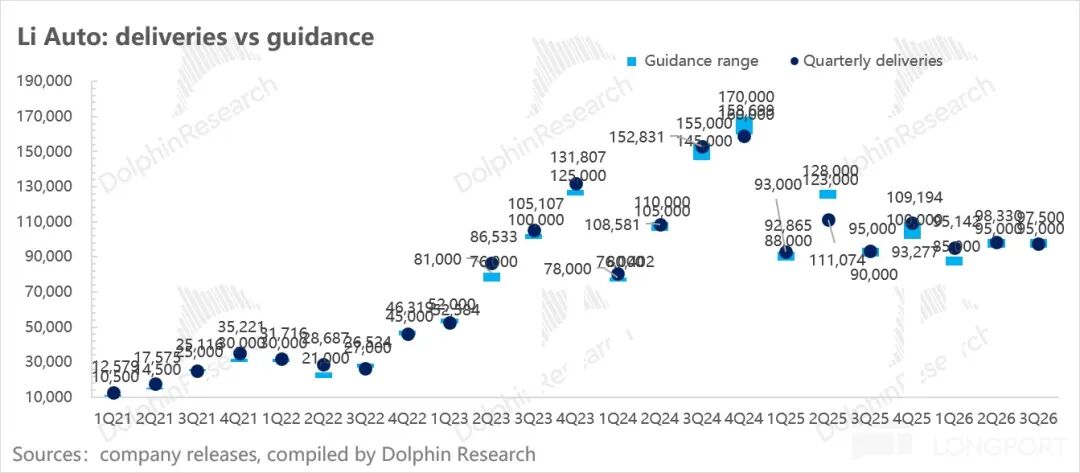
Li Auto's sales volume guidance for Q3 is 95,000-100,000 vehicles, significantly lower than the market expectation of 122,000 vehicles. Despite the Intensive new releases ( Intensive release ) of major mid-cycle facelifts for the L series and simultaneous launch of i series facelifts, the sales volume guidance showed no sequential increase from Q2 (98,000 vehicles).
Given that 30,000 vehicles were delivered in July, the implied average monthly sales for August/September under this guidance are 32,000-35,000 vehicles.
Despite the launch of the iterative L9 on May 15, the iterative L8 on June 23, and the new L6 on July 16, Li Auto's July delivery volume was 30,468 units, representing a year-over-year/sequential decline of 1%, falling short of market expectations. This was primarily due to a temporary interruption in the supply of headlight components for the pure electric SUV i6, resulting in a production reduction of approximately 4,000 units compared to the original production plan in mid-to-late July.
Furthermore, the pulling effect on sales volume from the launch of the L9 facelift has not been fully realized, with a sequential decline in July sales volume.
The Q3 sales volume guidance, which fell short of expectations, may imply relatively average order performance for the facelifted L6/L8 models, especially for the volume-selling L6 model, where order volume is still expected to be very average. At the same time, the launch of the facelifted L6 has also had a certain cannibalization effect on the pure electric i6 model of the same brand. Overall, the boosting effect of the new vehicle cycle on sales volume has been quite limited, and Li Auto still faces significant pressure in selling vehicles.
b) Revenue guidance also "underperformed"
The automotive revenue guidance for Q3 is 26.6-28 billion yuan, significantly lower than the market expectation of 32.7 billion yuan, with the fundamental reason still being the substantial miss in sales volume guidance.
However, the implied unit price in the revenue guidance is 263,000 yuan, continuing to rise by nearly 20,000 yuan from 245,000 yuan in Q2, primarily driven by the model mix upgrade of the facelifted L9+L8, while the proportion of the relatively lower-priced i6 has declined. However, this also directly reflects the very average order volume for the facelifted L6.
III. Three-expense control remains acceptable
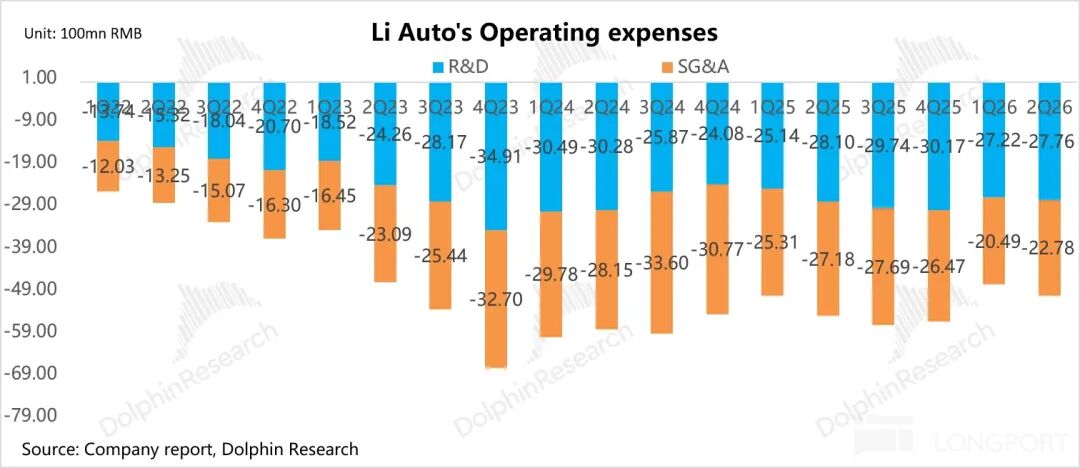
1) R&D expenses: Only a slight sequential increase
R&D expenses for this quarter were 2.78 billion yuan, up by only approximately 60 million yuan from 2.72 billion yuan in the previous quarter, falling short of the market expectation of 2.87 billion yuan. Previously, management guided for R&D expenses of 12 billion yuan for the full year of 2026 (a 6% year-over-year increase), which is expected to be adjusted downward. The main investment directions for R&D expenses are as follows:
a. Pre-emptive R&D investment for the Intensive new car cycle (intensive new vehicle cycle): To prepare for the product-heavy year of 2026, Li Auto is accelerating R&D reserves for new models. This includes not only comprehensive major facelifts for the L series family (L6, L7, L9, etc.) and i series facelifts (i8, i6) but also covers the new pure electric full-size SUV model i9.
b. Continuous investment in the "All in AI" strategy: AI has become Li Auto's largest R&D expenditure item. Looking back at 2025, Li Auto invested over 6 billion yuan in the AI field, accounting for more than half of the total annual R&D expenses of 11.3 billion yuan.
For 2026, it is expected that Li Auto's strategy of continuous investment in AI will remain unchanged, with full-year AI investment expected to still account for about half of R&D expenses. Centered around the core strategy of AI, the company is deploying in the following three directions:
① Deployment of self-developed computing power infrastructure: The self-developed "Mach M100" chip using a 5nm process has been mass-produced, with a single-chip computing power of 1280 TOPS and a dual-chip configuration providing an effective computing power of up to 2560 TOPS. This chip has been equipped in the facelifted L9/L8/L6 models and is planned to be standard across all models with the VLA large model in 2026.
The parameter count of the MindVLA model has increased by 10 times compared to the previous version, and its combination with the Mach M100 will bring a leap in the autonomous driving experience. Compared to the previous generation, the intelligent driving system equipped with the M100 makes more human-like decisions in complex scenarios and provides smoother longitudinal and lateral control. The next steps will include further expanding the scale and precision of input data, enhancing the model's cognitive ability for short-term causal relationships, with the company aiming to match the performance of Tesla FSD v14 in the US in the second half of this year.
② Cross-border embodied intelligence: R&D efforts are extending towards "spatial robots," integrating foundational models, self-developed chips, and robot operating systems. Li Auto's management compares current robot technology to new energy vehicles between 2010 and 2015—full-scale commercial deployment still requires more than three years, with multiple technical paths in specific directions not yet converged and many hard problems remaining to be solved.
③ Striving for L4 autonomous driving: Li Auto positions L4 autonomous driving as the core capability of "spatial robots" and has set a goal to achieve L4 autonomous driving by 2028 at the latest.
2) Sales and administrative expenses increased sequentially but remained reasonably controlled
Sales and administrative expenses for this quarter were 2.28 billion yuan, up by approximately 230 million yuan from about 2.05 billion yuan in the previous quarter, basically in line with expectations. The sequential increase in sales and administrative expenses was primarily due to the consecutive launch of major mid-cycle facelifts for the L9 and L8 in Q2, leading to increased market promotion expenses. However, overall expense control remains effective, primarily due to:
a. Organizational optimization and staff reduction: Li Auto previously made certain staff adjustments and structural optimizations in the marketing department, with a turnover rate of about 15% for frontline sales in directly operated stores, effectively reducing salary expenses.
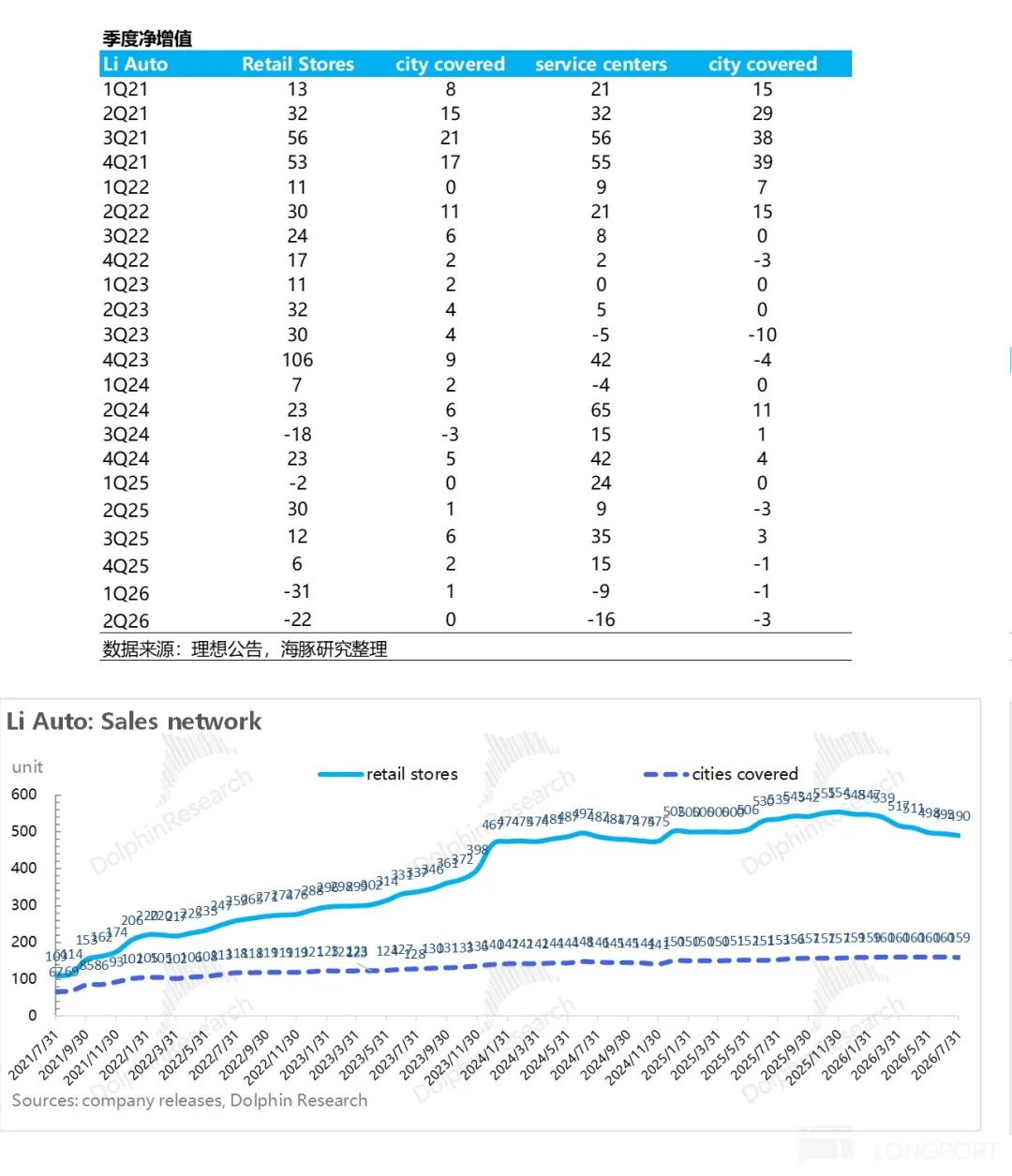
b. Channel strategy shifting from "expansion" to "intensive cultivation": Li Auto has shifted from aggressive early-stage expansion to cautious operation, proactively closing and optimizing some inefficient stores to reduce costs. In Q2, Li Auto's retail centers nationwide decreased by a net of 22, while service centers decreased by a net of 16.
IV. Revenue once again experienced year-over-year negative growth
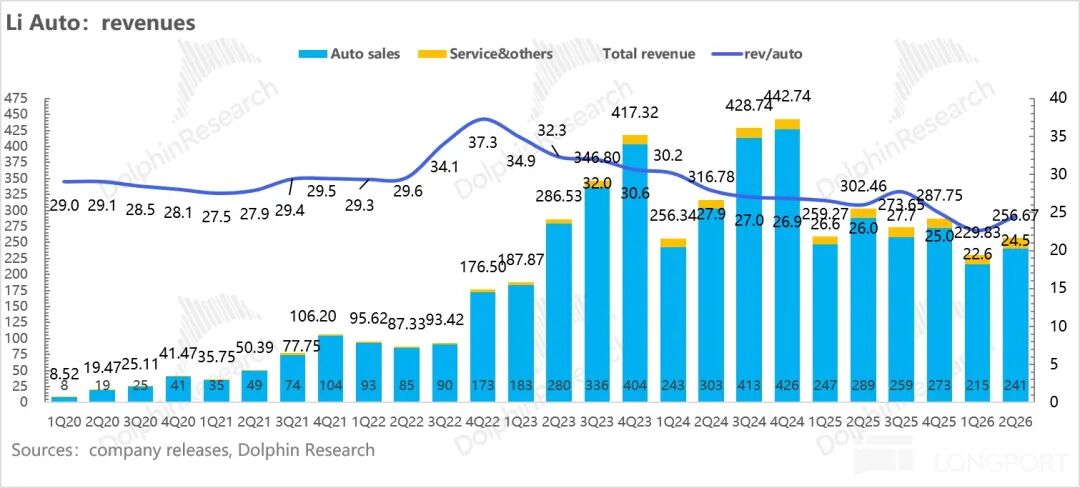
Given the published sales volume data, Li Auto's total revenue in Q2 was approximately 25.7 billion yuan, representing a 15% year-over-year decline but higher than the market expectation of 25 billion yuan.
Among this, automotive sales revenue was 24.1 billion yuan, a 17% year-over-year decline but higher than the market expectation of 23.5 billion yuan. The year-over-year decline was primarily due to declines in both vehicle sales volume (11% year-over-year) and unit price (6% year-over-year), indicating that even though Li Auto launched volume-selling models like the low-priced L6/I6 and increased promotional discounts for older L series models, it still could not boost overall sales volume amid the decline in purchase tax incentives and fierce market competition.
Other business revenue was 1.6 billion yuan, exceeding the expected 1.48 billion yuan and representing an 18% year-over-year increase, primarily driven by the continuous growth in vehicle ownership, which increased the provision of products and services matching (supporting) automotive sales.
In terms of gross profit margin, the overall gross profit margin for this quarter was 11%, slightly lower than the market expectation of 11.3% but up by 3.1 percentage points sequentially, primarily driven by the recovery in the gross profit margin from vehicle sales—the gross profit margin from vehicle sales increased by 3.3 percentage points sequentially to 9.4%, primarily due to the sequential increase in unit price.
The gross profit margin for other businesses was approximately 35.3%, up by about 0.8 percentage points sequentially. The sequential increase may primarily be due to the scale effect brought by ownership growth and an increase in the proportion of high-margin businesses such as maintenance, repairs, and accessory sales.
V. Free cash flow continues to be depleted, but cash reserves remain sufficient
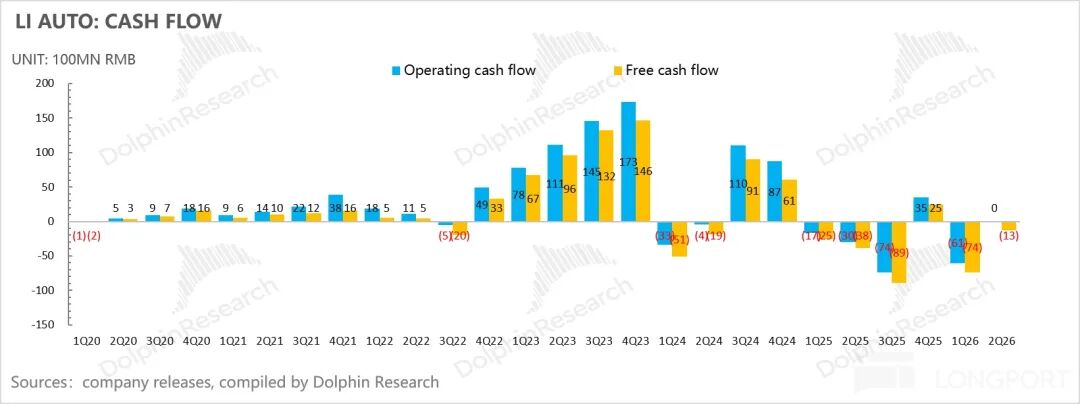
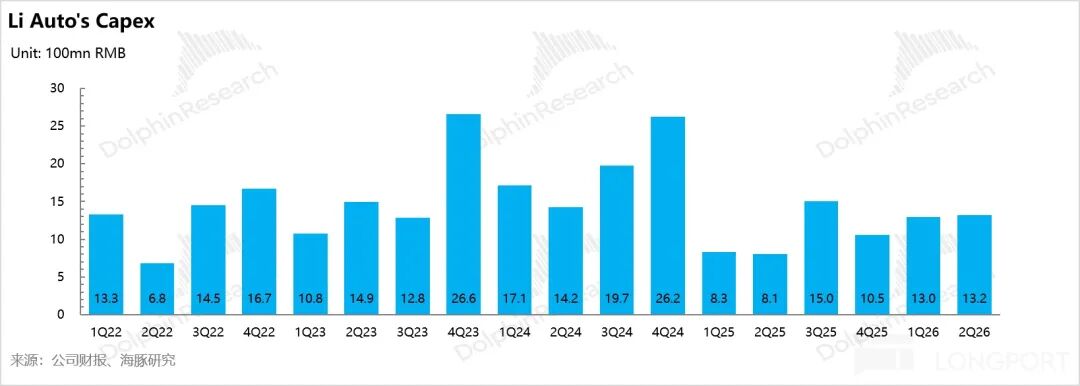
Operating cash flow for this quarter was 20 million yuan, up by approximately 6.1 billion yuan sequentially, primarily due to the recovery in the gross profit margin from vehicle sales driving a sequential rebound in net profit and increased fund occupation from accounts payable and prepayments. Capital expenditures remained flat sequentially at 1.32 billion yuan. Finally, free cash flow for this quarter was -1.3 billion yuan, up by approximately 6.1 billion yuan sequentially.
Nevertheless, Li Auto still has ample cash on hand. As of the end of Q2, the company held 85.6 billion yuan in cash and cash equivalents (net cash of 80.3 billion yuan), with short-term liquidity risks still controllable, providing relatively solid financial support for subsequent new vehicle cycles and AI investments.
- END -
// Reprint Authorization
This article is an original work by Dolphin Research. Reproduction requires authorization.
// Disclaimer and General Disclosure Notice
This report is for general comprehensive data purposes only, intended for general reading and data reference by users of Dolphin Research and its affiliated institutions. It does not consider the specific investment objectives, investment product preferences, risk tolerance, financial status, or special needs of any person receiving this report. Investors must consult with independent professional advisors before making investment decisions based on this report. Any person making investment decisions using or referring to the content or information mentioned in this report bears their own risks. Dolphin Research shall not be liable for any direct or indirect responsibilities or losses that may arise from using the data contained in this report. The information and data in this report are based on publicly available materials and are for reference purposes only. Dolphin Research strives to but does not guarantee the reliability, accuracy, and completeness of the relevant information and data.
The information or viewpoints mentioned in this report shall not be considered or construed as an offer to sell securities or an invitation to buy or sell securities in any jurisdiction, nor shall they constitute recommendations, inquiries, or endorsements of relevant securities or related financial instruments. The information, tools, and materials contained in this report are not intended for or intended to be distributed to jurisdictions where the distribution, publication, provision, or use of such information, tools, and materials contradicts applicable laws or regulations or requires Dolphin Research and/or its subsidiaries or affiliated companies to comply with any registration or licensing requirements in those jurisdictions, or to citizens or residents of those jurisdictions.
This report only reflects the personal viewpoints, insights, and analytical methods of the relevant creators and does not represent the stance of Dolphin Research and/or its affiliated institutions.
This report is produced by Dolphin Research, and the copyright is solely owned by Dolphin Research. No institution or individual may, without the prior written consent of Dolphin Research, (i) make, copy, reproduce, duplicate, forward, or distribute in any form copies or reproductions in any way, and/or (ii) directly or indirectly redistribute or transfer to other unauthorized persons. Dolphin Research reserves all relevant rights.
-
![]()
Can the Affordable IONIQ V Win Back Consumer Hearts?
-
![]()
【Xauto Intelligent Driving Rankings】Li Auto L9 Livis OTA9.1.0 Urban Evaluation Report
-
![]()
SAIC Audi Executives Claim Four-Ring Logo No Longer Holds Much Sway—Is That Accurate?
-
![]()
What Are the Odds of China's Battery-Swapping Heavy Trucks Making Inroads into Europe?
-
![]()
Vision: Has Li Auto's Extended-Range Ace 'Misfired,' Turning Guidance into a 'Pipe Dream?'
-
![]()
Too Pessimistic! MiniMax Isn't Doing That Badly
-
![]()
The 150,000-Yuan SUV Market: A Tempting yet Elusive Prize
-
![]()
The Endgame for New Car-Making Forces Is Set: Only a Three-Year Window Remains, Who Will Be Completely Eliminated?