【Xauto Intelligent Driving Rankings】Li Auto L9 Livis OTA9.1.0 Urban Evaluation Report
 08/27 2026
 363
363
— Test Point Evaluation
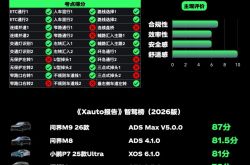
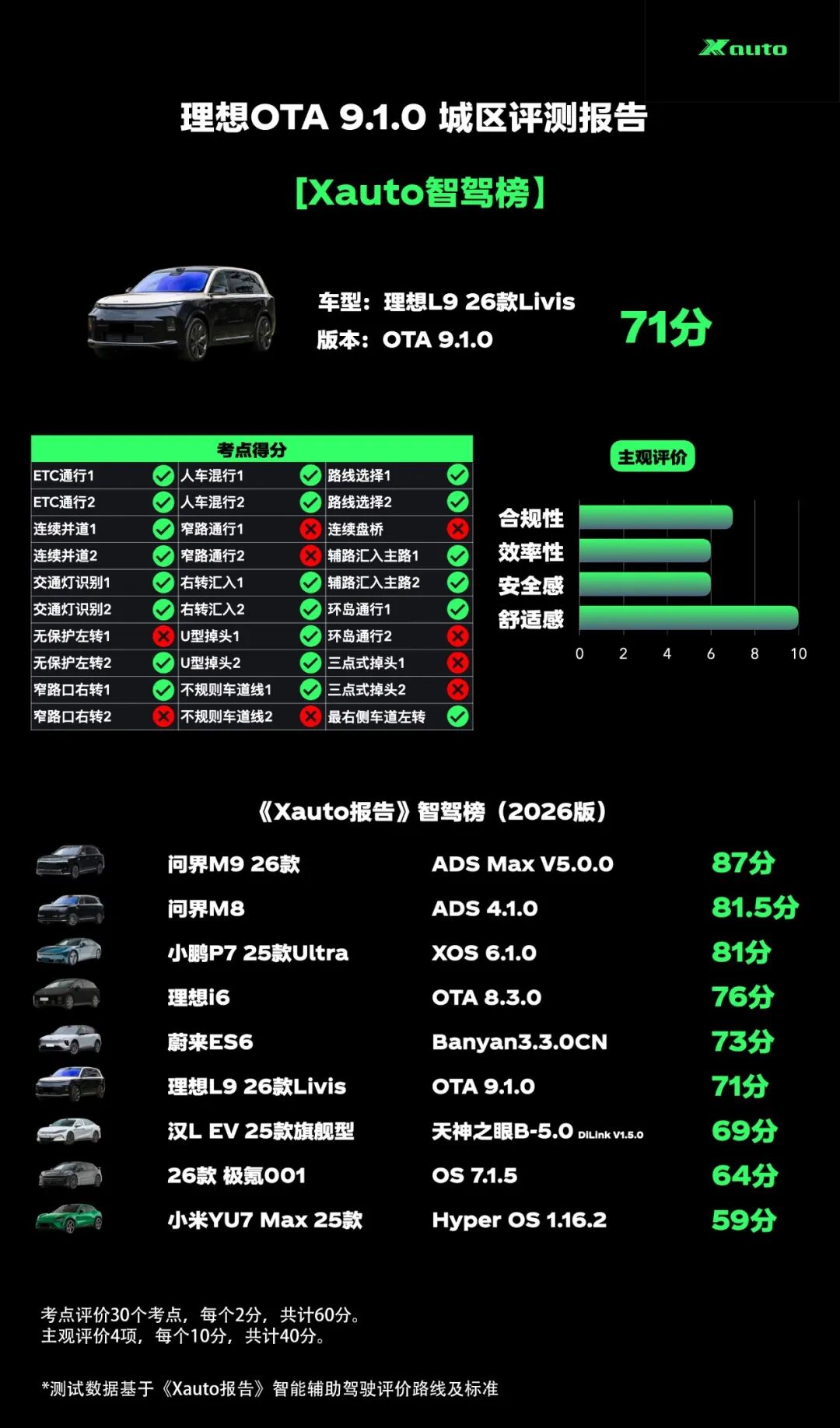
The Li Auto OTA 9.1.0 version scored a total of 42 points in test point evaluation, failing 9 test points. Compared to the 8.3.0 version we last experienced, there are two additional deducted test points.
The test points that failed in both versions are unprotected left turn test point 1, narrow intersection right turn test point 2, two narrow road passage test points, and two three-point turn test points.
It can be seen that while the issues from the 8.3.0 version were not optimized, the 9.1.0 version introduced additional problems. This led to the system frequently losing points in irregular lane line test point 2, roundabout passage test point 2, and continuous ramp navigation test points, which it had previously passed smoothly.
— Subjective Evaluation
— Compliance Dimension (7 points): There was an improvement compared to the 8.3.0 version, with two main deducted points. One was when the vehicle, already stopped at a red light, suddenly started moving for no apparent reason. Another deduction occurred in continuous lane merging test point 1, where the vehicle drove against traffic. The third deduction was in the continuous ramp navigation test, where the system significantly failed to yield to pedestrians.
— Efficiency Dimension (6 points): The most significant efficiency issue in the 9.1.0 version was various types of ineffective lane changes. First, the system lacked anticipation of other traffic participants' trajectories, often making ineffective lane changes even after other vehicles had left the lane.
The second type of ineffective lane change occurred when the system, believing the vehicle ahead was slow, changed lanes to a left-turn + straight lane, only to find it even slower. Alternatively, near intersections, the trajectory would wildly swing, and the system would choose a slow lane.
The third type of efficiency-affecting lane change was the system's tendency to change lanes too early for right turns at intersections, often ending up behind a bus, along with other unjustified ineffective lane changes.
Another efficiency issue was the following distance. While the system offered three adjustable following distances on highways, it did not support adjustments in urban scenarios, relying on intelligent distance adjustment. We believe the urban following distance was too long, leading to frequent cut-ins by other vehicles.
— Safety Dimension (6 points): Compared to the 8.3.0 version, speed control in curves was optimized, but there was still a slight issue with entering curves too fast, causing a slight sense of insecurity.
Simultaneously, the aggressive lane merging issue present in the 8.3.0 version was also optimized but remained imperfect, with the system still significantly slowing down to merge, forcing other vehicles to change lanes or brake sharply.
A new issue in this version was the handling of cut-ins, with slow and unenthusiastic reactions, nearly causing an accident once.
Another safety risk scenario occurred when the system attempted to bypass a parked vehicle by borrowing a lane, but when an oncoming bus approached, the system insisted on bypassing, requiring the driver to take over for safety. The timing of the bypass was problematic.
— Comfort Dimension (10 points): This version did not have any abrupt issues significantly affecting comfort.
In the subjective evaluation section, a total of 29 points were scored. The final score for the Li Auto L9 Livis OTA 9.1 version is 71 points.
— Supplementary Sharing
The 9.1.0 version scored 5 points lower than the 8.3.0 version, which was somewhat below expectations.
While it's understandable that the experience regressed due to the new architecture switch, one point we want to emphasize is that, whether in test point evaluations or subjective feelings, we believe the 9.1.0 version still retains traces of the 8.3.0 version, feeling like it hasn't completely abandoned the old architecture.
The overall capability of the 9.1.0 version is still acceptable. If one only experiences a short random urban road test drive, they might think this version is not bad. However, long-term testing reveals numerous small issues, such as hesitation in lane line selection, untimely responses to cut-in vehicles, failure to change lanes promptly on contra-flow lanes, insistence on competing with buses for lanes, and incorrect bypassing timing. These may be issues arising from the switch between old and new architectures.
Overall, we believe the experience maturity of the 9.1.0 version is insufficient and requires further refinement. Another version is expected in December, so let's look forward to the next update.
— Comprehensive Overview of Li Auto's Assisted Driving Product Line
Li Auto's intelligent driving adopts a hardware tiering + software unified OTA iteration model, divided into four major hardware tiers: AD Pro, AD Max (OrinX), AD Max (ThorU), and the Mach M100 platform (new-generation full-spec).
Software evolution: Traditional rules → End-to-end + VLM → VLA Driver Large Model → Mach VLA.
Iteration strategy: New vehicles (Mach M100) first run the full-spec model, collect data on a large scale, and then distill and deploy the model to older AD Max models like Thor U and Orin X upon maturity. AD Pro follows an independent route for popular urban NOA, not sharing the VLA large model stack.
I. Hardware Product Line Tiering (2026 Status)
1) AD Pro (Entry-Level Advanced, Horizon Scheme)
Old AD Pro (2022-2024 L7/L8/L9/Air) with Horizon Journey 5, 128TOPS, no LiDAR; only highway NOA and highway navigation, no urban NOA. Refreshed AD Pro (2025 Intelligent Refresh L6/L9) with Horizon Journey 6M, 128TOPS, standard Hesai ATL LiDAR; end-to-end urban NOA pushed via OTA 4.0 in January 2026, supporting both highway and urban NOA scenarios but not the VLA Driver Large Model, with an independent algorithm stack.
2) AD Max Initial Generation: Dual OrinX Platform (2022-2024, L7/L8/L9/MEGA)
Chips: Dual OrinX, 508TOPS computing power; Hesai 128-line LiDAR; 11-camera complete perception suite. Capabilities: Highway NOA + urban NOA; end-to-end + VLM architecture; VLA Driver Large Model (distilled version) pushed via OTA in 2025, and Mach VLA distilled and trimmed version pushed via OTA 8.6 in 2026, not full-spec Mach VLA due to computing power limitations.
3) AD Max ThorU Platform (2025 Refresh L6/L9 Max/Ultra; i8, i6)
Chips: Single ThorU, 700TOPS; Hesai ATL LiDAR, 7 8MP intelligent driving cameras. Capabilities: Factory-supported VLA Driver Large Model; Mach VLA distilled version pushed via OTA 8.6; full-scenario NOA, point-to-point intelligent driving from parking space to parking space, full-scenario VLA parking; higher hardware computing power than OrinX, better model distillation effects, but not full-spec Mach VLA.
4) Mach M100 Platform (Latest Self-Developed Platform, Top-Tier)
Representative models: 2026 L9 Ultra, L9 Livis; L8 Ultra, L8 Livis; L6 Ultra. Chips: Self-developed Mach M100 intelligent driving chip; Livis with dual M100s, 2560TOPS; Ultra with single M100; Livis upgraded with multiple LiDARs (3 variable-focus LiDARs), 360° omnidirectional laser perception. Software: Full-spec Mach VLA (MindVLAo1 base model), exclusive to OTA 9.1.0; complete world model, Agent intelligence, voice command vehicle control, stronger AEB/AES; point-to-point parking in unfamiliar parks; models not distilled or trimmed, all capabilities released.
II. Software Architecture Evolution Timeline
1. Rules Era: Traditional modular perception planning, highway NOA, no urban NOA. 2. End-to-End + VLM (2024): OrinX, AD Max launched, end-to-end perception and decision-making, large-scale urban NOA deployment. 3. VLA Driver Large Model (2025): Spatial intelligence + language intelligence + behavioral intelligence; supports voice command intervention in intelligent driving; pushed VLA large model to all OrinX/ThorU AD Max vehicles by Li Auto. 4. Mach VLA/MindVLAo1 (2026): Mach M100 new vehicles: full-spec Mach VLA (OTA 9.1). ThorU/dual OrinX old AD Max: Mach VLA distilled version (OTA 8.6), models trimmed for computing power, capabilities slightly lower than full-spec. AD Pro (Journey 6M): Independent end-to-end stack, not running VLA large model, independently iterating urban NOA.
-
![]()
Can the Affordable IONIQ V Win Back Consumer Hearts?
-
![]()
【Xauto Intelligent Driving Rankings】Li Auto L9 Livis OTA9.1.0 Urban Evaluation Report
-
![]()
SAIC Audi Executives Claim Four-Ring Logo No Longer Holds Much Sway—Is That Accurate?
-
![]()
What Are the Odds of China's Battery-Swapping Heavy Trucks Making Inroads into Europe?
-
![]()
Vision: Has Li Auto's Extended-Range Ace 'Misfired,' Turning Guidance into a 'Pipe Dream?'
-
![]()
Too Pessimistic! MiniMax Isn't Doing That Badly
-
![]()
The 150,000-Yuan SUV Market: A Tempting yet Elusive Prize
-
![]()
The Endgame for New Car-Making Forces Is Set: Only a Three-Year Window Remains, Who Will Be Completely Eliminated?