The First XR Patent Dispute Takes a New Twist: A Battle Reshaping Industry Dynamics and the "Initiation Rite" for Global Expansion
 01/19 2026
 542
542
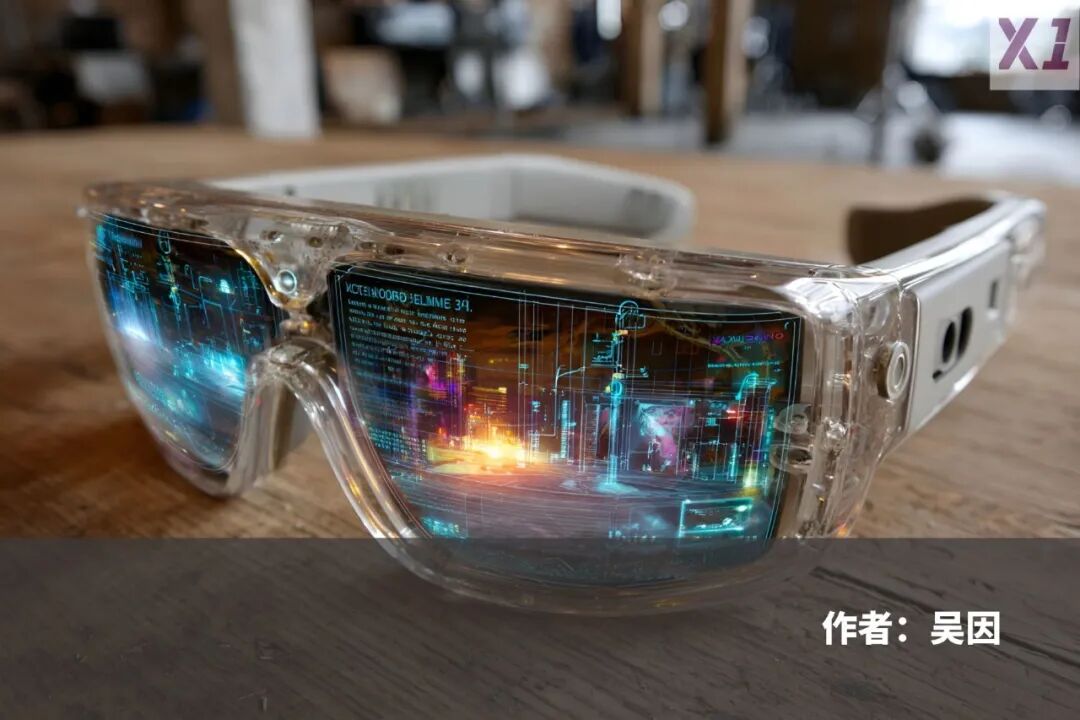
【Abstract】A sudden injunction from a German court has shattered the tranquility within the XR sector.
This dispute, hailed as the "First XR Patent Case" by industry insiders, has morphed from an initial product removal incident into a complex battleground encompassing core optical technologies, interpretation of patent scope, and strategies for international market competition.
On January 15, 2026, prior to the definitive ruling from the Munich District Court in Germany, XREAL initiated legal proceedings in the U.S. District Court for the Eastern District of Texas, alleging that Viture had infringed upon its core U.S. patent (US11988839) across multiple AR glasses products, reigniting the patent war.
The clash between XREAL and Viture, two leading Chinese XR firms embarking on global expansion, transcends mere commercial interests and may redefine the competitive landscape of the entire XR industry.
As technological prowess is transformed into patent weaponry and market share battles escalate into intellectual property confrontations, how will the outcome of this lawsuit shape the global XR industry? In this rapidly evolving technological landscape, who will wield the power to shape the future?
Here is the main text:

Behind the Injunction: Legal Wordplay and Market Realities
On November 13, 2025, a preliminary injunction issued by the Munich I Regional Court in Germany thrust two Chinese XR giants, XREAL and Viture, into the limelight.
The injunction mandates that Viture cease supplying, marketing, or utilizing optical systems that infringe upon XREAL's patents in the German market, "particularly the Viture Pro model."
The term "particularly" (German: "insbesondere") became the focal point of divergent interpretations by the parties involved. This seemingly innocuous word choice carries profound legal ramifications and market implications.
The German preliminary injunction system is renowned for its efficiency and stringency. According to Section 937 of the German Code of Civil Procedure, preliminary injunctions can be swiftly granted without a full trial process and must be immediately enforced upon issuance.
Crucially, even if the defendant appeals, the injunction typically remains in force during execution, meaning Viture must comply with the injunction throughout the potentially lengthy litigation process. This "enforce first, litigate later" approach renders preliminary injunctions a formidable weapon in patent litigation.
For XREAL, its insistence on interpreting "particularly" is essentially preserving room for subsequent legal maneuvers.
Should the court ultimately endorse this interpretation, XREAL can contend that the injunction encompasses all products employing similar optical designs, including Viture's newly launched Luma series.
The ingenuity of this strategy lies in its dual focus on existing products and deterrence of future ones.
Viture's emphasis on interpreting it as "solely involving" represents a classic crisis public relations and legal defense strategy.
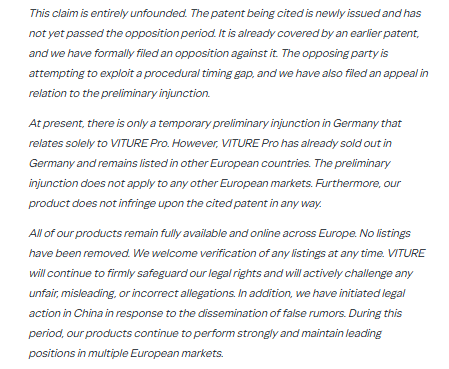
Source: Screenshot of Viture's response
In its official response, Viture first asserted that its products (especially the Viture Pro) do not infringe upon XREAL's patents, dismissing the allegations as "completely unfounded" and noting that it has already filed objections to the patent.
Secondly, the statement highlighted that the scope of the preliminary injunction solely targets the outdated Viture Pro product, which has already sold out in Germany, and does not impact sales in other European nations. Furthermore, sales of non-Viture Pro models remain unaffected.
Overall, through this response, Viture aimed to convey two key messages to the market: first, limited impact on its business operations; second, no repercussions for new products.
This statement has somewhat bolstered investor and partner confidence, buying time for legal countermeasures.
However, due to the injunction, the Viture Pro has been removed from nine EU websites, including Amazon Germany, France, Italy, Spain, Poland, the Netherlands, Ireland, Sweden, and Belgium.
On January 15, 2026, XREAL filed another lawsuit against Viture in the U.S. District Court for the Eastern District of Texas, alleging infringement of its core U.S. patent (US11988839) across multiple AR glasses products.
Before the definitive ruling from the Munich District Court in Germany was known, on January 15, 2026, XREAL once again sued Viture in the U.S. District Court for the Eastern District of Texas, accusing it of infringing upon the core optical patent US11988839, bringing the second patent battle to Viture's doorstep in the U.S. market.
According to the 2025 Q3 U.S. AR market sales rankings released by international data agency IDC, Viture claimed the top spot with a 28.1% share. More notably, the patent US11988839 that XREAL is alleging infringement of pertains to the overall architecture of the optical system in AR optical glasses. If infringement is confirmed, the entire product line will be affected.

Core Controversy: The Technical Intricacies of a Foundational Patent
To comprehend the significance of this patent dispute, one must first grasp the pivotal role of BirdBath technology in the XR industry.
BirdBath (bird bath-style optical solution) is currently one of the most prevalent display solutions for consumer-grade AR glasses. Its core principle involves utilizing a combination of a semi-transparent mirror and a curved mirror to reflect images from a microdisplay into the human eye.
The advantages of this solution lie in its cost-effectiveness, technological maturity, and excellent display performance, making it particularly suitable for consumer-grade products that need to balance performance and price.
Over the past five years, the BirdBath solution has propelled the transformation of AR glasses from niche gadgets to mainstream consumer products. It can be said that the BirdBath solution is a crucial technological foundation for the current prosperity of the XR consumer market.
XREAL holds the patent EP3754409B1, titled "Augmented Reality Device and Optical System Used Therein."
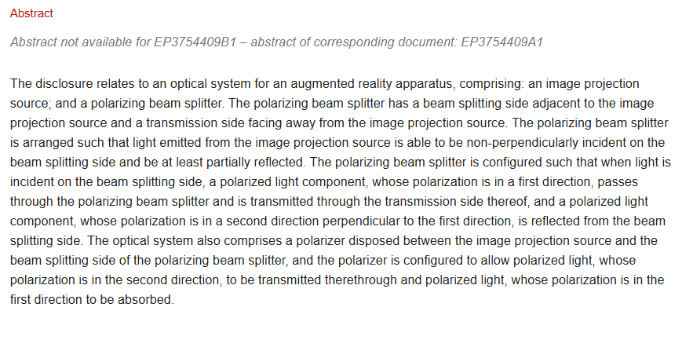
Source: Patent description
From the patent document, it is evident that this patent encompasses the core optical structure of the BirdBath solution. The patent claims meticulously detail a system comprising a specific arrangement of optical elements, light path design, and imaging characteristics.
XREAL asserts that this patent covers the optical path structure design of the display unit in Viture's products, which is why it is attempting to have the injunction apply not just to a single outdated model but to all allegedly infringing products.
Viture, on the other hand, contends that its patent bears a high resemblance to Microsoft's US9341843B2 patent. If the Munich District Court in Germany determines that XREAL's patented technology indeed overlaps with Microsoft's, it may be declared invalid or partially invalid, allowing Viture to circumvent the injunction.
Specifically, Microsoft's patent does involve the optical system of head-mounted display devices, but after review, the Munich District Court in Germany concluded that XREAL's patent features distinct characteristics from existing technologies in terms of optical element configuration and light path optimization, rendering Viture's strategy ineffective.
Given the current landscape, Germany's patent litigation system operates on a dual-track basis, where infringement lawsuits are heard by regional courts, while patent validity disputes are handled by specialized federal patent courts. These two procedures are independent and can proceed concurrently.
For Viture, this means that even if it is at a disadvantage in the infringement lawsuit, it can still seek to overturn the ruling through the invalidation procedure at the federal patent court.
However, the challenge lies in timing—the first-instance trial period for infringement lawsuits is approximately 12-18 months, while the average duration of invalidation procedures extends to 30-48 months. During this time gap, the preliminary injunction will remain in effect, posing significant pressure on Viture's market operations.

Industry Implications: Patents Transcend Soft Barriers to Become Survival Lines
XREAL's demonstrated patent prowess did not materialize overnight.
According to China Finance Online, the company has deployed over 800 patents globally, with more than 70 core European patents. This systematic patent布局 (strategic deployment) reflects XREAL's approach of treating intellectual property as a core strategic asset since its inception.
In a high-tech-intensive industry like XR, patent portfolios are not just defensive tools but also offensive weapons, negotiation leverage, and the foundation for ecosystem building.
Reflecting on the history of technology industry development, patent litigation often marks a significant milestone in industry maturation.
The century-long patent war between Apple and Samsung in the smartphone industry and Qualcomm's unique chip + patent licensing business model in the telecommunications industry both illustrate that when a technological field transitions from a blue ocean to a red ocean, from technological exploration to large-scale commercialization, patent disputes are almost inevitable.
The XR industry is currently at a similar critical juncture. With the maturation of the BirdBath solution and market expansion, the need for technological standardization and patent clarification is becoming increasingly urgent. The XREAL vs. Viture lawsuit may just be the harbinger of patent competition in the XR industry.
Meanwhile, this dispute offers multiple lessons for Chinese XR companies embarking on global expansion.
First is the imperative to establish patent early warning mechanisms. Many Chinese tech companies, when expanding overseas, often prioritize market expansion while neglecting intellectual property risk assessments.
The VITURE case underscores that even if a product may be technologically innovative, if it has not thoroughly researched and assessed the patent landscape in the target market, it can still face infringement risks.
Second is the recognition of the complexity of international legal environments. The patent systems in Europe and the United States differ significantly from China's, particularly in terms of preliminary injunctions, evidentiary rules, and damage calculations.
Third is the importance of strategic foresight in technology path selection. While BirdBath is currently the mainstream solution, alternative approaches like waveguide and off-axis optics are also rapidly developing. Companies need to balance technological leadership with patent risks in their R&D strategies.
Returning to this case, patent litigation does not necessarily yield a zero-sum outcome.
In the history of the tech industry, many fierce patent wars have ultimately culminated in cross-licensing agreements, strategic collaborations, or even corporate mergers. XREAL's statement that it is "willing to cooperate with companies worldwide that respect original technology" leaves room for possible settlement.
For the entire XR industry, the most desirable outcome might be the establishment of a reasonable patent licensing framework that protects innovation while promoting technology sharing, avoiding redundant R&D and resource waste.

Epilogue
The patent battle between XREAL and VITURE extends far beyond the two companies involved. It serves as a mirror, reflecting the challenges Chinese tech companies must confront when going global: how to protect their innovative achievements while respecting intellectual property rights? How to compete and coexist in the global market?
The lawsuit has not yet concluded, but it has already sent a resounding signal to the industry: in the new XR arena, patents are transforming from technical endorsements into competitive thresholds. They are no longer just proof of innovation capability but directly determine whether products can enter the market and whether companies can survive. The holder of core patents often tilts the industry's voice in their favor.
For Chinese XR companies venturing into the global market, this "First Case" may serve as the best enlightenment lesson.
- XINLIU -
-
On the Eve of Its IPO, Avatr Finds Itself Embroiled in a 'Farce of Controversy and Belittlement'
-
![]()
Yutong Optics' Japanese Subsidiary Unveiled in Tokyo, Shifting Strategic Focus to Technology-Driven Growth
-
![]()
Half-Year Revenue Outstrips Last Year’s Total! Zhongrun Optics Forecasts 80.2% H1 Revenue Growth
-
![]()
Why Does AI Competition Start with Computing Power?
-
![]()
Apple AI Finally Makes Its Debut in China, Yet iPhone's 'AI Autonomy' Faces Uncertainty
-
![]()
Apple AI and QianWen Make Up Lessons: Alibaba Has Its Own 'Doubao Phone'
-
![]()
QianWen Joins Apple, Signal for Large Models to ‘Fade into the Background’
-
![]()
The ‘Anchor’ Strategy of Google Hidden Behind the Bleeding Financial Report