Popular Science Essay | The Messenger of Light: The Science and Technology Behind the Black Hole Image
 03/06 2026
 677
677
The Messenger of Light: The Science and Technology Behind the Black Hole Image
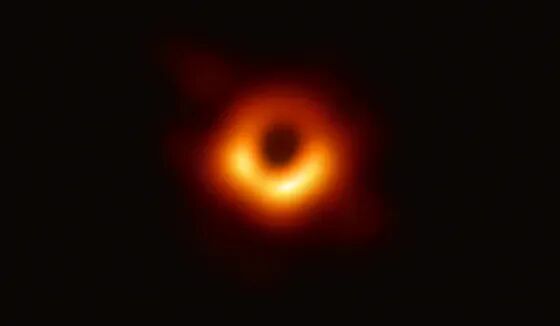
The M87 black hole, humanity's first-ever photograph of a black hole. Source: EHT Collaboration. In 2017, a group of photons, having traveled from 55 million light-years away, arrived on Earth. Their origin was not a mere theoretical construct or a figment of science fiction imagination but an awe-inspiring entity that truly exists in the cosmos. Researchers stationed at various locations across the globe were on high alert, meticulously maneuvering colossal telescopes to capture these elusive travelers. Over the ensuing two years, they meticulously analyzed the vast troves of data these photons brought with them. On April 10, 2019, humanity witnessed, for the first time, the silhouette of these photons in an image, and the researchers proudly proclaimed at the outset of their paper: "We present the first image of a black hole." How did these photons embark from the most enigmatic locale in the universe, carrying information about the ultimate fate of massive stars, traverse unfathomable distances to reach Earth, and be captured by human eyes? Let us endeavor to retrace their journey from the very beginning.
1. The Photon's Odyssey Begins
The homeland of these photons is the M87 galaxy, also known as the Virgo A galaxy. M87 is one of the most massive galaxies in proximity to the Milky Way, boasting an elliptical shape. If we envision a galaxy as a colossal kingdom, with each star cluster representing a city, then the M87 galaxy kingdom comprises approximately 12,000 such cities. These cities revolve around the kingdom's center—the black hole that piques our curiosity. It lies about 53-55 million light-years away from Earth, with a mass equivalent to 6.5-6.6 billion suns. It is believed to have formed from the collapse of a massive star at the end of its life, resulting in an incredibly dense object. The M87 black hole possesses a gravitational pull so strong that it can attract everything in its vicinity, including light itself. So, how was our luminous protagonist, the photon, born? There are three potential sources: synchrotron radiation from charged particles, thermal radiation from the friction of high-temperature gases, and relativistic jet radiation.
The M87 black hole is enshrouded by an extremely dense cocoon of gas and dust, known as an "accretion disk." Due to the black hole's immense gravitational force, the accretion disk orbits the black hole at ultra-high speeds, containing numerous charged particles that continuously alter their direction of motion under the influence of a magnetic field, emitting photons (electromagnetic waves) tangentially to their motion—a phenomenon known as synchrotron radiation. Simultaneously, the accretion disk is so dense that the friction between its constituent particles generates heat, radiating photons outward like a colossal furnace. Because the gas (plasma) on the inner side of the accretion disk moves faster than that on the outer side, it creates a highly distorted and powerful magnetic field. The plasma is then ejected along the magnetic field lines at the black hole's poles, a phenomenon known as relativistic jet radiation, forming another batch of high-energy photons. Picture it as a colossal whirlpool in an extremely hot lake, with towering geysers erupting from the whirlpool's center. During the black hole's astonishing energy release process, the photons commence their journey.
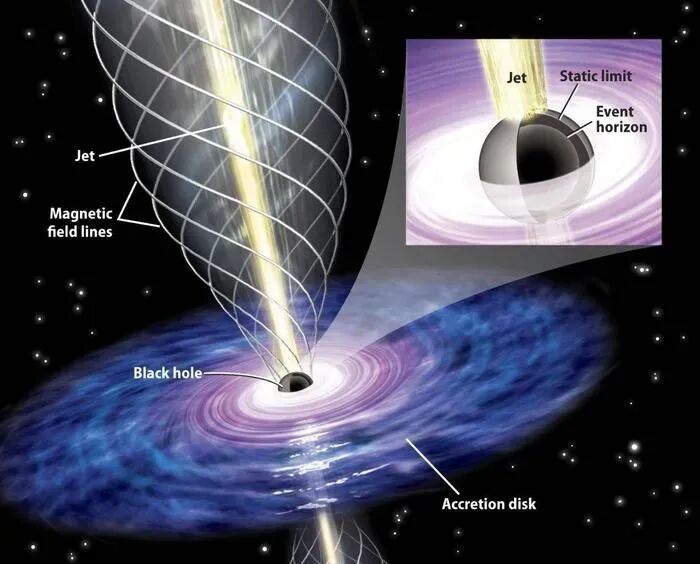
The Accretion Disk and Jets of a Black Hole. Source: Astronomy.
The photons born from the M87 black hole span a wide range of energies, including microwaves, visible light, X-rays, and gamma rays. Some high-energy photons, owing to their shorter wavelengths, are more prone to interact with microscopic particles or be absorbed. Conversely, some lower-energy photons (microwaves, radio waves) can bypass small dust particles due to their longer wavelengths and travel unimpeded through the vast expanse of the universe. However, during the photon's propagation, the universe is continuously expanding, stretching the photon's wavelength—a phenomenon known as the redshift effect. According to quantum mechanics, E=h⋅ν= hc/λ (where h is Planck's constant, ν is frequency, c is the speed of light, and λ is wavelength), when the wavelength λ increases, the photon's energy gradually diminishes. The light that ultimately reaches Earth is vastly different from the light originally emitted from M87. To capture these mysterious and swift travelers, humanity requires a colossal machine.
2. Captured by Machines
By the time the photons have traversed the universe, life on Earth has undergone seismic changes. Humans have recognized the limitations of their eyes as sensors and have continuously upgraded and iterated telescopes by leveraging the propagation laws of visible light. From refracting and reflecting telescopes capable of observing neighboring planets to today's X-ray and gamma-ray telescopes suspended beyond Earth's atmosphere, humanity has always been contemplating how to capture photons to observe celestial bodies more comprehensively. For the M87 black hole, the first decision was determining which wavelength band of photons to observe. Researchers opted for the microwave band because its wavelength is just right—neither too "short" nor too "long." Some high-energy photons with very short wavelengths (X-rays, gamma rays) are already absorbed or scattered en route to Earth, while observing electromagnetic waves with longer wavelengths (radio waves) would necessitate a telescope with an aperture far larger than Earth's diameter—a feat difficult to achieve in the near term.
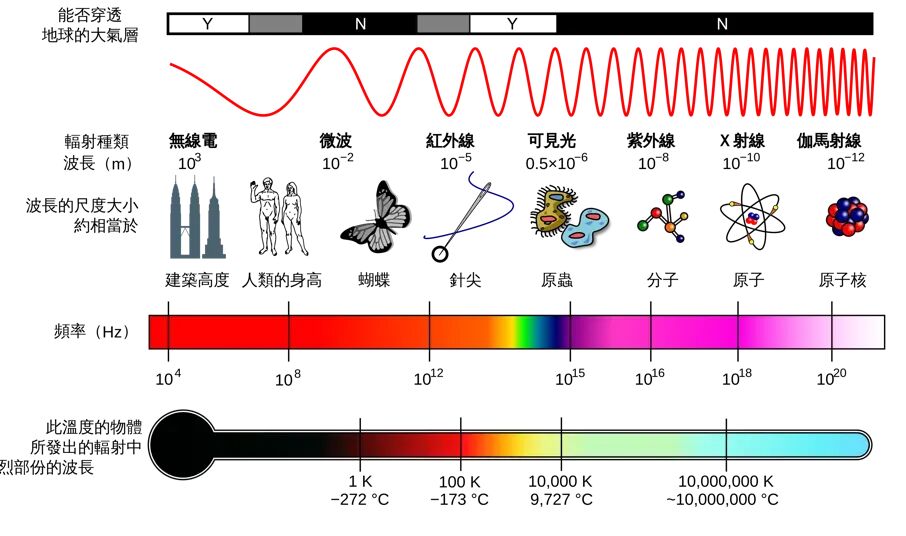
The Electromagnetic Spectrum. Source: Wikipedia.
However, observing microwaves also demands a telescope with an aperture comparable to Earth's diameter. Thus, a grand plan was conceived—the "Event Horizon Telescope" (EHT). It is not a single telescope but a colossal "virtual telescope" equivalently composed of eight telescopes located in Chile, Mexico, the United States, Greenland, and Antarctica. The Shanghai Astronomical Observatory of the Chinese Academy of Sciences also collaborated, ensuring the operation of the James Clerk Maxwell Telescope (JCMT) in Hawaii for the EHT. The "event horizon" refers to the boundary surrounding a black hole. Once any matter or light crosses this boundary, it can no longer escape to the outside, rendering it impossible for humans to directly observe any events within. Just as its name suggests, the EHT embodies the determination to confront the extreme.
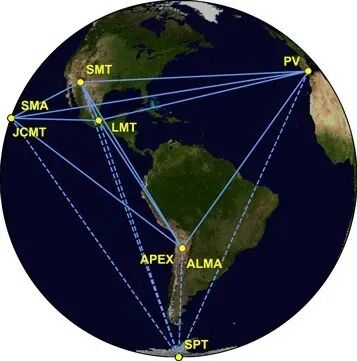
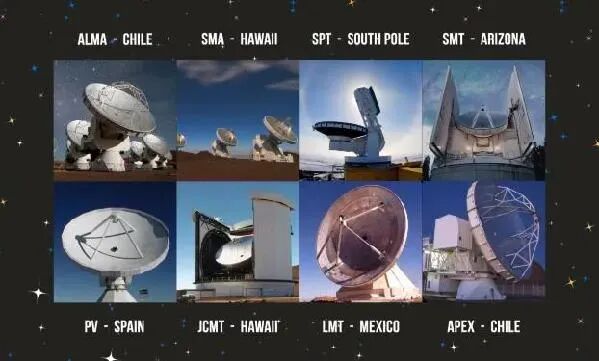
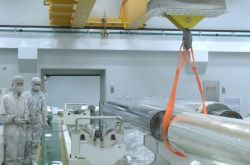
Members of the EHT Telescope Observing the M87 Black Hole. Source: EHT Collaboration, Guangming Net.
Theoretical predictions suggest that the size of the M87 black hole is about 40 microarcseconds—roughly the angular size seen from Earth when a coin is placed on the Moon. To resolve such a minuscule structure, the telescope's resolution must surpass this value. The telescope resolution θ≈1.22λ/D (where λ is the observation wavelength, and D is the effective aperture of the telescope). To achieve a resolution as small as possible below 40 microarcseconds, and considering the feasibility of existing technology and equipment, after continuous theoretical deductions, the EHT chose to use the 1.3-millimeter (230 GHz) microwave band to observe the M87 black hole. The technology adopted by the EHT is called "Very-Long-Baseline Interferometry" (VLBI). Astronomical telescopes at different locations are equipped with high-precision atomic clocks to accurately receive faint signals from deep-space celestial bodies simultaneously. The data collected by each telescope is recorded on hard drives and transported to a data processing center for comparison and synthesis, eliminating noise and extracting valid information, ultimately being synthesized into an image visible to humans.
On four clear nights in April 2017, multiple telescopes on Earth were poised to welcome the rain of photons. They successfully received echoes from the distant universe. Since then, the photon's cosmic journey has temporarily concluded, but humanity must now recreate their image for posterity.
3. Information Reconstruction
The massive amounts of data collected from the EHT telescope, measured in petabytes (PB), resemble the enormous luggage brought by the photons after their journey, requiring meticulous organization. Data processing is divided into three steps: First is data alignment. In the "correlator," a supercomputer, data from different telescopes is precisely compared, and their similarities are calculated, integrating scattered signals into a unified interference signal. Second is data calibration and quality control. This is a very time-consuming and crucial step. Researchers use complex algorithms and known calibration sources to meticulously remove noise and biases, ensuring that every data point is authentic and reliable. The final step is the most challenging: image reconstruction. The VLBI technology used by the EHT can only collect partial spatial frequency information, requiring the deduction of the entire picture from several incomplete clues. Instead of relying on a single algorithm, the researchers adopted multiple independently developed imaging algorithms. The most famous is the CLEAN algorithm. The steps of this algorithm are as follows: First, find the brightest point (the strongest signal source) in the reconstructed image. Second, assume the brightest point is a perfect point source, calculate what kind of artifacts it would produce in the interference data, and then subtract this point source and its artifacts from the original data. By repeating this process iteratively, all the subtracted "point sources" are synthesized together to form a "clean" image without artifacts.
To ensure the reliability of the results, the EHT organization established four completely independent analysis teams. Each team used different algorithms from start to finish for analysis without communicating with each other. Ultimately, all four teams obtained highly consistent results: a bright ring structure and a clearly visible dark region in the center—which is the M87 black hole image we see today.
Although we have journeyed alongside a special group of photons from the M87 black hole, the universe is teeming with countless photons. Each faint light from a distant galaxy carries an ancient tale. Light does not convey immediate changes of the present but rather historical events that have already transpired. It transmits information across unfathomable distances to us, allowing us to perceive the existence and evolution of extreme celestial bodies in the depths of the universe without close contact. Light, as the oldest messenger of the universe, is not only a carrier for retracing history but also illuminates the future path of scientific advancement, becoming an eternal driving force for humanity to continuously explore.
-
![]()
Jitian Xingzhou: A Pioneer in Optical Payloads Secures Hundreds of Millions in Series B Funding!
-
![]()
Orders Secured Through to the Second Half of the Year! The Rationale Behind the 'Surge' in Demand for This Company’s Optical-Grade Base Films
-
![]()
Beyond Patents: The Retail Rivalry of Insta360 and DJI Unfolds
-
![]()
180 Billion Market Cap Vanished! How Did Seres Fall So Far?
-
![]()
Blockbuster! Domestic storage takes the global double crown for the first time, from an AI company
-
![]()
China Spearheads Formulation! World's Pioneering Global Technical Regulation for Automated Driving Systems Greenlit and Unveiled
-
![]()
Farewell to Pulsed Support Policies: Three Major Auto Policy Directions from Multiple Departments Take Effect on the Same Day
-
![]()
Embercore AI’s Accelerated Funding: The Robot Industry’s Shift Toward ‘Learning Systems’