Profits Slashed and Now Embroiled in DJI's 'Patent Battle', Liu Jingkang, with 28.5 Billion Yuan Fortune, Faces 'New Challenges'
 06/16 2026
 498
498
Produced by Leadar Radar. Authored by Zhou Hui. Edited by Meng Shuai.
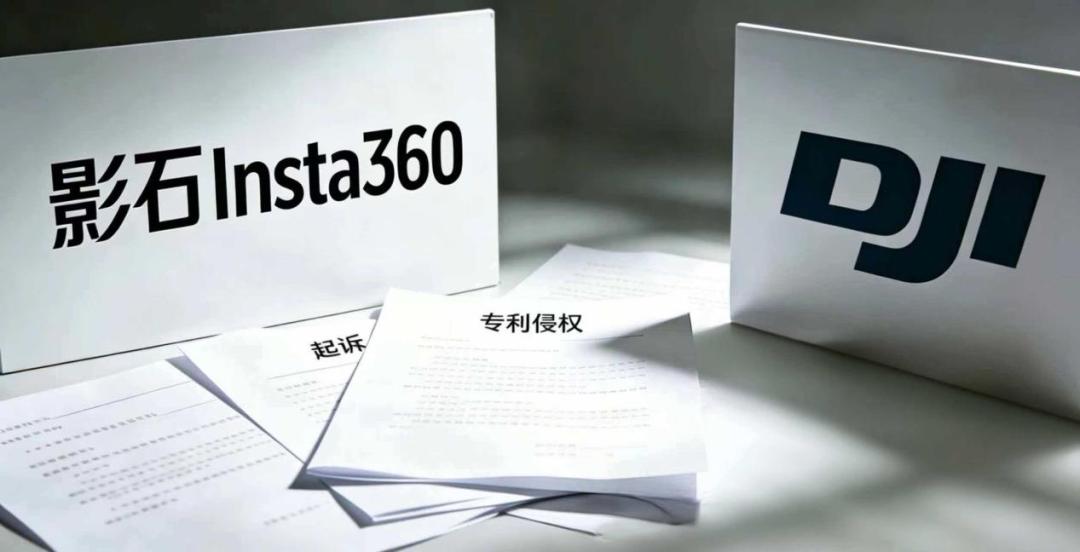
Insta360, a frontrunner in the smart imaging device industry, is once again embroiled in a 'patent battle' initiated by DJI.
Media reports indicate that on June 10 and 11 (local time), DJI and its Osmo brand filed lawsuits against Insta360 and its affiliated entities in the U.S. District Court for the Eastern District of Texas, alleging patent infringement related to the U.S. launch of Insta360's Luna series handheld gimbal cameras.
The lawsuits encompass two design patents and four invention patents, covering several core technologies underlying DJI's Osmo Pocket series products.
DJI has requested the court to order Insta360 to halt the alleged infringing sales and seek compensation for infringing profits, damages, legal fees, and attorney's fees.
In response to DJI's overseas lawsuit, Insta360 promptly countered. On June 12, Insta360 filed a patent counterclaim against DJI in the United States and simultaneously sought the invalidation of related patent families with the China National Intellectual Property Administration.
As two key players in the imaging industry, Insta360 and DJI once followed a trajectory of complementary development. However, since 2025, Insta360 has taken the lead in venturing into the drone sector, traditionally DJI's stronghold, while DJI has retaliated by entering the panoramic camera field, where Insta360 excels.
Amidst fierce market competition, Insta360 has maintained robust revenue growth, but its profitability has raised concerns.
In the first quarter of this year, Insta360 reported revenue of 2.481 billion yuan, up 83.11% year-on-year; however, net profit attributable to the parent company was only 85 million yuan, a 50% decline from the same period last year.
Notably, in March this year, Insta360 founder Liu Jingkang, with a fortune of 28.5 billion yuan, made his debut on the Hurun Global Rich List, ranking 1123rd.
Imaging Titans Reignite 'Patent Battle'
The 'patent battle' between DJI and Insta360 has escalated from domestic to international arenas. On June 9, Insta360 launched its Luna series handheld gimbal cameras in the United States, but shortly after the product release, it faced DJI's patent 'onslaught'.
According to Dahe Daily, on June 10 and 11 (local time in the United States), DJI and its Osmo brand filed patent infringement lawsuits against Insta360 and its affiliated companies in the U.S. District Court for the Eastern District of Texas, with case numbers 2:26-cv-00462 and 2:26-cv-00463, respectively.
According to the complaints, DJI alleges that the Luna cameras infringe two of its design patents (patent numbers D1110390, D1072023) and four invention patents (patent numbers: 11009181, 11245855, 11381751, 11539893), covering technologies and designs related to DJI's Osmo Pocket series products, including core underlying technologies such as gimbal electromechanical control and shooting control.
In the design patent allegations, DJI claims that Insta360's Luna cameras bear a striking resemblance to its Osmo Pocket 3 in appearance, with similar body proportions, overall handle structure paired with the gimbal, and internal component layout.
The invention patents in question focus on core shooting functions, including single-button switching between gimbal following and locking modes, independent device-based person tracking with real-time display, gimbal operation adjustment based on the shooting scene, and an independent target tracking display system.
DJI points out that Insta360 was aware of the alleged patent infringement when the complaint was filed and served but continued to import, manufacture, use, sell, and offer to sell the accused products, as well as induced users of the accused products to infringe the patents in question. DJI argues that this constitutes willful infringement and warrants enhanced damages.
Therefore, DJI requests the court to issue a permanent injunction against Insta360's infringing sales and other acts, as well as demand that Insta360 disgorge infringing profits, pay damages, and cover related legal fees and attorney's fees.
Facing DJI's accusations, Insta360 has not retreated. According to National Business Daily, on June 12, Insta360 filed a patent counterclaim against DJI in the United States, involving five invention patents related to gimbal cameras and panoramic cameras, covering key technologies such as gimbal stabilization algorithms, gimbal pointing control, camera smooth anti-shake, motion data overlay, and panoramic video stabilization.
At the same time, Insta360 also requested the invalidation of related patent families with the China National Intellectual Property Administration.
From Complementary Coexistence to Mutual 'Encroachment'
According to Tianyancha information, Shenzhen DJI Innovations Technology Co., Ltd. (DJI for short), founded in 2006, specializes in the R&D and production of drones, handheld imaging devices, and robotics education. It is a global leader in drone and smart imaging technologies.
Insta360 Innovation Technology Co., Ltd. (Insta360 for short), founded in 2015, focuses on the R&D, production, and sales of smart imaging devices such as panoramic cameras and action cameras.
As a 'latecomer,' Insta360 initially chose to avoid direct competition with DJI's strengths and focused on the panoramic camera sector. In 2016, Insta360 launched its first consumer-grade panoramic camera, the Insta360 Nano.
As the first product in the industry to allow users to connect directly to a smartphone for one-click panoramic photo and video shooting, the Nano quickly gained popularity in the consumer market upon its release.
Since then, Insta360 has continued to deepen its presence in the panoramic camera sector, expanding its market share with differentiated panoramic algorithms and user-friendly product designs.
According to Frost & Sullivan's 'White Paper on the Development of the Global and Chinese Handheld Smart Imaging Device Markets' released last year, Insta360 held 67.2% and 75.3% of the global consumer panoramic camera market share in 2023 and 2024, respectively, ranking first in global market share for eight consecutive years.
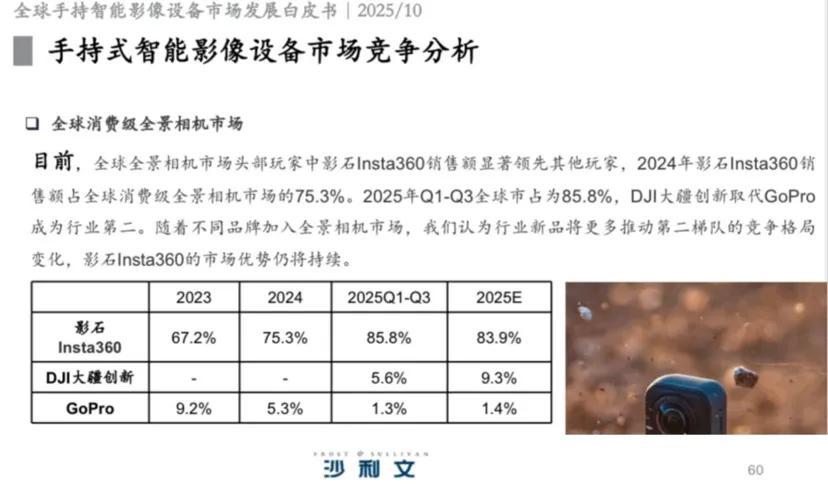
During the same period, DJI primarily focused on the global drone market and did not venture into the panoramic camera sector. The 'White Paper' shows that before 2025, DJI held zero market share in the global consumer panoramic camera market.
In their respective core sectors, DJI and Insta360 once maintained a pattern of complementary development, but this dynamic is gradually changing.
In 2025, seeking new growth drivers, Insta360 took the lead in entering DJI's 'stronghold.' In July of that year, Insta360 officially announced its entry into the drone industry, planning to launch its own drone brand and collaborate with third parties to incubate new drone brands.
In response to the offensive from a competitor, DJI swiftly countered. On July 31 of the same year, DJI launched its first panoramic camera, the Osmo 360, officially entering the panoramic camera sector.
As a new entrant to this niche market, DJI quickly gained market share through a 'price-for-market' strategy.
The aforementioned 'White Paper' points out that in the third quarter of 2025, DJI captured approximately 17.1% of the global panoramic camera market share, with its domestic market share rising to 37.1%.
It is worth noting that Frost & Sullivan withdrew the report after internal data verification, while Qianzhan Consulting, based on e-commerce GMV calculations, indicated that in the third quarter of 2025, DJI's global market share climbed to 43%, while Insta360's share declined to 49%.
Despite slight discrepancies in the data, it is undeniable that the panoramic camera market has formed a pattern where 'Insta360 leads, and DJI pursues.'
Entering 2026, the 'conflict' between the two companies further escalated. In March this year, DJI filed a lawsuit against Insta360 with the Shenzhen Intermediate People's Court in Guangdong Province, involving six patent ownership disputes covering key technologies such as drone flight control, structural design, and image processing.
Several former DJI core R&D personnel were allegedly involved. In the complaint, DJI pointed out that the patents in question were invented by former employees within one year of their departure and were closely related to their work tasks during their employment at DJI.
In response, Insta360 founder Liu Jingkang stated, 'DJI claims that all patents created by former employees within one year of their departure should belong to DJI. We carefully examined the patents applied for by the involved employees during that period, and the existing evidence shows that they were all original ideas and independently innovative achievements generated within Insta360.'
Liu also said, 'I fully understand the mindset of a giant whose market is being encroached upon. Regarding DJI's lawsuit against Insta360, we should await the normal evidence-gathering and investigation procedures of the court. This is common in competition among tech companies.'
First-Quarter Profits Halved, Liu Jingkang Admits to 'Multiple Pressures'
Amidst fierce market competition, Insta360 has maintained robust revenue growth, but its profitability has raised red flags.
In 2025, Insta360 achieved total revenue of 9.741 billion yuan, up 74.76% year-on-year; however, net profit attributable to the parent company was 929 million yuan, down 6.62% year-on-year, showing a trend of 'revenue growth without profit growth.'
In 2026, the downward trend in Insta360's profits further accelerated. In the first quarter of this year, the company reported revenue of 2.481 billion yuan, up 83.11% year-on-year; however, net profit attributable to the parent company was only 85 million yuan, a 50% drop from the same period last year.
In response, Insta360 explained in its financial report that the increase in revenue was primarily due to the launch of new products, market expansion, and continued growth in online and offline sales.
The decrease in net profit attributable to the parent company was attributed to the company's proactive increase in strategic R&D investment and market expansion, leading to higher related expenses. Additionally, rising prices of storage components and intensified competition in the imaging industry contributed to a decline in the company's gross profit margin.
According to TrendForce, memory prices rose across the board in the first quarter of 2026. It is estimated that the overall Conventional DRAM contract prices will increase by 90-95% from the previously announced 55-60% growth in early January, while NAND Flash contract prices will rise from 33-38% to 55-60%, with further upward revisions not ruled out.
As a result, Insta360's operating costs expanded significantly in the first quarter, increasing by 113.18% year-on-year to 1.36 billion yuan.
On the expense side, Insta360's growing R&D expenditure has become another 'profit drain.'
Financial reports show that in the first quarter of this year, Insta360's R&D expenses reached 465 million yuan, doubling from 232 million yuan in the same period last year.
Regarding Insta360's 'aggressive' R&D investment, Liu Jingkang pointed out in a letter to shareholders that the company's current main business primarily stems from bold attempts made seven or eight years ago, but the imaging market is a growth-driven sector reliant on product definition and technological innovation.
Therefore, in addition to its existing business (panoramic cameras, thumb cameras, action cameras, etc.), Insta360 has strategically invested in R&D for two drone models (including the Shadow Panoramic Drone), gimbal cameras, wireless lavalier microphones, and three other new product categories, as well as custom-developed three chip models.
Liu admitted that while high-intensity strategic investments support the company's long-term development, they have also led to a decline in short-term profitability indicators.
Additionally, on the sales front, to expand its online business, Insta360 has recently entered third-party e-commerce platforms such as Amazon, Tmall, and JD.com. As sales channels have increased and revenue has grown, sales expenses have also risen.
In 2025, Insta360's sales expenses reached 1.679 billion yuan, up 103.31% year-on-year; in the first quarter of this year, sales expenses reached 449 million yuan, up 75.54% from the same period in 2025.
Overall, in the first quarter of 2026, Insta360's total operating costs were 2.457 billion yuan, up 107.22% year-on-year, surpassing the 83.11% growth in revenue during the same period.
The widening gap between revenue and cost growth has further impacted the company's profitability. In the first quarter of this year, Insta360's gross profit margin was 45.2%, a significant decline of 7.73 percentage points from 52.93% in the same period of 2025.
Liu Jingkang admitted in a letter to shareholders, 'We are under some pressure from short-term storage costs, which may rise further and affect our gross profit margin. Continued investment is needed for several custom chips to ensure the company's future development and competitiveness. Additionally, the deep integration of AI and organizational processes requires increased investment in IT and data infrastructure, all of which contribute to short-term profit pressures.'
However, Liu also pointed out that improvements in R&D and marketing efficiency, as well as product design and supply chain integration, will lead to significant cost savings. The three new product categories—gimbal cameras, microphones, and drones—are expected to launch within the next year, transitioning from 'investments' to 'revenue generators' and boosting profits.
-
![]()
Two Key Moves in a Month! This Optical Giant is Quietly Shifting Tracks
-
![]()
Strong Alliance Unveiled! CooperVision and Eb Medical Forge Strategic Partnership
-
![]()
Is AI-Powered Shopping Really Worth It or Not Necessary At All?
-
![]()
Doushengsheng: Is It Really 'Stealing the Base'?
-
![]()
Dealer Service Operation Capability | After-sales Customer Retention: Three Key Strategies for Attracting Customers with Competitive Pricing
-
![]()
Revealed: CXMT’s New Wafer Fab Set to Establish Presence Here
-
![]()
Is Ant Afu Facing Its First Leadership Shuffle? Official Statement Dismisses Claims as Baseless
-
![]()
Pixel 11 Specs and Price Leaked Early: Price Hike of $100, Yet Memory Trimmed to 12GB