Legal Disputes, Share Unlock, and Pricing Controversies Converge: Insta360 Reaches a Pivotal Juncture
 06/29 2026
 574
574
In June 2026, Insta360 Innovation (688775.SH) found itself embroiled in four significant events simultaneously.
On June 9, the Luna Ultra, the inaugural horizontal dual-lens gimbal camera, was unveiled, marking Insta360's formal entry into the handheld gimbal market—a domain long dominated by DJI.
On June 10, DJI initiated legal proceedings in the U.S. District Court for the Eastern District of Texas, alleging that Luna infringed upon six of its patents.
On June 11, a substantial 227 million restricted shares were unlocked, representing 56.5% of the total share capital and equating to a market value of approximately 40.9 billion yuan. This led to an almost eightfold expansion of the free float overnight.
From June 10 to 24, a national subsidy pricing dispute intensified following consumer complaints. According to the Straits Metropolis Daily, the Luna launch event promoted a "standard version starting at 3,999 yuan." However, consumers later discovered that this price included a 15% national subsidy (around 705 yuan), with the product's original price being 4,729 yuan. After the controversy emerged, Insta360 removed the national subsidy portal nationwide, while the 4,699 yuan Creator Bundle remained available for purchase.
According to Insta360 Innovation's 2025 annual report, released following its listing on the STAR Market, the company achieved revenue of 9.741 billion yuan in 2025, held a 68% global market share in panoramic cameras, and its market value once surpassed 70 billion yuan.
With new products, litigation, share unlocks, and subsidy disputes all arising within a single month, Insta360—the world's leading seller of panoramic cameras by shipment volume—now faces multiple critical challenges.
Industry Report Analysis
According to IDC's Worldwide Handheld Smart Camera Market Tracker Report for Q1 2026, released on June 25, 2026, global shipments of handheld smart cameras reached 4.14 million units in Q1 2026, up 33% year-over-year, with sales exceeding 10.5 billion yuan, up 20% year-over-year. The faster growth in shipment volume compared to sales revenue indicates a decline in average product prices.
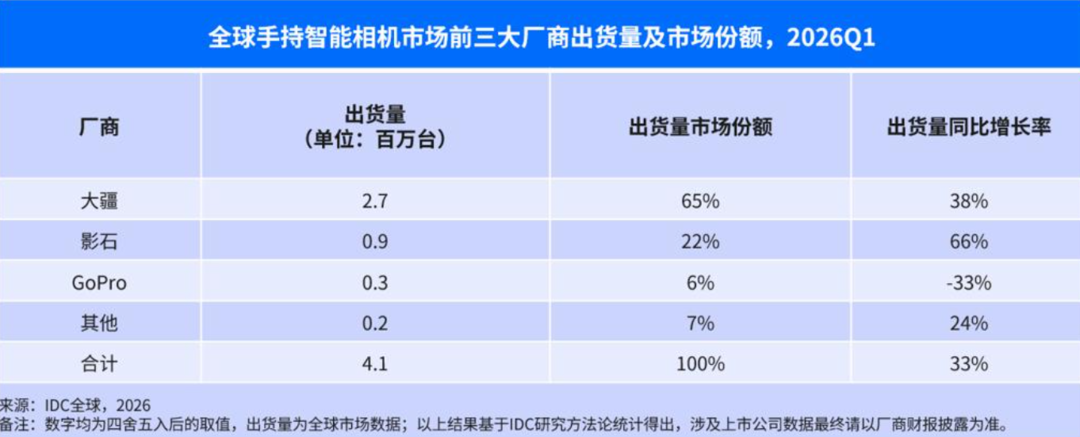
Among these, DJI ranked first globally with 2.7 million units shipped, while Insta360 ranked second with 900,000 units. Insta360's 66% year-over-year growth was the fastest among leading brands, though its absolute volume remained just one-third of DJI's.
A breakdown of the data by product category reveals a clearer industry landscape:
• Action Cameras: 2.01 million units shipped in Q1, up 39% year-over-year, with an average price of 2,149 yuan, down 11% year-over-year.
• Gimbal Cameras: Shipments increased by over 18% year-over-year, with an average price of 2,840 yuan, down 12.5% year-over-year.
• Panoramic Cameras: Over 500,000 units shipped, up 55% year-over-year, but accounting for only about 12% of the total market.
Detachable action cameras (thumb cameras) represented the fastest-growing segment, with year-over-year growth exceeding 350%. Reports indicate that DJI's Osmo Nano captured over half of the market share within four months of its launch. In the non-detachable action camera segment, DJI held a 54% share and continued to gain ground, while Insta360's Ace Pro 2 achieved a record-high 17% share for the brand in this category.
The IDC report also noted that over the next three to five years, the distinctions between panoramic cameras, action cameras, and gimbal cameras are diminishing, with functional overlap increasing. The space for differentiation through a single product category is narrowing.
The same IDC report revealed that GoPro shipped only 300,000 units in Q1, down 33% year-over-year, with its market share dropping to 6%.
The Cost of Expansion
Relying on a single product category is no longer sufficient to sustain high growth, and Insta360 is well aware of this. In recent years, the company has sought to transform from a "panoramic camera company" into an "imaging product company."
Gimbal cameras represent Insta360's newest and most critical step. On June 9, the Luna Ultra, the first horizontal dual-lens gimbal camera, was launched, marking Insta360's entry into a category long dominated by DJI's Pocket series.
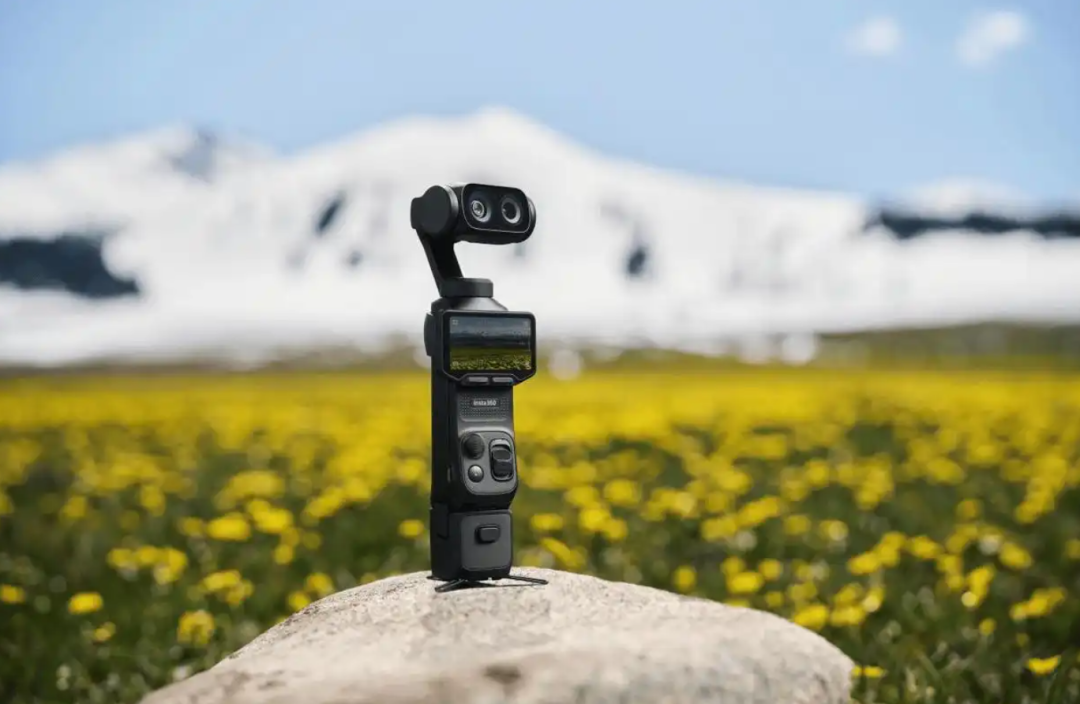
The day after Luna's launch, DJI filed a lawsuit in the U.S. District Court for the Eastern District of Texas, alleging infringement of four utility patents and two design patents, seeking triple damages and a permanent injunction. This court is known for its rapid handling of patent cases, and if an injunction is granted, Luna's access to the U.S. market could be entirely cut off.
The gap in patent portfolios is a factual reality. According to Insta360's 2025 annual report, the company currently holds 1,120 patents, including 261 invention patents and 859 utility and design patents, accounting for 76.7%. DJI has not publicly disclosed its total number of patents, but according to data from the National Intellectual Property Administration and patent database searches, DJI's global patent applications number in the tens of thousands, several times that of Insta360.
Insta360 has filed a countersuit and submitted a petition to the National Intellectual Property Administration to declare the patents invalid. However, patent litigation typically spans years, and for Insta360, which is eager to establish itself in the new market segment, the consumption of time and resources itself constitutes strategic pressure.
Luna's pricing has also sparked controversy. As mentioned earlier, the Straits Metropolis Daily reported that after the incident came to light, Insta360 removed the national subsidy portal nationwide and replaced it with brand coupons. Insta360 responded by stating that it "did not engage in subsidy fraud or illegal use of subsidies" but did not directly address why it had marketed the subsidized price as the retail price.
Insta360 is also making efforts to expand its product lineup. In the thumb camera segment, shipments of the Go 3S and Go Ultra doubled, showing strong growth. In the non-detachable action camera segment, the Ace Pro 2 saw improved product competitiveness, capturing a 17% global market share in 2025—a record high for Insta360 in this category. Additionally, the company launched new products such as the panoramic drone Yingling A1 and the AI-powered omnidirectional microphone Wave.
The simultaneous advancement of multiple product lines has driven up R&D and marketing costs, while market competition has forced Insta360 to lower prices across several categories. This dual pressure is directly reflected in its profit statements. In 2025, revenue reached 9.741 billion yuan, up 74.76% year-over-year, but net profit attributable to shareholders fell 6.62% to 929 million yuan. In Q1 2026, revenue was 2.481 billion yuan, up 83.11% year-over-year, but net profit attributable to shareholders was just 84.62 million yuan, down 52.02% year-over-year, with non-recurring profit after tax at 62.25 million yuan, down 61.27% year-over-year. Revenue growth and profit trends continued to diverge. During the same period, net cash from operating activities was -1.471 billion yuan, indicating a net outflow of cash beyond profits.
The average price of action cameras fell 11% year-over-year to 2,149 yuan, while gimbal cameras fell 12.5% to 2,840 yuan. On the other end of the price declines, gross margins continued to erode: from 52.2% in 2024 to 45.74% in 2025, with Q4 2025 seeing a mere 37.53%. Rising costs of core components, coupled with falling selling prices, squeezed profits from both directions. DJI, with 2.7 million units shipped in a single quarter, has far greater supply chain bargaining power than Insta360's 900,000 units, putting Insta360 at a disadvantage in procurement costs.
Industry competition is also intensifying. According to IDC, citing analyst views, some smartphone manufacturers are evaluating the gimbal camera market, with related projects originally planned for launch around Q3 2026 or the 618 shopping festival now potentially delayed to Q4 or later.
Additionally, according to Jiemian News, citing an internal letter from Insta360 founder Liu Jingkang in December 2025, over 30 core suppliers of the Yingling A1 panoramic drone faced exclusive pressure from DJI in the six months leading up to its launch. Beyond patent and price wars, competition at the supply chain level is also escalating.
Hardware Weaknesses, High Marketing Costs, and Secondary Market Pressures

From a revenue perspective, Insta360 generated 6.676 billion yuan in overseas revenue in 2025, accounting for about 69% of total revenue, making it a company highly dependent on foreign markets. Its core competitiveness lies in panoramic shooting algorithms and AI-powered smart editing, with fast software iteration and a low barrier to entry, which helped it establish a user base early on. However, at the hardware level, it still needs to address shortcomings in areas such as image sensors, gimbal mechanical structures, stabilization hardware, and self-developed main control chips.
In the past two years, the company has significantly increased its hardware R&D investment, spending 1.53 billion yuan in 2025 and doubling that in Q1 2026, with a focus on self-developed chips, gimbal hardware, and drone projects. Hardware R&D is characterized by long cycles, high investment, and high failure risk, making it difficult to translate into mature competitive advantages in the short term. After DJI rapidly caught up with several software algorithm features, Insta360's room for differentiation has narrowed.
According to Insta360's annual report and public information cited by the 21st Century Business Herald, of the 1.53 billion yuan in R&D expenses, 762 million yuan was strategically invested in new categories such as drones, gimbal cameras, microphones, and self-developed chips, accounting for about 80% of the net profit attributable to shareholders for the same period. In Q1 2026, strategic investment reached 262 million yuan, about 300% of the net profit for the same period. Liu Jingkang stated in a shareholder letter that revenue from Insta360's original niche categories now accounts for over 60% of total revenue, adding, "Today's core business comes from brave attempts we made seven or eight years ago."
Meanwhile, Insta360 acknowledged in its semi-annual report that its chips are currently primarily sourced from international suppliers such as Sony and Ambarella, posing a risk of supply disruption. Self-developed chips aim to reduce this dependency.
In terms of business model, Insta360 derives the vast majority of its revenue from hardware sales. In contrast, GoPro offers a membership subscription service (cloud storage, trade-in programs), and DJI has DJI Care replacement plans and other extended warranty revenues, providing both companies with a portion of recurring income beyond hardware. While Insta360 offers the Insta360 Care service, its scale and revenue contribution are not yet significant enough to serve as an independent revenue pillar. The hardware business has an inherent weakness: after selling one generation, the company must start from scratch to sell the next, with no continuous cash flow in between.
At the same time, Insta360 is expanding across multiple fronts, including thumb gimbal cameras, action cameras, panoramic drones, and microphone accessories, while rapidly increasing its offline retail stores from 36 in 2024 to about 300 in 2025. The cost of this expansion is directly reflected in selling expenses. In 2025, selling expenses reached 1.679 billion yuan, up 103.31% year-over-year, with a selling expense ratio of 17.23%. According to Wind data, this ratio ranked first among 87 companies on the STAR Market's electronics sector with revenue exceeding 1 billion yuan, about 5.3 times the industry median. In Q1 2026, the selling expense ratio further rose to 18.10%, still topping the list of comparable companies. For comparison, the R&D expense ratio during the same period was 15.70%, meaning selling expenses exceeded R&D expenses.
In the two weeks following the share unlock, the CICC seat on Beijing Jianguomenwai Avenue sold a cumulative 2.8984 million shares over three days, matching the total allocation of two employee asset management plans during the IPO. Employee stock holdings were fully liquidated, and early funds exited at a discount. Meanwhile, IDG holds 47.976 million shares (with an average cost of about 1.35 yuan, yielding a paper profit exceeding 125 times), and Qiming holds about 33.84 million shares (with a paper profit of about 5.8 billion yuan). These top institutions, with hundredfold profits, have yet to issue pre-disclosure notices for share reductions. The real unlocking pressure may still lie ahead.
Among securities firms, Caitong Securities issued a "Buy" rating, Guohai Securities issued a "Buy" rating, Huatai Securities issued an "Overweight" rating, and Goldman Sachs issued an "Overweight" rating. J.P. Morgan initiated coverage with a "Neutral" rating, stating that a "perfect story" had encountered "poor timing."
As the market re-examines the valuation logic behind the "world's No. 1 in panoramic cameras," more questions arise: How much is a company with a selling expense ratio higher than its R&D expense ratio, declining net profits, and limited growth potential in its core segments truly worth? Beneath the STAR Market veneer, is it more of a tech company or a marketing company? The answer may only emerge with time.
(Note: The data on institutional shareholding costs and paper profits in this article are static estimates based on the historical financing costs and current stock prices disclosed in Insta360 Innovation's prospectus.)
Consumer Notice: The product pricing and public sentiment information in this article are objective restatements of publicly available data and do not constitute product purchase recommendations.
-
![]()
Registered Capital Slashed to 372 Million Yuan! Yutong Optical Finalizes Industrial and Commercial Change Registration
-
![]()
Zhuque-3 Successfully Lands, and 'Time Traveler' Secures Another ¥100 Million in Funding: China's Commercial Space Industry Experiences a 'Dynamic August'
-
![]()
Autohome Faces a Shrinking Window of Opportunity
-
![]()
Even a Titan Like Musk Has Faced Setbacks in Fulfilling Promises
-
![]()
AI Office: The End of the Racing Era, Context Becomes the Key to Success
-
![]()
Domestic Vehicle Chassis Revolution ②: The Steering Wheel Remains, But Mechanical Connections in the Steering System Are Decreasing
-
![]()
Exploring MiniMax Design: Can Video Editing Be as Simple as Speaking?
-
![]()
Why Can SenseTime Achieve Profitability While CloudWalk Still Faces Challenges, Despite Both Adopting Large Models?