Unmanned Delivery Vehicles 'Break the Ice' in Xiamen: A Burst of 'JD Red' Sparks Road Testing—Will the 'Last Mile' Be Transformed?
 01/09 2026
 754
754
Introduction
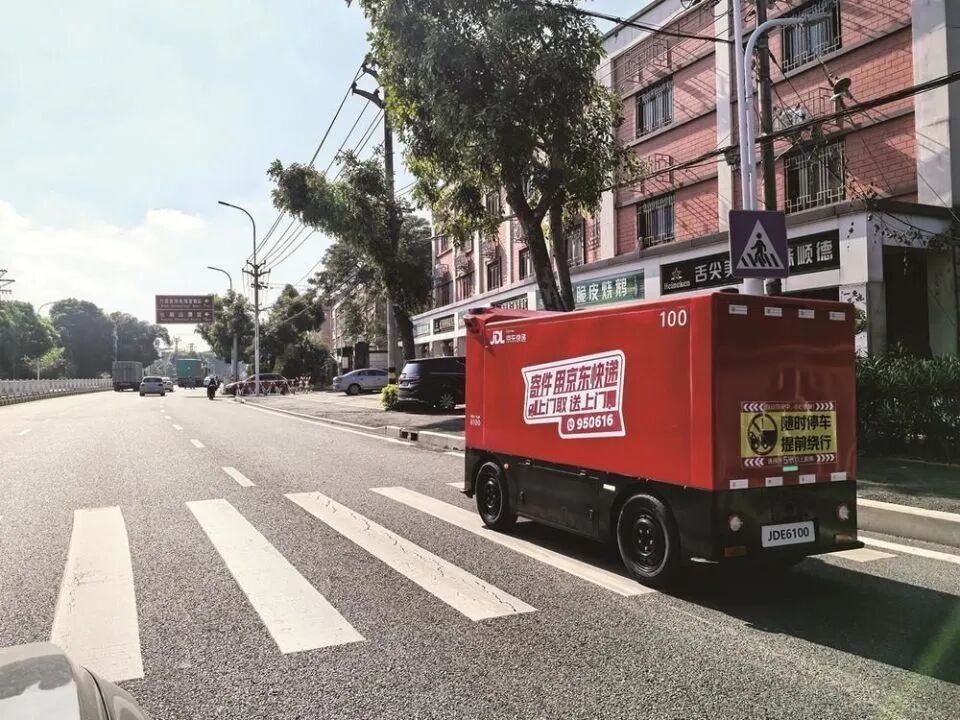
Recently, a vibrant red unmanned delivery vehicle from JD Asia No. 1 Logistics Park in Tong'an District, Xiamen, made its debut on a public road, successfully completing a point-to-point autonomous transportation test from the warehouse to a transfer point.
This milestone not only marks Xiamen's first-ever autonomous driving delivery test on open roads but also signifies a comprehensive exploration into urban intelligent transportation management systems, future logistics paradigms, and industrial innovation ecosystems.
Though seemingly a brief journey for a single vehicle, this test embodies profound implications for technological breakthroughs, policy innovations, and urban development, indicating that Xiamen has taken a decisive and pivotal step towards embracing smart cities and green logistics.
(For further information, please refer to: 'Xiamen: The First Batch of 7 Functional Unmanned Vehicles Hits the Road, from King Long Motor Group, Xiagong Chonggang, KUSA Technology, Fulongma, Jiushi Intelligent, etc., Covering Autonomous Driving Delivery, Sanitation, Security, etc.')
I. Technological Implementation: From Laboratory to Open Roads—A 'Capability Verification' Journey
The centerpiece of this test is an unmanned delivery vehicle boasting L4-level autonomous driving capabilities.
L4, or 'highly autonomous driving,' implies that under predefined operating conditions, the vehicle can execute all driving tasks without human intervention. The test route, stretching directly from the warehouse to the Tingxi transfer point, demanded the vehicle to autonomously navigate real-world traffic lights, pedestrians, non-motorized vehicles, and other cars—a significant 'exam' for its perception, decision-making, and execution systems.
The vehicle's disclosed technical specifications—200 kilometers of range, 1,000 kilograms of payload capacity, 45 kilometers per hour speed, and over a hundred patents—paint a picture of an industrial-grade product that is not merely a 'conceptual showpiece' but a practical and efficient solution.
With a payload capacity of up to one ton, it can efficiently handle bulk transportation tasks from regional warehouses to community stations, forming a differentiated complement to the currently prevalent small passenger autonomous vehicles or low-payload unmanned vehicles.
A reduction in operating costs by over 10% directly addresses the core challenge of commercial operations: cost reduction and efficiency enhancement.
In essence, this test represents a full-process closed-loop capability verification in a complex urban environment, proving that existing technologies have initially acquired the ability to manage specific logistics scenarios and laying a solid foundation of valuable raw data and confidence for subsequent large-scale and regular operations.
II. Scenario Breakthrough: Mode Innovation and Value Reshaping of 'Last Mile' Logistics
The introduction of unmanned delivery vehicles onto roads directly impacts and reshapes the 'last mile' and even the 'last few miles' of urban logistics.
Traditional delivery methods heavily rely on manpower and face challenges such as escalating costs, efficiency bottlenecks, traffic safety issues, and difficulties in ensuring service during extreme weather conditions. The involvement of unmanned delivery vehicles offers new solutions to these pain points.
The 'warehouse-to-transfer point' model chosen for this test is highly representative.
It targets the branch transfer links in the logistics chain, efficiently and stably transporting goods from large storage centers to transfer stations or front-end warehouses around communities, with final home delivery completed by manpower or other means.
This hybrid model of 'unmanned main lines + manned ends' or 'unmanned transfers' leverages the efficiency and cost advantages of autonomous driving in regular and repetitive short-to-medium distance transportation while avoiding potential risks in extremely crowded and complex home delivery scenarios that current technologies may face, representing a pragmatic and intelligent incremental development path.

From a broader perspective, the large-scale application of unmanned delivery will optimize urban freight transportation structures.
Through algorithm-based unified scheduling, vehicles can effectively avoid empty trips and detours, enhancing road resource utilization efficiency;
The combination of electrification and autonomous driving also contributes to reducing carbon emissions and traffic accidents, supporting green and safe urban development.
This represents not only an enhancement of corporate logistics efficiency but also a wise upgrade of urban public services and governance capabilities.
III. Policy Support: Striking the 'Xiamen Balance' Between Innovation and Safety
The core challenge of autonomous vehicles on public roads lies not only in technology but also in policies and regulations.
The smooth conduct of this test in Xiamen is attributable to forward-looking policy design and prudent management measures. Relevant departments in Tong'an District have explicitly stated their commitment to formulating special management measures in accordance with national regulations to ensure 'rules to follow,' setting clear tracks and bottom lines for innovative activities.
Several details of this test reflect this 'art of balance':
First, 'selected routes' avoid the most complex and congested core areas, opting for relatively controllable testing environments;
Second, 'restricted time slots' only permit testing during daily traffic off-peak periods, minimizing potential impacts on public road traffic efficiency;
Third, 'public participation' is encouraged through QR codes on the vehicle body, incorporating public supervision and feedback into the testing closed loop, reflecting an open and inclusive governance mindset.
This tripartite collaborative model of 'government regulation, corporate testing, and public participation' provides a replicable template for other cities.
It demonstrates that promoting cutting-edge technology applications requires neither excessive conservatism that stifles innovation nor blind recklessness that ignores risks but rather finding a dynamic and refined balance between encouraging innovation and safeguarding public safety and social order.
Xiamen is exploring and constructing 'soft' infrastructure—namely, policy and regulatory systems—adapted to the development of intelligent connected vehicles through this test.
IV. Future Outlook: Opportunities and Challenges from 'Testing' to 'Ecosystem'
As an important industrial hub, Tong'an District, Xiamen, integrates intelligent connected vehicle application pilots with its industrial planning, with clear intentions:
This is not an isolated technological display but the prologue to cultivating new quality productive forces and building a new industrial ecosystem.
The conduct of autonomous driving tests can attract related technology companies, component suppliers, and algorithm talents, driving the development of local artificial intelligence, high-precision mapping, vehicle-road coordination, big data, and other associated industries.
However, the journey from a single test to a mature ecosystem is long and arduous.
At the technological level, the stability and reliability of L4-level autonomous driving in extreme weather conditions such as rain and fog and sudden complex road situations still require continuous verification.
At the cost level, vehicle manufacturing costs, later maintenance costs, and high-precision mapping update costs remain barriers to large-scale popularization.
At the regulatory and standard level, laws and regulations regarding accident liability determination, insurance claims, network security, and data privacy still need further refinement.
At the social acceptance level, public trust in the safety of unmanned vehicles takes time to establish, and deeper exploration is needed for harmonious coexistence with human traffic participants.
In summary, Unmanned Vehicles Are Coming (WeChat Official Account: Unmanned Vehicles Are Coming) believes:
The splash of 'JD Red' on Xiamen's open roads is a clear signal: the era of unmanned delivery is transitioning from blueprints to reality, from enclosed parks to open cities.
It is a successful technological roadshow, a cautious policy practice, and an industrial invitation letter to the future.
Converting this 'ice-breaking' move into sustained leading 'endurance' capabilities requires continuous collaboration from governments, enterprises, research institutions, and civil society.
Only by advancing simultaneously in technological innovation, regulatory refinement, infrastructure support, and public awareness can we truly unlock the enormous potential of intelligent logistics and inject powerful and lasting technological momentum into the high-quality development of Xiamen and even the entire country.
Hey! What do you think?
#UnmannedVehiclesAreComing #AutonomousDriving #SelfDriving #UnmannedVehicles
-
![]()
Net Profit Surges 13.65% Year-on-Year! Yutong Optics Reports RMB 1.782 Billion in H1 Revenue
-
![]()
Q2 Net Profit Slashes Losses by 80%! Has Costar Emerged from Its Darkest Hour?
-
AI Agents: The Paradigm Shift from 'Conversation' to 'Execution'
-
NVIDIA Takes Bold Strides to Lead in Both Hardware and Software Realms
-
![]()
It's Hard to Build Cars, Even Harder to Build Humans, and XPENG is Doing Both
-
![]()
Valuation Soars by $57 Billion: Three Entrepreneurs Born in the 1980s Forge an AI Unicorn Now Suddenly on the Market
-
![]()
How Can We Achieve the Goal of 100,000 Hydrogen Vehicles by 2030?
-
![]()
July Online Market for Consumer-Grade Sports Cameras: Robust Double-Digit Growth in Sales Volume and Value, Mid-Range Products Fuel Market Expansion