Overnight Paper Gain of 1 Trillion Yuan: Hefei's 18-Year Gambit——【The Hefei Model: Uncopyable】Series
 07/29 2026
 498
498
【The Hefei Model: Uncopyable】Series · Issue 1
On July 27, 2026, an unprecedented scene unfolded on the A-share market.
A company named Changxin Technology listed on the STAR Market. With an issue price of 8.66 yuan, it soared to 49.5 yuan at the opening, peaked at 55 yuan during the session, and finally closed at 49 yuan—a single-day gain of 465.82%.
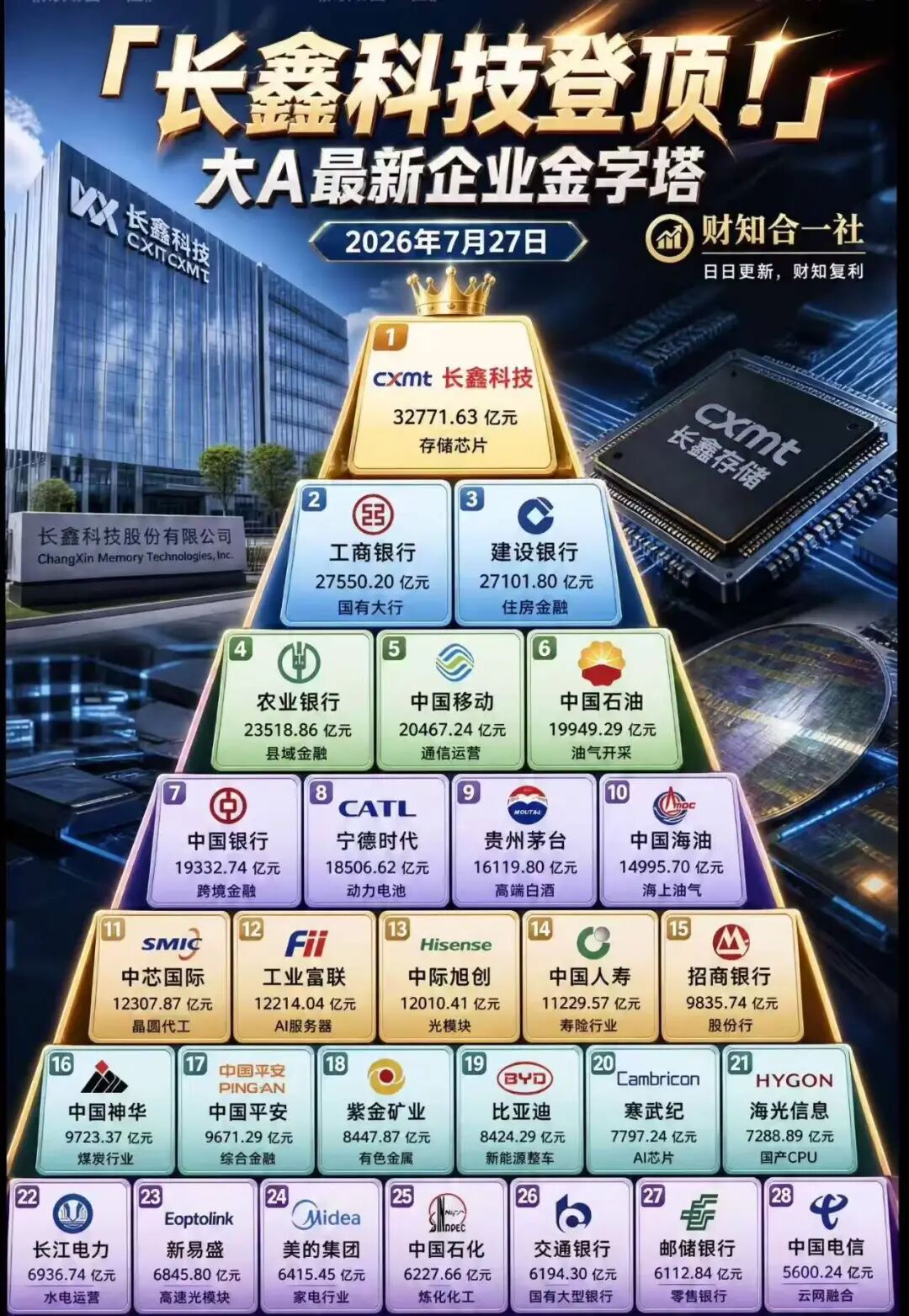
At the closing bell, its total market cap stood at 3.28 trillion yuan.
What does that mean? It dethroned Industrial and Commercial Bank of China (ICBC) as the A-share market cap leader, surpassed Intel, and was equivalent to two Kweichow Moutais in size. With a full-day trading volume of 141.1 billion yuan, it set a historical record for the highest single-day turnover of an individual A-share stock.
Rewind the clock: This was a company that had once posted losses for 10 consecutive years.
And the biggest winner behind it? A local government—Hefei.
Based on the closing price on July 27, 2026, the shares held by Hefei's state-owned asset system corresponded to a market value exceeding 1.1 trillion yuan, with paper gains of approximately 1.2 trillion yuan—nearly 46 times the cumulative investment of about 30 billion yuan.
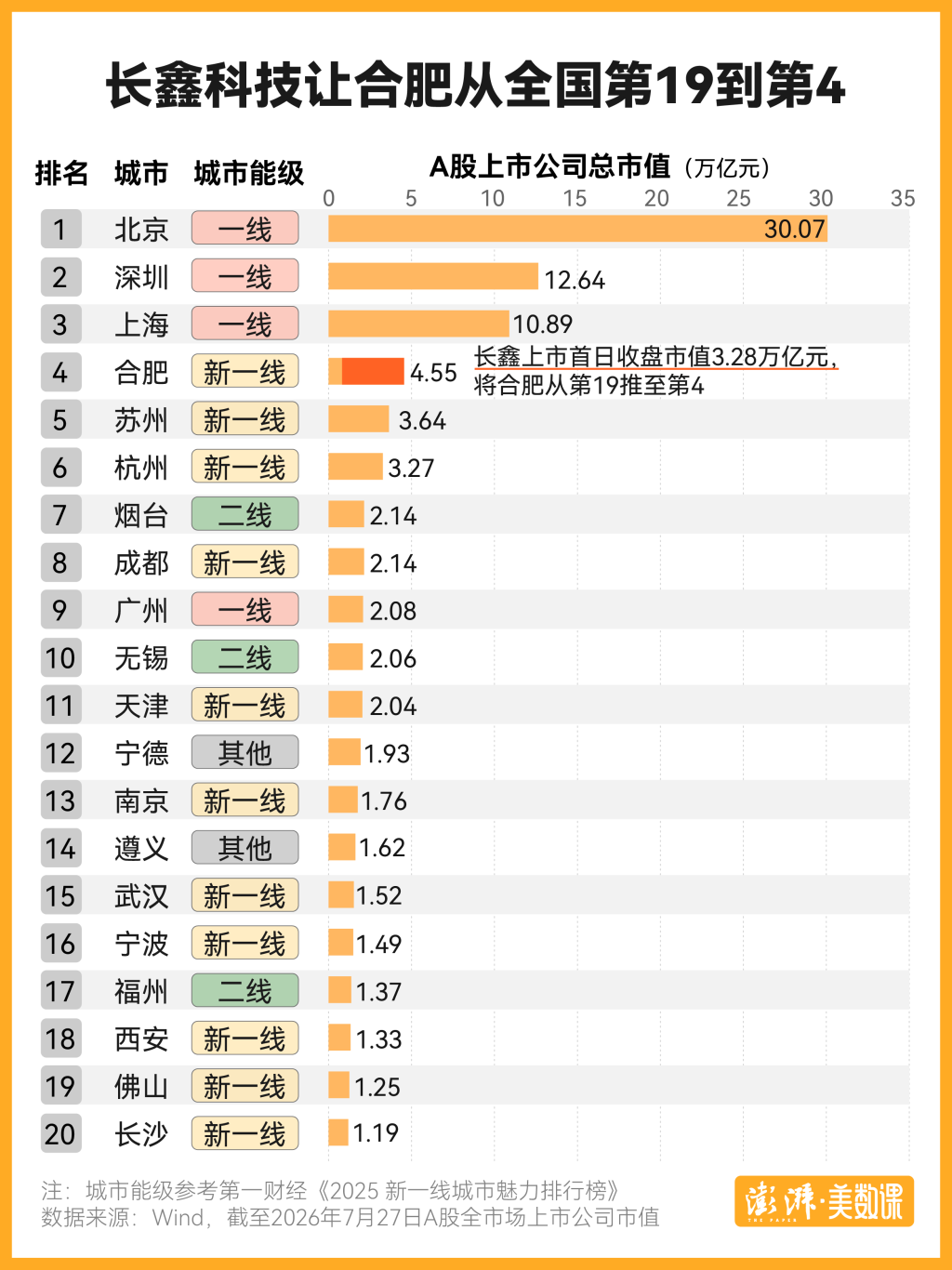
Excluding Changxin Technology, the total market cap of Hefei's other A-share listed companies was about 1.27 trillion yuan, ranking 19th nationally. Including Changxin, this figure surpassed 4.55 trillion yuan. Hefei leapfrogged 15 cities, including Suzhou, Hangzhou, Wuxi, Chengdu, Guangzhou, and Tianjin, leaving only Beijing, Shenzhen, and Shanghai ahead.
Overnight, the internet buzzed with a single phrase: "Hefei: The Ultimate Venture Capital City."
But "overnight success" is an illusion.
Hefei's gambit took 18 years.
01 We Take What Others Reject
To grasp the weight of Hefei's bet on Changxin, one must first understand: What kind of race is DRAM?
It's one of the toughest nuts to crack in semiconductors. Samsung, SK Hynix, and Micron dominate 97% of the global market. Yet China, the world's largest electronics manufacturing base, spends over $50 billion annually importing DRAM chips, with domestic self-sufficiency below 5% for years. Every smartphone, computer, and server we build relies on foreign-controlled "memory" chips—prone to price hikes at any moment.
Is this a "difficult" track ( track translated as "race" or "field")? No, it's a field where every Chinese player has previously stumbled.
From the "908 Project" and "909 Project" in the 1990s to Fujian Jinhua's shutdown after U.S. sanctions—China's repeated charges into DRAM ended in defeat. In other words, when Changxin sought a location, it faced not a "dare to bet" question but collective doubt: "Can anyone in this country pull it off?"
That's the first layer of "what others reject."
Changxin's initial top choice was Nanjing. With strong sci-tech and educational resources, Nanjing seemed the logical pick. But faced with high investment, long cycles, intense R&D, and a decade of guaranteed losses—Nanjing ultimately declined.
But you might not know: "Taking what others reject" is no isolated incident for Hefei—it's muscle memory.
Rewind to 2008. BOE wanted to build China's first 6th-generation LCD panel line, needing 17.5 billion yuan. It first approached Shenzhen (the "Julong Plan" derailed by Japan's Sharp), then Shanghai (Sharp struck again), and finally turned to Hefei as a last resort. At the time, Hefei's annual fiscal revenue was just over 30 billion yuan—yet it "scrounged" 17.5 billion yuan, even delaying metro construction to do so.
That year's BOE was identical to later Changxin: both were "heavy-asset, long-cycle, lose-first-then-profit" hard nuts others dared not crack. Hefei took the bet and stuck it out for a full decade before the panel industry exploded.
So in 2016, when Changxin—an even tougher version—emerged, Hefei was unfazed. It had already run through the "losses-to-inflection" playbook once.
But between "can take" and "can succeed" lies a chasm called "zero technical foundation."
Changxin faced an iron wall: Beyond the three giants' 97% market share lay suffocating patent blockades. Nearly all core DRAM patents were held by others. Changxin started by scavenging—acquiring tens of millions of technical documents and over 7,000 patents from bankrupt German DRAM giant Qimonda, then stacking massive self-developed R&D to barely erect its tech system. Launched in 2016, it took three years to mass-produce its first DDR4 chip in September 2019—followed by years of losses before hitting an inflection point, ranking as the world's fourth-largest DRAM foundry (China's only one).
Along the way, not everyone stayed the course. Country Garden is the most painful example: In September 2021, its venture arm invested ~900 million yuan in Changxin's Series C round as a strategic B-round investor, acquiring ~1.56% equity. To repay public debt and deliver housing projects, Country Garden transferred all 1.56% of Changxin's shares to Hefei's state-owned background entity for 2 billion yuan in December 2024. Had Country Garden held, what would that stake be worth today? At 54.65 yuan/share midday price, 1.56% equity corresponds to ~49 billion yuan in market value (3.66 trillion × 1.56%). To put it in perspective: Country Garden's current market cap is ~12 billion HKD (~10.4 billion RMB). In other words, Country Garden "lost" returns nearly 4.5 times its own market cap on this single deal.
While others retreated to cut losses, Hefei doubled down.
This is the core of the "Hefei Model": patient capital. It's never a gambler's frenzy but the confidence to "walk through the loss phase with you" after calculating industrial cycles.
02 Not Gambling, But "Seeing Through": An 18-Year Trilogy
Many attribute Hefei's success to one word: boldness.
Bold enough to halt metro construction for BOE, to bet 7 billion yuan on NIO at its lowest point, to keep funding Changxin through a decade of losses.
"Boldness" matters. But if you only see "bold," you'll never replicate Hefei.
The real keyword is "seeing through."
When BOE landed in Hefei in 2008, the city was China's "home appliance capital," with millions of fridges and washing machines guzzling panels annually. Hefei wasn't betting on a concept—it was betting on an inevitable industrial chain demand.
When Changxin landed, Hefei didn't want a "chip concept stock"—it wanted China to have its own DRAM foundry. This judgment stemmed from a decade of industrial understanding, not stock-picking intuition.
This reveals the most overlooked thread in the Hefei Model—
Why does this city "see through" hard tech?
The answer lies in a university.
In 1970, the University of Science and Technology of China (USTC) relocated to Hefei as a last resort. Then-poor Hefei did something "crazy": It built a dedicated heating line for USTC before the entire province had central heating, prioritized USTC's power supply over the provincial government, and later assigned Anhui's top tertiary hospital to serve it.
Half a century later, USTC repaid in kind: Three "Quantum Pioneers" emerged from here, 34 alumni-founded companies went IPO, and the institute incubated nearly 300 tech firms. More crucially, USTC gave Hefei the "seeing through" edge: talent + cognition.
Conclusion: Hefei's bets on BOE, Changxin, and NIO stem from the "cognitive water level" sustained by a top-tier university. Other cities can mimic "bold investments" but struggle to replicate this "seeing through" capability short-term.
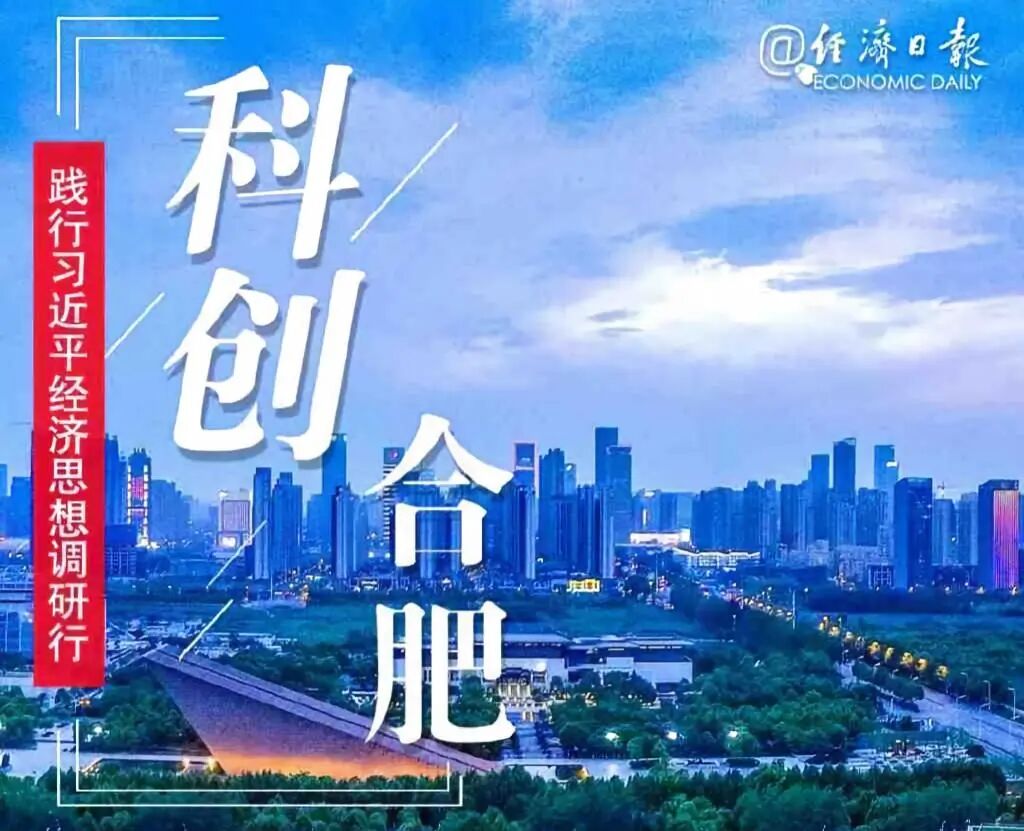
Placing Changxin's IPO on a longer timeline reveals Hefei's full strategy.
2008: BOE. Hefei invested ~1/3 of its annual fiscal revenue, delaying metro projects to introduce China's first 6th-gen LCD line. BOE, then loss-making, faced public backlash. Later, it grew into a 100-billion-revenue giant, yielding Hefei over 10 billion yuan in paper gains and, more critically, entry into the "display industry."
2016: Changxin. State-led capital, Joint ( Joint translated as "united") with industrial forces, nurtured China's sole global top-four DRAM foundry from scratch. A decade of patience yielded 3.28 trillion yuan in market cap and 1.2 trillion yuan in paper gains.
2020: NIO. At NIO's darkest hour, Hefei Construction Investment teamed with three-tier state platforms to inject 7 billion yuan. This didn't just save a automaker—it propelled Hefei to the "New Energy Vehicle Capital" spotlight, later attracting BYD's 50+ billion yuan investments and Volkswagen's localizations.
You'll notice Hefei uses the same "operating system":
Team recruitment → State-led capital → Project landing → Equity exit → Recycle capital.
Three campaigns over 18 years. That's why I call July 27's "overnight" success an 18-year masterstroke.
03 The Hefei Model: Uncopyable
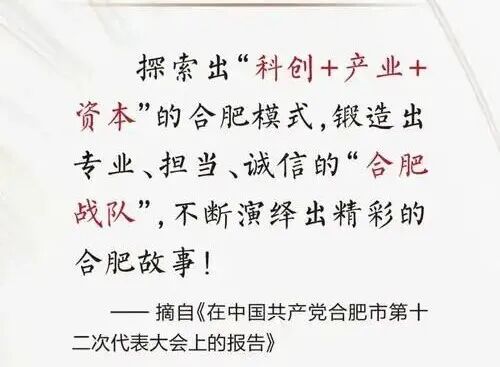
Dissecting the Hefei Model reveals three pillars:
Bold Investments: State capital acts as "long-term, patient, strategic capital." Not chasing quick profits but enduring a sector's loss phase. Changxin lost for a decade—Hefei stayed. NIO nearly died—Hefei caught it.
Smart Investments: Not impulsive but investment-bank-grade decision-making. Take NIO: Hefei advanced on four fronts simultaneously—expert teams + policy analysis + legal/financial due diligence + commercial negotiations. This resembled a top-tier PE firm more than a government.
Strategic Exits: Closed-loop capital recycling. As projects mature, state equity exits orderly, funds return to the pool for the next bet. After BOE came Changxin, then NIO, followed by fusion energy funds and AI Fund of Funds ( Fund of Funds translated as "fund of funds").
Individually, none of these are mystical. But having all three pillars fire consistently for 18 years—each hit aligning with industrial upgrades—is rare.
"The Hefei Model: Uncopyable."
Not because Hefei hoards technical secrets. But because—
Other cities copying "Hefei's homework" grasp "bold investments" but miss "smart investments" and "strategic exits," let alone the university-fueled talent pool and decision-making mechanisms that underpin them. These soft powers are the uncopyable essence.
As someone who studied and lived in Hefei for 20 years, watching its transformation fills me with regional pride. With Changxin's IPO, I write this series to let more understand this city once dubbed a "small transparent."


-
![]()
Sales Soar: Has Ora Staged a Remarkable Comeback?
-
![]()
What Kind of AI Phones Do We Actually Need?
-
![]()
DingTalk, Feishu, and WeCom's Silent 'March Eastward'
-
![]()
Is 'Data Scarcity' More Fatal Than 'Computing Power Shortage'? Is It Bringing Disaster?
-
![]()
Yutong Bus Steps Up the Rollout of an External Circulation Marketing Model Among Listed Companies
-
![]()
The US Wants to Strangle Chinese Automakers, but Mercedes-Benz Becomes the First 'Sitting Duck'
-
![]()
Earning Foreigners' Money Is a Breeze: China's Car Exports Rock Europe and America!
-
![]()
"Meituan Retreats into the Background of AI", "Meituan, AI, API, local services, business strategy", "Meituan has announced a partnership with Tencent Yuanbao, enabling users to place takeout orders t